
BRC Full Form: Bank Realisation Certificate Meaning, Format & Download (2026)

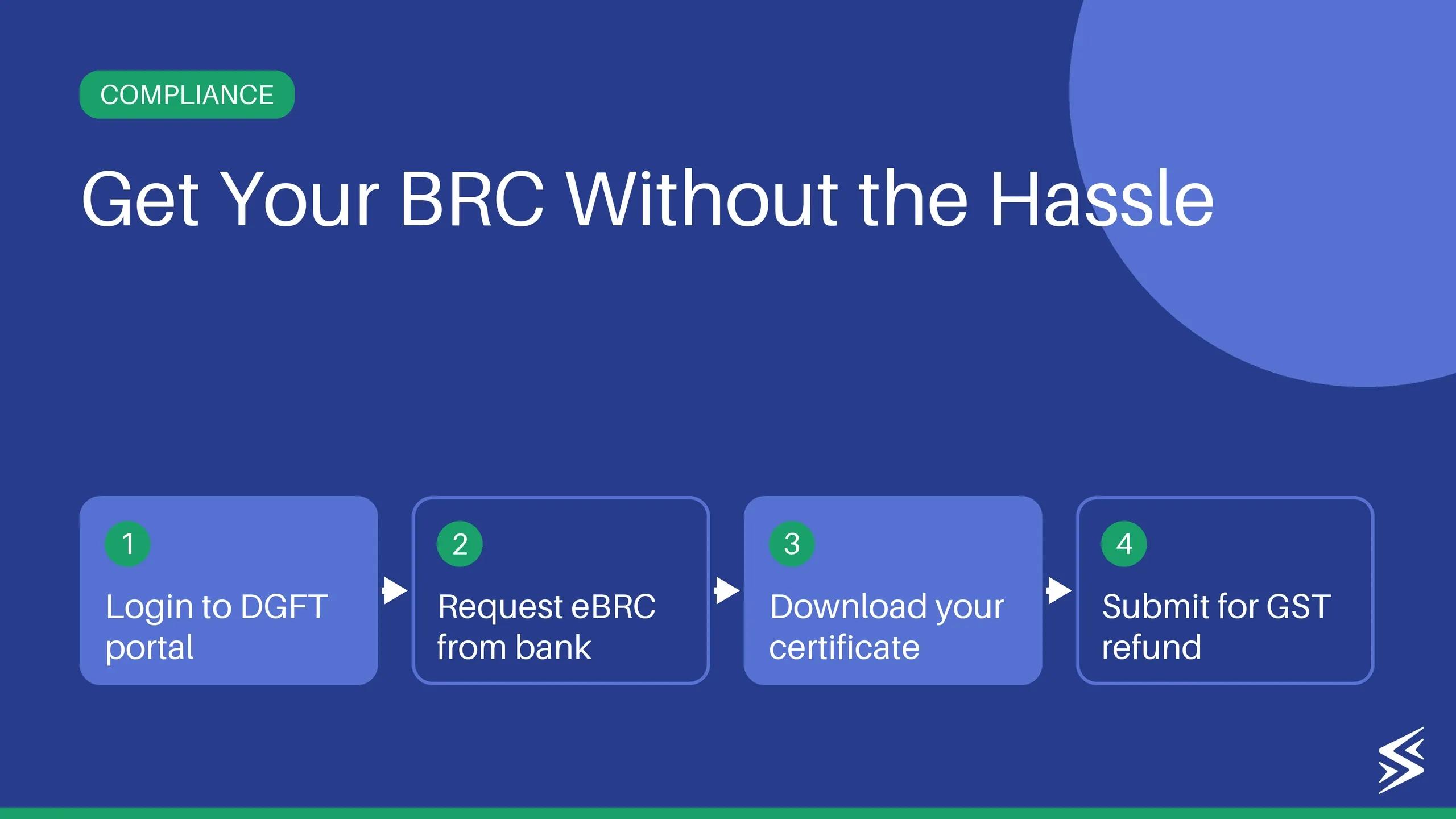
Skydo auto-maps IRMs to shipping bills so you can approve & generate eBRCs in a single click
TL;DR
- What is a Bank Realisation Certificate? A certificate that proves you have received payment from an international buyer for exported goods or services. It is now issued digitally as eBRC through the DGFT portal.
- Why was BRC replaced by eBRC? The original BRC process was manual and required physical collection from the bank. eBRC digitised the process, making it faster, more accurate, and accessible directly through the DGFT portal.
- Why is BRC important? It is required to claim export incentives like Duty Drawback, EPCG, Advance Authorization, and GST refunds. It also serves as proof of payment realization for DGFT and foreign exchange compliance.
- How do you download your BRC? Log in to the DGFT portal, go to My Dashboard, navigate to Repositories, select Bank Realisations under Bills Repositories, search for your entry, and click Print eBRC to download.
- What documents does your bank need to generate BRC? IEC, shipping bill or bill of export, commercial invoice, bank realization details, and any additional documents requested by the bank for verification.
What is a Bank Realisation Certificate (BRC)?
A Bank Realisation Certificate (BRC) proves you have received payment from an international buyer for exporting your goods or providing services. BRC in banking was a document that was issued by the bank after a series of steps were completed.
- Reporting the value of goods to be exported to your bank.
- Bank then recorded the transaction in the export data processing and monitoring system (EDPMS).
- After the payment was received and shipping bill details submitted to the bank, they close the transaction on EDPMS and issue BRC.
Bank Realisation Certificates (BRC) were needed to establish the credibility of your export earnings, and to claim incentives and various export benefits. Currently, the eBRC issued by Directorate General of Foreign Trade (DGFT) makes sure these objectives are met.

Revenue Leak Calculator
- ✓ Fees quietly eating margin?
- ✓ Current provider vs Skydo
- ✓ Reclaim what's yours
Why was BRC replaced by eBRC?
Till 2012, the entire process of BRC generation was manual and time-consuming. e-BRC (Electronic Bank Realisation Certificate) is the digitised version of the process which is more efficient and convenient for both the banks and exporters. Before e-BRC, you had to visit the bank to collect the physical form of BRC and then hand it over to the DGFT to claim export benefits.
eBRC was introduced to make the process:
- faster, by allowing banks to upload export realization data electronically,
- more accurate, by reducing manual paperwork and reconciliation errors,
- and easier for exporters, who can now access and track eBRC records digitally through the Directorate General of Foreign Trade portal instead of handling physical certificates.
Why is BRC important for exports?
Why BRC Matters for Exporters
Confirms that export proceeds have been realised and repatriated through authorised banking channels. Key proof of payment for shipping bills, SOFTEX filings, and DGFT processes.
Required to claim benefits under Duty Drawback, EPCG, Advance Authorization, GST refunds, and other DGFT-linked export schemes.
Under older schemes like MEIS (goods) and SEIS (services), BRC was required to claim duty credit scrips against eligible exports.
Creates an official record of foreign exchange inflows into India, helping regulators monitor export realisation through authorised banking channels.
The BRC (Bank Realisation Certificate) acts as proof that an exporter has received payment from an overseas buyer. It plays an important role in export compliance, incentive claims, and foreign exchange reporting.
Helps maintain export compliance
BRC is an important document under India’s export compliance framework. It confirms that export proceeds have been realized and repatriated through authorised banking channels. Banks and government authorities use it to verify that export transactions have been completed properly.
For many export transactions involving shipping bills, SOFTEX filings, or DGFT-related processes, BRC/eBRC serves as a key proof of payment realization.
Required for claiming export incentives
Exporters often need BRC/eBRC to claim benefits under various export promotion and refund schemes, including:
- Duty Drawback,
- EPCG (Export Promotion Capital Goods),
- Advance Authorization,
- GST-related export refunds,
- and other DGFT-linked export benefits.
Used for MEIS and SEIS claims
Under older export incentive schemes like:
- MEIS (Merchandise Exports from India Scheme), and
- SEIS (Service Exports from India Scheme),
BRC was required to claim duty credit scrips issued against eligible exports. These scrips could then be used to offset customs duties and certain other government levies.
Supports foreign exchange tracking
BRC also helps regulators monitor foreign exchange inflows into India. Since export payments are routed through authorised banking channels, the certificate creates an official record of export realization for compliance and reporting purposes.
How to download Bank Realisation Certificate (BRC)?
Note: BRC has been replaced by eBRC. The below steps describe how to download eBRC.
- Visit the DGFT Website
- Log in using your user ID and password.
- On the home screen, navigate to My Dashboard and select Repositories from the drop-down menu.
- Under the Bills Repositories section, click on Explore to proceed to the Bills Repositories page.
- From the Select Bill drop-down, choose Bank Realisations (eBRC). Enter the required details to search for your e-BRC and click Search.
- Scroll down to find the eBRC you need and click on the Bank Realisation hyperlink.
- Click the Print eBRC button to generate and download your certificate.
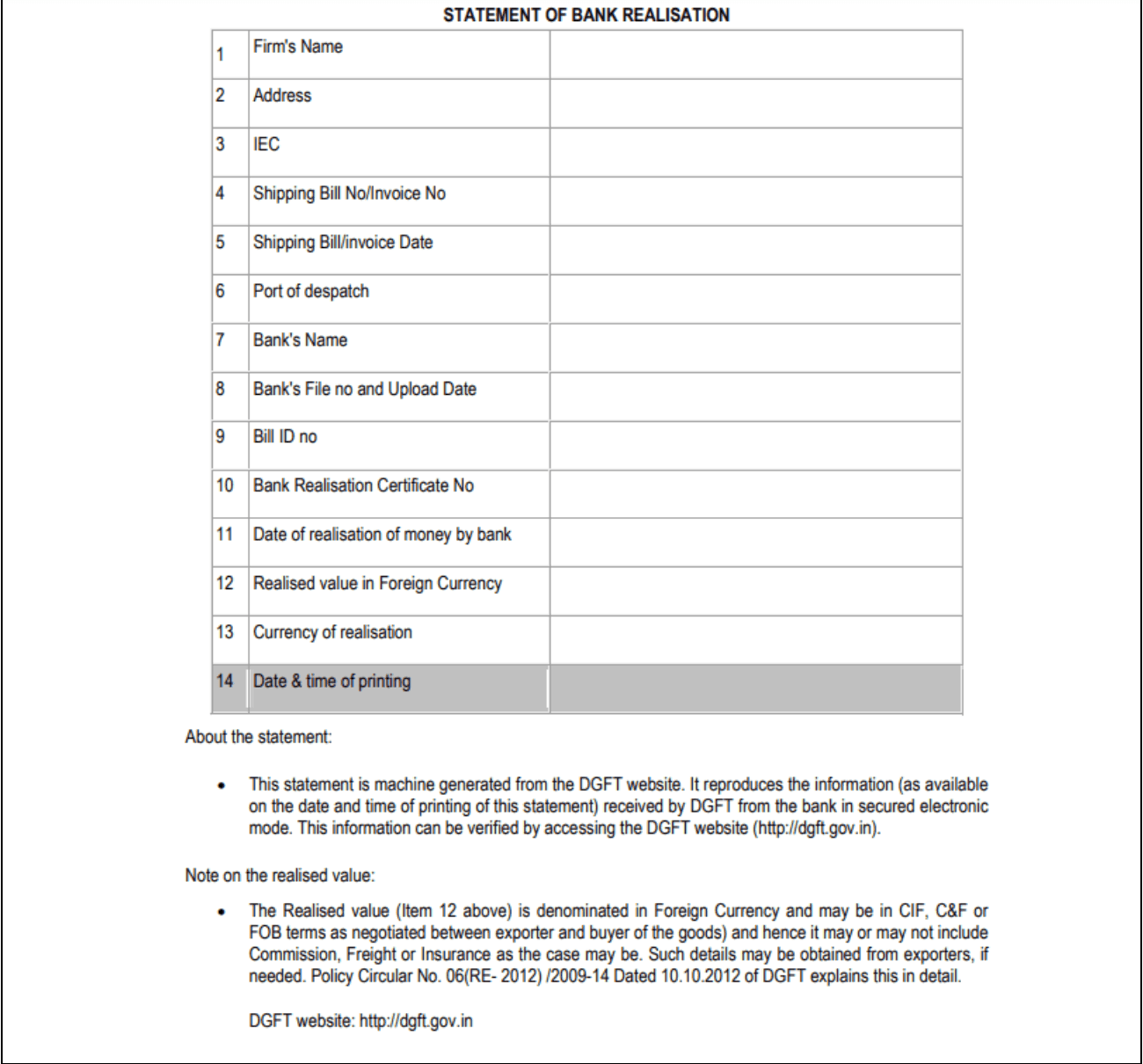
Bank Realisation Certificate Format
Here is a sample of the e-BRC downloaded from the DGFT website. All the information is electronically filled out by the bank and sent to DGFT.
Documents required to download BRC
Previously the BRC was available as a physical copy from the banks. Now it has been replaced by an eBRC available for download from DGFT. You need to make sure that the following documents have been shared with your bank so that IRMs are generated:
- IEC (Import Export Code): Your business’s registration number for carrying out import-export transactions.
- Business identity details: Business name, address, and other registration details linked to the export transaction.
- Shipping bill or bill of export: Customs document containing shipment and export details.
- Commercial invoice: Invoice issued to the overseas buyer for the exported goods or services.
- Bank realization details: Information related to the inward remittance received against the export.
- Bank account details: The account through which the export payment was received.
- Supporting export documents: Any additional documents requested by the bank or DGFT for verification and reconciliation.
How Skydo helps with BRC generation
BRC/eBRC is essential for export compliance, DGFT processes, and claiming export incentives. But manually matching remittances with shipping bills and generating eBRCs can be time-consuming.
Skydo simplifies this process.
With Skydo:
- IRMs are automatically matched with shipping bills,
- you can link your Directorate General of Foreign Trade account once,
- bulk upload shipping bills,
- and approve eBRC generation directly through the workflow.
Skydo also gives you:
- instant FIRA for every payment,
- structured payment and compliance records,
- flat transaction fees,
- zero forex markup,
- and transparent exchange rates for international payments.

Get international bank accounts in 5 mins

Save as much as ₹10 lakh annually with Zero FX Margin

Real time payment tracking and instant FIRA
Get international bank accounts in 5 mins
Save as much as ₹10 lakh annually with Zero FX Margin
Real time payment tracking and instant FIRA
Frequently asked questions
BRC stands for Bank Realisation Certificate. It is a document issued based on export payment realization data to confirm that an exporter has received payment from an overseas buyer through authorised banking channels.
About the author

Solution & banking
With a decade of experience at Citi Bank, Prashanth leads payments partnerships and solutions at Skydo.

Verified by
CA Akshay KumarLatest blog posts
View all posts
ICEGATE Shipping Bill Status: How to Check & Track? (2026)
HSN Code: Full Form, Meaning & How to Find It?

How to Get US Clients from India: A Practical Guide
Related blog posts
View all postsICEGATE Shipping Bill Status: How to Check & Track? (2026)

RCMC Renewal: Process, Documents, Fees & Validity (2026)