B2B Payments in India: From Checks to Digital

In 2025, enterprise finance teams are waking up to a simple fact: the old ways won’t suffice anymore. Checks are fading fast, but digital rails haven’t fully taken over. The latest AFP Digital Payments Survey shows that only 26% of B2B disbursements are still made by check – a sharp drop from 33% just three years ago. In other words, checks now make up roughly one-quarter of B2B spend, down 7 points since 2022. Meanwhile, a full 76% of organisations report they will “update their payments strategy” within the next three years. Finance leaders increasingly recognise that a modern enterprise payment strategy must evolve beyond legacy systems and manual processes.
However, a deeper look at the data reveals a disconnect. Only about 22% of companies say “most of their eligible B2B payments are digital” – roughly the same share as in 2019. In short, even as check usage retreats, the pace of overall digital adoption has flat-lined. This gap suggests that many firms still rely on checks or paper-based methods for a large slice of transactions, even as they plan to overhaul their payments programs. Finance teams need to ask: What’s holding us back, and how can we reset our core payments approach?
The End of the Check Era (Almost)
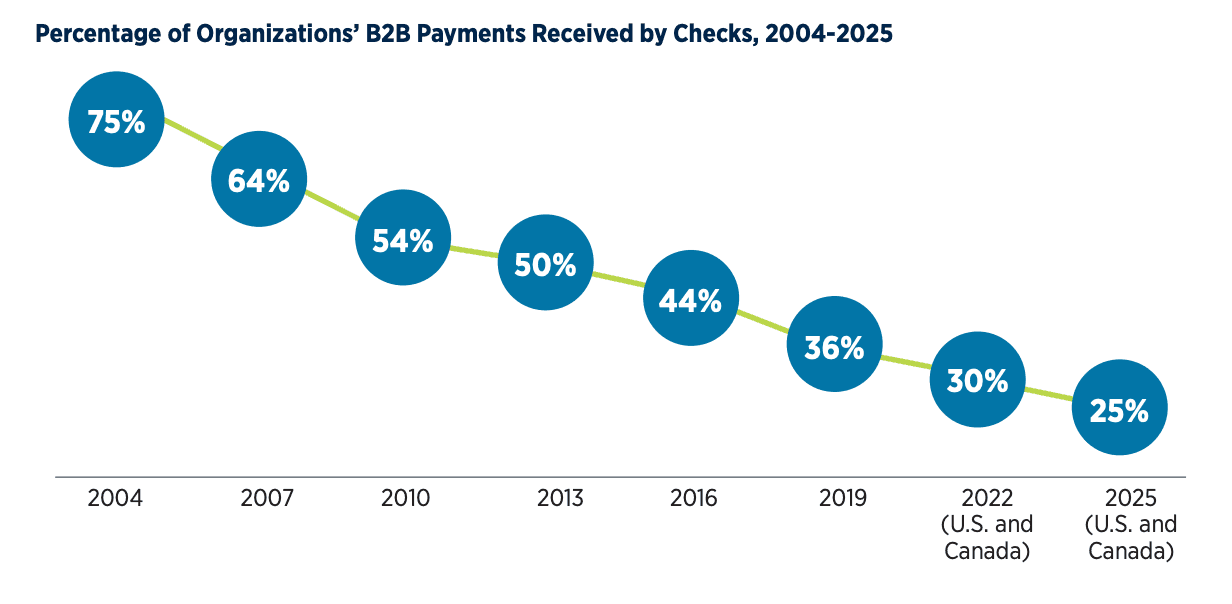
Over the last two decades, checks have gone from dominant to minority status. The AFP survey charts show that in 2004, over 80% of B2B payments were by check – today it’s only 26%. For corporate collections (incoming payments), the trend is similar: just 25% of customers now pay by check, down from 30% in 2022.
 <br>
<br>Source: 2025 AFP Digital Payments Survey Report, Underwritten by JP Morgan
This shift reflects growing trust in digital payments – faster networks, ERP systems, and bank integrations – but also the aftermath of external pressure. For example, a 2025 U.S. Executive Order mandates that federal disbursements go fully electronic by Sept. 2025, sending a strong signal.
Despite the clear downward trend, the real surprise is how slow the flip has been. The survey notes that “the trend toward moving all eligible payments to digital methods has shown only modest growth”. In 2022, 24% of U.S. firms said most of their supplier payments were already digital; by 2025, that number fell to 22%. In other words, the share of companies fully embracing digital B2B payments hasn’t budged. That plateau suggests many organizations have digitized the easy part of their payments, but the last miles (smaller payees, legacy flows, edge cases) still run on paper.
Why B2B Payments Lag Behind
The stubborn reliance on checks (and similar manual methods) isn’t due to ignorance – it’s a mix of practical barriers. Survey respondents highlight that vendors and customers often resist change. Many small suppliers “do not have the overhead to process several forms of electronic payment,” and may lack the necessary infrastructure or simply prefer the familiarity of checks. In fact, industry analysts note that common hurdles include the high cost of replacing old technology, the difficulty of onboarding small trading partners, and the straightforward comfort of familiar check workflows.
Other roadblocks stem from corporate IT. Legacy accounting and ERP systems can be expensive to retool, making even migrating payment file formats (e.g. updating batch files to ISO-standard XML) a major project. Many firms still lack real-time payment confirmation tools, so they stick with what they know. A finance director quoted in the AFP survey put it bluntly: “We recognise the long-term benefits of digital payments – cost savings, speed and transparency – but the short-term disruption and upfront cost create a barrier to rapid adoption.”
In short, the barriers to going digital are often cultural and technical: smaller suppliers reluctant to change, entrenched legacy systems, and established check-based approval workflows. These factors keep many organisations from fully committing to accounts payable automation and straight-through processing. Until these obstacles are addressed, the bulk of B2B payments will not move online.
Rethinking Your Enterprise Payment Strategy
The good news is that nearly three-quarters of companies realize they need a new playbook. According to the AFP, 76% of enterprises plan to refresh their payments strategy within three years. That’s a mandate to action. Finance and treasury leaders are now defining a baseline: what mix of payment rails do we use today, and what do we need tomorrow? They’re also exploring new payment rails and channels – everything from real-time payments and RTP® networks to blockchain pilots and expanded global wires – to find faster, more secure alternatives.
Key strategic steps emerge from the survey insights. Companies are focusing on:
- Exploring new payment formats and channels (72%). This includes testing faster payments (FedNow, SWIFT gpi), virtual card programs, or payment APIs. By diversifying rails, organisations reduce single-point failure risk (e.g. over-reliance on checks) and can match the right rail to each payment type.
- Updating/migrating payment file formats (40%). Many firms still use outdated file layouts (ACH NACHA or check EDI formats). Moving to ISO 20022 and XML formats can enable richer remittance data and easier integration with modern ERPs – a crucial step for full automation.
- Developing a baseline payment-rail strategy (38%). Finance teams are mapping their current state: what percentage of disbursements are on checks, ACH, cards, etc., and where they want to be. Having a clear baseline helps prioritize which payment corridors to digitize first.
These priorities are not pie-in-the-sky – they reflect practical projects Treasury and AP teams can do. For example, defining baseline rail usage might start as a simple internal audit of AP/AR flows. Expanding file formats could mean working with your bank or TMS to accept ISO files. Each step lays the groundwork for broader change.
Check to ACH and AP Automation
One concrete tactic many organisations are pursuing is check-to-ACH conversion. Replacing outgoing checks with ACH transfers is low-hanging fruit: it cuts fraud risk, automates reconciliation, and is supported by virtually all suppliers. Some companies even set policies like “max 10% of AP volume by check” to force migration. Accounts payable teams can accelerate this by offering incentives (like earlier payment terms) for ACH invoices, or by implementing vendor portals that make ACH enrollment easy.
At the same time, accounts payable automation is becoming central to the strategy reset. AP automation tools (often cloud-based) let firms route invoices, approvals and payments electronically, without rekeying. In practice, this means invoices hit an AP portal or workflow instead of an inbox. Once digital, payments can be routed via the best rail automatically (for example, client bills go via ACH, vendor refunds via RTP®). This reduces human touch points and makes it easier to enforce payment policy changes.
Naturally, any major AP overhaul requires change management, but many recent surveys find that the ROI on AP automation is persuasive. Fewer checks means fewer manual sign-offs, less postage, and lower error rates. And with audit trails and reporting built in, controllers get visibility they never had with paper. As one finance executive put it, the real gain isn’t just cost savings – it’s freeing up team bandwidth for strategic tasks.
The Digital Plateau: Addressing the Flatline
Despite these efforts, the AFP data remind us that digital adoption has stalled at around 20–25%. Why? Even companies on board with the vision often find only incremental progress. For instance, the survey notes that the proportion of firms expecting to “convert all eligible payments to digital” over the next three years is still only about 72% – hardly higher than 2022. Many organisations have already digitalised their large payments (high-volume, repeat suppliers) but struggle with the tail of low-volume vendors.
To break through the plateau, some treasurers are taking bold steps. They negotiate with their 80/20 of suppliers, or invest in onboarding services for small businesses (outsourced banking portals, OCR for checks, even digital wallets). Others implement flexible rails for small vendors – for example, sending B2B payment links or using virtual cards with dynamic limits. Essentially, the goal is to make it as easy as possible for any payee to accept non-check funds.
Conclusion: Modernizing Without the IT Headache
Reimagining enterprise payments doesn’t always require a ground-up system rewrite. Many firms are proving that incremental, focused changes to the core can pay off immediately. For example, a mid-market company might start by automating vendor enrollment onto ACH, updating its ERP to support ISO files, and retraining AP staff on new policies. Over time, those steps accumulate into a real transformation.
In fact, platform solutions are emerging to help organisations “operationalise” modern B2B payments without a massive IT lift. These cloud-based hubs connect ERPs, banks and suppliers to multiple rails and currencies. For instance, platforms like Skydo now offer virtual global accounts, automated invoicing, and multi-rail payment routing. A finance team in India can use such a platform to receive international payments, international invoices (achieving “check to ACH” or cross-border transfers) while automatically generating compliance docs – without rebuilding their back-end. The key is that these tools plug into existing workflows, gradually phasing out paper checks.
In 2025, the message is clear: finance teams must modernise their core or risk falling behind. The declining check usage proves the demand is there, and three-quarters of firms are already resetting their strategy to meet it. By recognising the human and technical barriers (vendor habits, legacy systems) and taking strategic steps (baseline analytics, file conversion, new rails), companies can unlock digital growth. And with smart platforms (like Skydo) aiding the journey, even large enterprises can migrate tens of millions in B2B flows without a total IT overhaul.
Every CFO and treasurer today should be asking: How many more payments can we digitise? Because the future of finance is digital, and the time to modernise is now.
What are B2B payments?
B2B payments are payments between businesses—like paying suppliers, contractors, logistics partners, or collecting invoices from corporate customers—via checks, ACH, wire, cards, or instant rails.
Why are enterprises moving from checks to digital B2B payments?
What’s the best way to migrate from checks to ACH and other digital rails?
How should an enterprise choose the right payment rail for each use case?
What controls should enterprises add when digitizing B2B payments?