
Bank Routing Number: Meaning, Format, Uses & How to Find It

TL;DR - Summary
- What is a bank routing number? - It is a unique nine-digit code assigned to financial institutions in the United States. Also known as an ABA routing number or Routing Transit Number (RTN), it is a bank's digital address to route domestic electronic transfers, direct deposits, and paper checks.
- Why are bank routing numbers needed? - They ensure domestic funds are routed to the correct bank automatically, securely, and quickly. Clearing systems read these numbers to process payroll direct deposits, tax refunds, and recurring bill payments on their own.
- How does a bank routing number differ from an account number? - A routing number identifies the financial institution and is shared by many customers. An account number is unique to a specific account.
- Routing number vs. SWIFT vs. IFSC: What's the difference? - The differences lie in geography and the network used. A routing number is for domestic US transfers; IFSC is an 11-character alphanumeric code for domestic Indian transfers, and SWIFT is an 8–11 character alphanumeric code for cross-border international transfers.
What Is a Bank Routing Number?
A bank routing number is a unique nine-digit code assigned to financial institutions in the United States. It identifies a specific bank so that the funds move accurately between institutions.
A bank routing number is also known as an American Bankers Association (ABA) routing number or a routing transit number (RTN). If your client mentions any of these terms, they’re referencing the same 9-digit code.
Only US-based federal or state-chartered financial institutions that maintain an account at a Federal Reserve Bank are eligible to receive these numbers. LexisNexis Risk Solutions acts as the official registrar of routing numbers. New financial institutions and banks must apply directly to them for routing numbers.
The structure of the nine digits is fixed and serves a specific purpose:
Anatomy of a nine-digit routing number
1–2
3
4
5–8
9
Federal Reserve district
Original Fed check processing centre
State where the bank is located
The specific financial institution
Check digit , validates the first eight and catches typos
The 12 Federal Reserve Districts associated with the first two digits are:
| Federal Reserve District | First two digits |
|---|---|
| Boston | 01 |
| New York | 02 |
| Philadelphia | 03 |
| Cleveland | 04 |
| Richmond | 05 |
| Atlanta | 06 |
| Chicago | 07 |
| St. Louis | 08 |
| Minneapolis | 09 |
| Kansas City | 10 |
| Dallas | 11 |
| San Francisco | 12 |
A bank routing number example is Chase Bank’s number: 021000021. Here, "02" refers to the New York Federal Reserve district, "1000" is the unique identifier for Chase Bank, and "1" is the check digit.
Financial systems use routing numbers to process direct deposits, ACH transfers, wire transfers, and bill payments.
Remember that a routing number identifies the bank branch rather than an individual account. Every customer at the same branch shares the same routing number. The account number, which contains 8–12 digits, is the specific identifier for the individual's funds within that bank.
Where To Find a Routing Number?
You will find the routing number on paper checks, online banking portal, banking app, even on the bank website. Here’s a quick guide on where you must be looking:
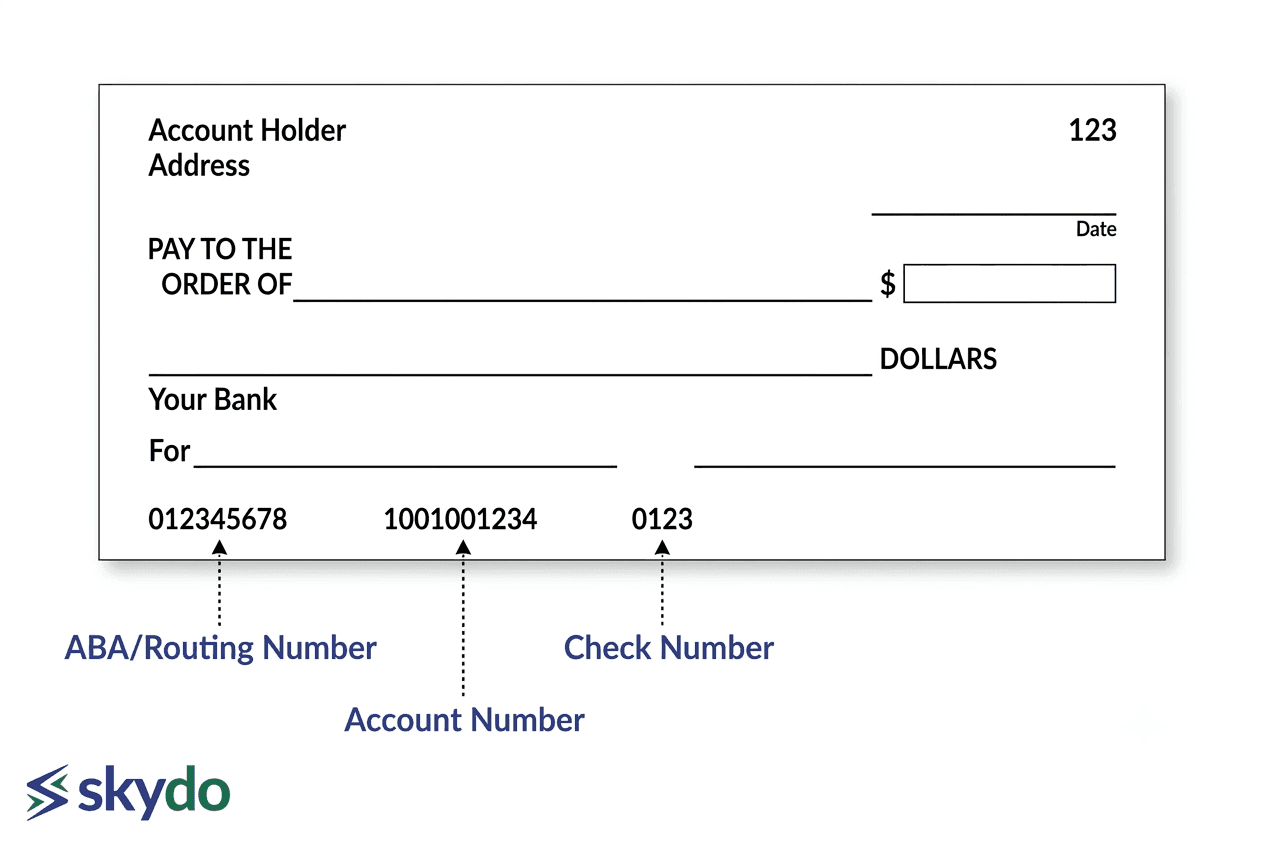
Paper check: The routing number is the first set of nine digits printed in the bottom-left corner. It is printed in magnetic ink (MICR format) for automated processing. The sequence on a check always reads from left to right: routing number, then account number, then check number.
Banking portal or app: The routing number is listed under "Account Details," "Account Summary," or "Direct Deposit Information." You will also find the routing number on a digital or paper monthly statement near the account information.
Bank website: Banks list their routing numbers for different states or transaction types on their website. The American Bankers Association also provides an official routing number lookup tool to verify a routing number.
If these methods are unavailable, you can call the bank’s customer service department to confirm the routing number.
But if you’re using a virtual bank account, the routing number is right in the platform dashboard. You don’t need any of these extra sources.

Why Are Bank Routing Numbers Needed?
Bank routing numbers are needed to ensure that funds from electronic or paper transactions reach the correct bank automatically. They are like a postal address for financial institutions, helping automated clearing systems to pinpoint the exact US bank that should receive a specific payment.
Bank routing numbers are needed for the following specific reasons:
Direct deposits: Employers and government agencies use routing numbers with account numbers to deposit paychecks or tax refunds directly into the right bank.
Bill payments: Utility companies use routing numbers to automatically pull recurring monthly payments from customer’s accounts.
Check processing: The automated systems read the first nine digits on the bottom-left of a US paper check to direct the money during processing
Accuracy: When moving money between different US banks, the routing number tells the automated system which institution to contact. Even a one digit error can cause a transaction to fail or send money to the wrong institution.
Speed: As the system is automated, payments settle much faster than manual sorting methods.
ABA routing numbers vs. ACH routing numbers
ABA routing numbers were created for paper checks, but are now used for electronic transfers. ACH routing numbers are used only for electronic payments like payroll. While many banks use the same nine-digit code for both, some large institutions use different numbers. Always verify with the bank which number applies to your transaction type.
When Does an Indian Freelancer or Exporter Need to Know About Routing Number?
An Indian freelancer or exporter needs a routing number only when using a US-based virtual account to collect payments from US clients via ACH. It is not applicable for standard SWIFT wire transfers into an Indian bank account.
Indian bank accounts do not have ABA or ACH routing numbers. They use the 11-character IFSC for domestic transfers and SWIFT codes for international wire transfers.
When do you need a routing number?
- When you use a cross-border payment platform like Skydo. You get a virtual US bank account with a real US routing number and account number.
- Your American clients pay you via a domestic ACH transfer, which is cheaper and faster for them compared to an international wire.
When do you not need a routing number?
- When your US client wires money directly to your Indian bank account via SWIFT. You only have to provide your bank's SWIFT/BIC code, your account number, and your IFSC.
- For domestic financial transactions.
⚠️ COMMON MISCONCEPTION
Sharing your SWIFT code when a client asks for a routing number will not work for ACH transfers. They are used in completely different payment networks.
Routing Number vs Account Number: Key Differences
The key difference between a routing number and an account number is the level of identification. A routing number identifies the financial institution, while an account number identifies a specific bank account.
Besides, remember these major differences:
- In the US, both numbers are required. The routing number directs the payment to the correct bank, and the account number ensures the bank credits the correct person. Mixing up these numbers causes failed transactions.
- Customers at the same bank or branch share the same routing number. However, account numbers are specific to each individual.
- Routing numbers are 9-digit codes found at the bottom-left of a check, whereas account numbers are made of 8-12 digits found in the middle of the bottom.
- Routing numbers are publicly available as it only identifies the bank. Account numbers are private as they identify individuals. Sharing them openly could cause unauthorized access and fraudulent withdrawals.
| Comparison | Routing number | Account number |
|---|---|---|
| What it identifies | The bank or financial institution | The individual's account |
| Uniqueness | Same for many customers at one bank | Unique to each account holder |
| Length | Always 9 digits | Mostly 8–12 digits |
| Location on a check | Bottom-left | Middle-bottom |
| Sensitivity | Lower | Higher — protect carefully |
Routing Number vs SWIFT Code vs IFSC: What's the Difference?
The core difference between these codes is geography. Routing numbers are for domestic transfers within the US, IFSC handles domestic transfers within India, and SWIFT codes handle international transfers across borders.
Routing number (ABA/ACH): Routing numbers are nine-digit codes regulated by the American Bankers Association (ABA) and the Federal Reserve. It is only used within the US for domestic ACH transfers, wire payments, check clearing, and direct deposits.
IFSC (Indian Financial System Code): IFSC is an 11-character alphanumeric code used only within India and regulated by the Reserve Bank of India (RBI). The first four characters represent the bank name, the fifth is always zero, and the last six digits identify the branch.
SWIFT (Society for Worldwide Interbank Fund Transfer): A SWIFT code, also known as Bank Identification Code (BIC) comprises 8 or 11 alphanumeric characters and is regulated by the ISO/SWIFT network. Think of it as an international mailing address for a bank.
Indian exporters or freelancers use the IFSC for domestic transfers within India. They use a SWIFT code only when receiving an international wire or paying a foreign vendor. A routing number is useful to them when they have a virtual US bank account to receive ACH payments from a US client.
| Feature | Routing Number (ABA) | IFSC | SWIFT Code (BIC) |
|---|---|---|---|
| Geographic Scope | United States only | India only | Global / Worldwide |
| Primary Purpose | Domestic ACH and wire transfers | Domestic NEFT, RTGS and IMPS | Cross-border payments |
| Format | 9 digits (numbers only) | 11 characters (alphanumeric) | 8 or 11 characters (alphanumeric) |
| Regulating Body | American Bankers Association | Reserve Bank of India (RBI) | ISO / SWIFT Network |
How Does Skydo Help Indian Freelancers with a Bank Routing Number?
Skydo helps Indian freelancers and exporters with a US virtual bank account, which includes a dedicated ABA/ACH routing number. Your US client uses the local ACH payment network to settle the payment.
Skydo solves a major problem for Indian business owners. As Indian banks do not use routing numbers and rely on SWIFT codes for international payments, your clients only have the option to send the payment as a SWIFT transfer. SWIFT payments are reliable, but slow and expensive.
With Skydo, you get a US virtual account accessible from India. US clients now have the option to use ACH methods and avoid international wire fees on their end. Plus, you get the payment in less than 48 hours.
It takes 10–15 minutes to set up your Skydo account. The virtual USD account and its associated routing number are available immediately after onboarding. Once you receive an international payment in the virtual account via ACH, Skydo converts the USD and settles the amount into your bank account within one working day.
Skydo uses transparent forex rates and a flat-fee pricing model to remove hidden costs:
- Payments under $2,000: $19 flat fee.
- Payments between $2,000–$10,000: $29 flat fee.
- Payments over $10,000: 0.3% fee.
There are no monthly maintenance fees. Every transaction includes an automatic Foreign Inward Remittance Advice (FIRA) certificate, which is necessary for tax compliance and legal documentation in India.
Skydo has India-based customer support through WhatsApp, call, and text to assist with payment status updates.
Are IFSC code and routing number the same?
IFSC and routing numbers are different codes for different regions. The IFSC is an 11-character alphanumeric code used strictly for domestic transfers within India. A routing number is a 9-digit numeric code used only for transfers within the United States.
Do Indian banks like HDFC or SBI have routing numbers?
What routing number is 021000089?
Whose routing number is 111000025?
What is a 9-digit routing code?
Can I receive an ACH transfer from a US client directly into my Indian bank account?
What is the difference between ABA and ACH routing numbers?
How many digits is a routing number, and can it change?