Direct Debit Payment ACH: Meaning, How It Works & More

TL;DR - Summary
- What is a direct debit payment ACH? - A direct debit payment ACH is an ACH debit transaction, where an authorised business pulls funds directly out of a payer's US bank account through the Automated Clearing House network instead of the payer sending the money over themselves.
- How does a direct debit payment ACH work? - A direct debit ACH runs on authorisation first: the payer shares an account and routing number with the business. The business then submits the transaction through its own bank, which pushes it into the ACH network, where it moves in a batch alongside thousands of others rather than one at a time. The payer's bank debits the account and the funds settle, usually within one business day.
- What is a direct debit payment ACH used for? - Direct debit ACH payments handle recurring, predictable collections: utility bills, subscriptions, loan repayments, insurance premiums, rent, and B2B invoicing. The appeal is cost, since ACH is cheaper than card processing and often cheaper than a wire.
- Can Indian businesses receive ACH payments from US clients? - Indian businesses cannot receive ACH payments into a regular Indian bank account, since there is no US routing number for the network to route towards. With a US receiving account, a US client can pay through ACH exactly as they would any American vendor, and the provider then settles the funds into the Indian account.
What Is a Direct Debit Payment ACH?
A direct debit payment ACH is an arrangement where a customer gives a business standing permission to take money out of their US bank account, and the business then collects each payment itself instead of waiting for the customer to send it. The gym that charges a membership fee on the same date every month, or the utility company that takes a bill without anyone lifting a finger, is running one.
ACH stands for Automated Clearing House, the electronic backbone that most of America's banking runs on. Direct deposits, bill payments, business-to-business transfers, all of it typically rides on this network, and it connects to almost every bank and credit union in the country.
The one thing worth getting straight early is the difference between an ACH credit and an ACH debit, because people mix these up constantly:
- With an ACH credit, the payer pushes the money. A salary landing in an account each month is a classic example.
- With an ACH debit, the recipient pulls the money, but only after getting the green light. A gym membership or an electricity bill quietly leaving an account every month without anyone lifting a finger is a good example.
So when a company mentions "ACH Direct Debit," it usually just means it has been authorised to withdraw funds from a customer's account on a schedule. NACHA, the organisation that sets the rules for this entire network, governs how all of this works, and unlike a wire transfer, which moves one payment at a time, ACH transactions travel in batches.
One thing Indian businesses run into fairly often: ACH is a purely American system. It doesn't reach into a standard Indian bank account. So if a US client insists on paying through ACH, an Indian freelancer or business needs some kind of US-based receiving setup first.
💡 QUICK INSIGHT
- ACH is a US-domestic network. It cannot directly send money to an Indian bank account, which is why a US client saying "I'll pay via ACH" can create confusion about how your funds actually arrive.
How Does a Direct Debit Payment ACH Work?
A direct debit ACH payment works in five stages: authorisation, initiation, batching, routing, and settlement, with the payee pulling funds from the payer's account only after receiving explicit permission.
- It starts with permission - Before any business can touch an account, the payer has to authorise it, usually by handing over an account number and routing number, either through an online form, a signed document, or sometimes a recorded phone call.
- Then the business kicks things off - Once it has that authorisation, the payee submits the transaction through its own bank, specifying how much to pull and from which account.
- The transaction enters the network - From there, the originating bank sends the request into the ACH system, where it gets processed alongside a huge batch of other transactions - The Federal Reserve and The Clearing House act as the two operators handling this traffic.
- The payer's bank processes the debit - The instruction eventually reaches whichever bank holds the payer's account, and assuming everything checks out (enough funds, valid details), that bank pulls the money.
- Funds Credited - The money then moves through the system and shows up in the recipient's account, according to the specific settlement timeline.
If something goes wrong along the way, such as insufficient funds, a closed account, or incorrect details, the transaction gets returned, and Nacha's rules dictate how that plays out.
It's important because the same network handles credits too. So if a US client is paying an Indian freelancer through a US receiving account, that's technically an ACH credit on the client's end: the client is the one pushing the payment, not the freelancer pulling it.
What are the Uses of Direct Debit ACH Payments?
Direct debit ACH payments are used mainly for recurring, predictable collections, such as utility bills, subscriptions, loan repayments, insurance premiums, rent, and B2B invoicing.
A few places this shows up constantly:
- Utility bills: electricity, water, and internet providers all lean on ACH to keep collections automatic.
- Subscriptions: a streaming service or software licence probably pulls its monthly fee this exact way.
- Loans and mortgages: lenders use it to collect scheduled repayments without chasing anyone down.
- Insurance premiums: insurers rely on it for predictable, recurring collection.
- Rent: plenty of landlords and property managers have shifted to this instead of chasing paper cheques.
- B2B payments: vendors and suppliers sometimes get paid this way too, particularly where the relationship supports it.
- Charitable donations: nonprofits often use it for recurring monthly donors.
And on the credit side, payroll is probably the single most common use of ACH overall. NACHA itself calls out payroll, bill payments, account transfers, and B2B payments as the network's biggest use cases.
The appeal really comes down to cost. ACH is generally cheaper than card processing and often cheaper than a wire, which makes it the obvious choice whenever instant settlement isn't the priority.
For Indian exporters and freelancers specifically, though, the relevant scenario is rarely the "debit" side. What's usually happening is an ACH credit: a US client pushes the invoice amount to a receiving account rather than the freelancer pulling it from the client's account.
💡 QUICK INSIGHT
- ACH handles both recurring and one-time payments, but it is not suited for transactions where the recipient needs money immediately, for those, wire transfers or real-time payment rails are the better option.
How Long Do Direct Debit ACH Payments Take to Process?
Most direct debit ACH payments settle within one business day, though the exact timing depends on when the payment was submitted, which processing window it falls into, and how the receiving bank handles posting.
Here's a myth worth killing early: not every ACH payment takes three to five business days. That reputation is outdated. NACHA's own numbers show that roughly 80% of ACH payments settle within a single banking day or faster.
Same Day ACH exists specifically for time-sensitive transfers and can clear in a matter of hours, as long as it's submitted within the right processing window. It works for both credits and debits.
That said, settlement and availability aren't always the same thing: a bank might still apply its own posting delays even after the transaction technically clears.
For an Indian business receiving money this way, there are really two legs to account for:
- The US client sends the ACH payment into a US receiving account.
- The receiving provider then moves that money into the Indian bank account.
So the total time before rupees actually show up in the account will usually be longer than the ACH settlement window alone. It depends on how quickly the provider handles that second leg.
⚠️ COMMON MISCONCEPTION
- ACH and Zelle are not the same. Zelle is a separate real-time payment service and is not processed through the standard ACH batch network.
Can Indian Businesses Use Direct Debit ACH Payment to Receive Funds from the US?
Not directly, no. A regular Indian savings or current account was never built to plug into the US ACH system: there's no US routing number attached, so there's nothing for the network to route a payment towards.
This confuses people more than you'd expect. A US client says "we only pay by ACH," and the instinct is just to send over Indian bank details, but that won't work. Indian account numbers simply aren't compatible with how ACH routes payments.
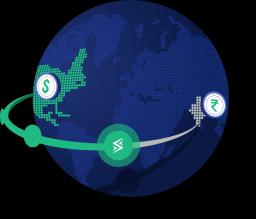
The workaround is a US receiving account. An Indian business gets issued US account details, including a routing and account number, and hands those over to the client instead of the Indian ones. From the client's end, it looks and feels exactly like paying any other American vendor. The client initiates the ACH payment, it lands in the receiving account, and from there it gets moved into the Indian bank account.
It's also worth flagging: this is almost always a credit, not a debit. The client is pushing the payment. They're not authorising the Indian business to pull funds from their account.
One more thing that matters here, especially for exporters: the cross-border leg still has to comply with RBI, FEMA, and GST requirements. Keeping invoices and remittance records organised matters, and if there's uncertainty about how a particular payment should be treated, it's worth a quick word with a tax professional rather than guessing.
If a US client says they can only pay by ACH, do not send them your Indian bank details. ACH is a US domestic network, so you need US receiving details, a US routing number and account number. And for a normal invoice, the client is making an ACH credit, not a debit: they push the money to you, you are not authorising them to pull it from your account.

How Does Skydo Help Indian Businesses Receive ACH Payments?
Skydo helps Indian businesses receive ACH payments by issuing them a US receiving account, complete with a real US routing and account number, that a client can pay into exactly the way they'd pay any domestic American vendor.
Here's roughly how it plays out:
- Set up a Skydo account - It's fully digital, and once it's active, Skydo issues a set of global receiving account details.
- Share the US details with the client - No SWIFT codes, no explaining international banking, just a normal US account number and routing number.
- The client pays like they would any US vendor - They send the ACH payment the same way they'd pay a domestic supplier.
- Skydo settles it into the Indian account - Funds convert at the live mid-market rate with zero markup, and Skydo settles them into the linked Indian bank account, typically within 24 hours of receiving the payment.
- Skydo generates the FIRA automatically - No chasing a bank branch, no waiting on a relationship manager; Skydo issues it the moment the transaction settles.
On pricing, Skydo keeps things flat rather than tying fees to a percentage for smaller transfers: $19 for anything up to $2,000, $29 for payments between $2,001 and $10,000, and 0.3% once a payment goes above that.
For freelancers and exporters whose US clients would rather stick to domestic payment rails, this setup tends to make the whole relationship a lot smoother for both sides. The client pays the way they normally would, and Skydo handles everything on the Indian end.
Are direct debit and ACH the same thing?
Not exactly, though they overlap. "Direct debit" is the broader idea: a payer permitting someone to collect money from their account. ACH is the specific US network that a lot of these transactions run through. In the US, "ACH debit" and "direct debit" are often used interchangeably, but ACH also handles credits like payroll, so the two terms aren't perfectly identical.
Why did I receive an unexpected ACH payment in my account?
What does ACH debit payment mean when my US client mentions it?
What is the difference between ACH and a wire transfer?
Is Zelle an ACH or a wire transfer?
Is an ACH routing number the same as a regular routing number?
Can ACH payments be reversed?