Top International Ecommerce Payment Gateways: Fees, FX & FIRC

TL;DR - Summary
- What is an international ecommerce payment gateway? - An international ecommerce payment gateway is a digital service that captures an online checkout transaction and sends it to the relevant card network, bank, or wallet for authorisation.
- Which international payment gateways are the best fit for Indian businesses in 2026? - The best international payment gateways for Indian businesses in 2026 include Razorpay, Cashfree, Stripe, PayPal, Adyen, and Payoneer. They serve different needs, from card-based checkout to B2B payment collection and marketplace payouts.
- Does an international payment gateway automatically comply with RBI rules for Indian exporters? - No. An international payment gateway does not automatically comply with RBI rules for Indian exporters. RBI authorisation, including PA-CB authorisation where applicable, is a separate India-specific regulatory requirement.
- What is the real cost of using an international payment gateway beyond the listed fee? - The real cost of an international payment gateway includes its listed transaction fee, FX markup, and other applicable charges. An FX markup of 1.5% to 3% would add $75 to $150 to a $5,000 payment.
What Is an International Ecommerce Payment Gateway?
An international ecommerce payment gateway is a digital service that securely captures a customer's payment details at checkout and routes the transaction to the relevant financial network for authorisation when the customer and merchant are in different countries. It connects the merchant's website or app with the buyer's bank, card provider, digital wallet, and other payment infrastructure involved in completing the transaction.
An international ecommerce payment gateway can support multiple currencies and local payment methods, facilitate authentication and fraud checks, and integrate with ecommerce platforms such as Shopify and WooCommerce. The exact payment methods and currencies available depend on the provider and the merchant's setup.
Additionally, note that a payment gateway is different from a payment processor. A payment gateway captures and securely transmits payment information for authorisation, while a payment processor handles the transaction communication between the merchant, issuing bank, acquiring bank, and relevant payment networks. However, many modern cross-border payment providers combine gateway and processing functions in a single service.
What are the Top Features of an International Ecommerce Payment Gateway?
The top features of an international ecommerce payment gateway include multi-currency checkout, local payment methods, transparent FX rates and fees, predictable settlement, fraud and chargeback controls, ecommerce integrations, API access, recurring payments, and support for expansion across countries.
- Multi-Currency Checkout: Displaying prices in customers' local currencies can make international purchases easier and more familiar. Businesses should also check whether the gateway can actually settle those currencies into their preferred payout currency.
- Local Payment Methods: Payment preferences vary by market. Cards are widely used in some countries, while bank transfers, digital wallets, and other local payment methods are more important in others. Supporting the methods customers already use can reduce checkout friction.
- Transparent FX Rates: The actual cost of a cross-border payment can include an FX markup in addition to the stated transaction fee. Businesses should compare the provider's exchange rate with the applicable market rate rather than evaluating the transaction fee alone, while choosing a payment gateway for international payments in India.
- Fast and Predictable Settlement: Settlement can range from same-day to T+2 or longer depending on the provider, payment method, and merchant setup. A clearly defined settlement timeline helps businesses plan cash flow.
- Fraud Prevention and Chargeback Tools: International card payments can expose merchants to fraud and disputes. Features such as 3D Secure authentication, transaction monitoring, fraud screening, and chargeback management can help reduce these risks.
- Native eCommerce Platform Integrations: Official integrations for platforms such as Shopify, WooCommerce, and Magento can simplify setup and reduce the maintenance involved in building and maintaining a custom payment integration.
- API Access: APIs allow businesses to customise payment flows and connect transaction data with systems such as CRMs, accounting software, and ERPs. They can also support automated reporting and reconciliation.
- Recurring Payments Support: Subscription businesses need features such as stored payment credentials, automated recurring charges, plan changes, and failed-payment retries to manage recurring revenue effectively.
- Reliable Settlement and Reporting: Payment and settlement data should be available in a format that supports reconciliation and business analysis. The settlement currency and payout timeline also determine when the business can access its funds.
- RBI-Authorised PA-CB Status for Indian Businesses: For an Indian business using a provider that performs regulated cross-border payment aggregation, the provider's RBI authorisation status is an important compliance consideration. Payment Aggregator-Cross Border (PA-CB) authorisation is separate from general international availability and should be verified for the specific payment service being used.

Which Are the Top International Ecommerce Payment Gateways in 2026?
The top international ecommerce payment gateways for Indian businesses in 2026 include Razorpay, Cashfree, Stripe, PayPal, and Adyen for online checkout, while cross-border payment platforms and Payoneer serve invoice-based collections and marketplace payouts. The right cross-border payment solution depends on whether the business primarily accepts card payments at checkout, receives B2B invoice payments, or collects marketplace earnings.
| Gateway | Best For | Transaction Fee (India) | FX Markup | FIRC/eBRC Support | INR Settlement Speed | RBI PA-CB Licensed | India Support |
|---|---|---|---|---|---|---|---|
| Razorpay | Card checkout and export receiving | Up to 3% for cards; 1% for Money Saver bank transfers | 0% on Money Saver | FIRS available; export documentation depends on transaction | T+1 for Money Saver | Yes | Yes |
| Cashfree | International card checkout and broad currency coverage | 2.99% standard | Not publicly specified | FIRA/FIRS available; export documentation varies | T+2 for international cards | Yes, PA-CB E&I | Yes |
| Stripe | Developer-first card checkout | 3% for international Visa/Mastercard; 3.5% Amex; 4.3% for international cards with foreign-currency presentment | +2% when currency conversion is required | Payment Advice available; export documentation depends on transaction | Varies | No PA-CB licence | Invite-only |
| PayPal | Widely recognised international acceptance | 4.40% + fixed fee | 3% above base exchange rate for converting received balances | Depends on payment and banking route | Varies | Not positioned as a PA-CB provider | Yes |
| Adyen | Enterprise and high-volume processing | Custom | Custom | Depends on payment flow | Depends on setup | Yes, PA-CB-I | Yes |
| Payoneer | Marketplace payouts and direct B2B payments | Varies by payment method | Varies | Depends on payment route | Automatic withdrawal to Indian bank/EEFC within 24 hours | Not positioned as a PA-CB provider | Yes |
Razorpay
Razorpay is better suited to Indian businesses that need international card acceptance or bank-transfer-based export collections. Its international offering supports 135 currencies, while Money Saver Export Account supports local receiving accounts and bank transfers. Money Saver charges 1% with 0% FX markup, and its settlement cycle is T+1 once the invoice or payment details are captured. Razorpay also provides FIRS within 24 hours after settlement. Razorpay received RBI's PA-CB licence in December 2025.
Cashfree
Cashfree is a strong option for businesses prioritising international card acceptance and broad currency coverage. Its international gateway supports 140+ currencies across 170+ markets, with standard international card pricing of 2.99%. International card payments settle in INR on T+2, and Cashfree generates FIRA within 24 hours through Global Collections. Cashfree also holds the RBI's PA-CB Export & Import authorisation.
Stripe
Stripe is best suited to developer-led businesses that need a highly customisable international checkout. Stripe India supports 135+ currencies. Its current India pricing includes 3% for international Visa and Mastercard cards, 3.5% for international American Express cards, and 4.3% for international cards with USD or another non-INR currency presentment, with an additional 2% when currency conversion is required. Indian Stripe accounts are currently invite-only. Stripe’s Indian accounts can accept international payments while settling to an Indian bank account in INR.
PayPal
PayPal is suited to businesses that prioritise broad international recognition and an easy payment acceptance. PayPal's current India fee is 4.40% plus a fixed fee for receiving international commercial transactions. When converting received balances, PayPal charges 3% above its base exchange rate, so the effective cost can be considerably higher than the headline transaction fee.
Adyen
Adyen is primarily suited to enterprise businesses requiring large-scale international payment processing and multiple payment methods. Its pricing is customised by payment method and setup rather than a single India-wide transaction rate. Adyen is authorised in India as an Online Payment Aggregator and has RBI approval as an Import-only Payment Aggregator Cross Border (PA-CB-I).
Payoneer
Payoneer is useful for both marketplace payouts and direct payments from international business clients. It connects with more than 2,000 marketplaces and platforms, including Amazon, Fiverr, and Upwork, and also lets businesses send payment requests to overseas clients. For Indian customers, funds received into Payoneer are automatically withdrawn to a linked Indian bank or EEFC account. Payoneer also has a 24-hour withdrawal timeline on its India payment-request and marketplace pages.
What RBI and FEMA Compliance Rules Apply to International Ecommerce Payment Gateways?
The RBI and FEMA compliance rules for international ecommerce payment gateways depend on the payment activity, but Indian businesses receiving cross-border payments must use an appropriate regulated payment route and comply with applicable foreign-exchange reporting and documentation requirements. Key considerations include PA-CB authorisation where applicable, export-proceeds reporting, EDPMS and eBRC processes for eligible exports, and FEMA requirements.
- PA-CB Licence: The RBI's Payment Aggregator-Cross Border (PA-CB) framework regulates entities carrying out permitted cross-border payment aggregation activities. Indian businesses should verify that a provider has the appropriate RBI authorisation for the specific cross-border service it offers, rather than assuming that global availability means Indian regulatory authorisation.
- FIRC (Foreign Inward Remittance Certificate): A FIRC or other inward-remittance documentation is not automatically required for every foreign payment received in India. The documentation issued depends on the transaction, payment route, and applicable banking requirements. Where a FIRC or other applicable certificate is issued, it can serve as evidence of the inward remittance for relevant tax, export, or compliance purposes. RBI rules refer to FIRC issuance in specific circumstances rather than making it a universal certificate for every inward remittance.
- eBRC (Electronic Bank Realisation Certificate): eBRC records the realisation of eligible export proceeds and is used by DGFT for export-related processes and benefits. Exporters can generate eBRC using the relevant Inward Remittance Message (IRM), and the process can link export realisations with shipping bills or eligible service-export invoices.
- FEMA (Foreign Exchange Management Act): Cross-border receipts by Indian businesses are subject to FEMA and the RBI rules issued under it. Exporters must realise and repatriate export proceeds within the applicable period and comply with the prescribed reporting and banking requirements. The exact requirements vary by the type of export and transaction.
Additionally, note that not every global gateway has PA-CB authorisation. A provider's international presence does not by itself establish that it holds an RBI PA-CB licence. Stripe, for example, withdrew its PA-CB licence application after working with RBI to validate its cross-border payment services. Stripe’s cross-border services continue to be offered to Indian businesses on an invite-only basis.
Also, check documentation before choosing a provider. Businesses, (including export-specific payment arrangement) should confirm which inward-remittance and export documents the provider or its banking partner supplies for their particular payment flow. FIRC and FIRA are not interchangeable terms. A provider such as Skydo currently issues an instant FIRA for every payment, while FIRC availability depends on the applicable transaction and banking route. Businesses should also check eBRC support, EDPMS reconciliation, purpose-code handling, and settlement arrangements along with negotiating international payment terms.
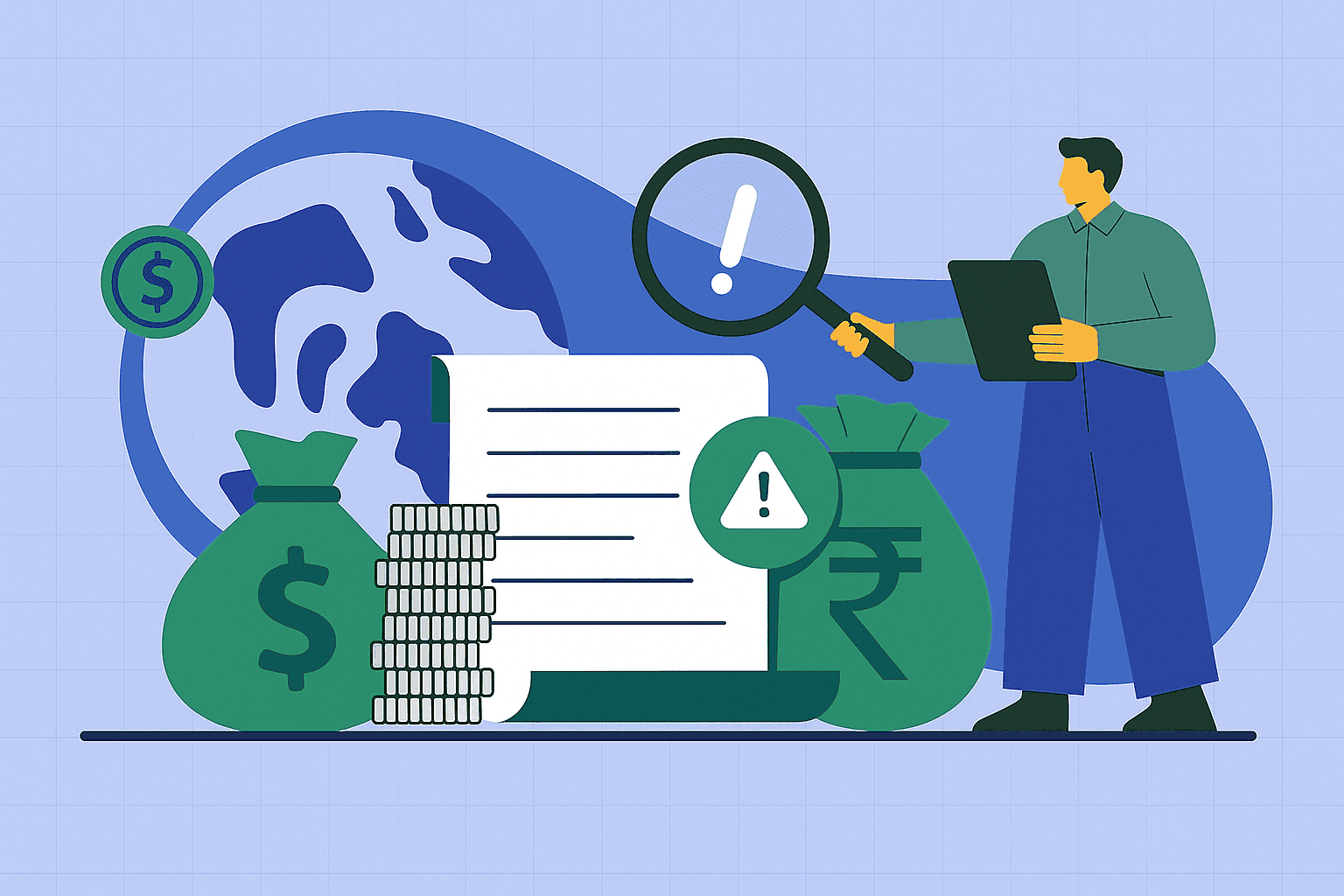
⚠️ COMMON MISCONCEPTION
A globally trusted payment gateway is not automatically authorised for every type of cross-border payment activity in India. Businesses should verify the provider's applicable RBI authorisation and confirm how its payment flow handles FEMA, export reporting, and required documentation.
How Do You Choose the Right International Payment Gateway for Your Business?
The right international payment gateway depends on how exactly your business gets paid. A D2C ecommerce seller accepting checkout payments, a service exporter receiving invoice payments, and a marketplace seller receiving platform payouts will have different requirements. Hence, always compare the following factors before choosing a provider:
- Transaction Fee + FX Markup: Compare both charges and not just the advertised transaction fee. For example, a 3% transaction fee on a ₹1,00,000 payment costs ₹3,000. If the provider also applies a 2% FX markup, that can add another ₹2,000, thereby taking the combined cost to about ₹5,000 before applicable taxes or other charges. Compare the actual exchange rate and total amount received, thereby avoiding hidden international transaction charges to an extent.
- Currencies Accepted + INR Settlement Speed: Check which currencies the gateway supports and how quickly it settles funds into your Indian bank account. Settlement can range from same-day or T+1 to T+2 or longer, depending on the provider, payment method, and product.
- RBI PA-CB Authorisation: If you are using a payment aggregator for cross-border transactions, check whether the provider has the appropriate RBI authorisation for that activity. The exact regulatory requirement depends on the payment service and transaction flow.
- FIRC/eBRC Support: Check what inward-remittance documentation the provider issues and whether it is generated automatically. Goods exporters should also check whether the provider supports eBRC and EDPMS processes.
- Payment Methods and Local Checkout: D2C businesses should check whether the gateway supports cards, wallets, and local payment methods preferred in their target markets. For B2B invoice payments, bank-transfer support may be more important.
- Accounting Integrations: Check whether the provider integrates with tools such as Zoho Books or Tally for easier reconciliation. Ecommerce businesses should also look for integrations with platforms such as Shopify, WooCommerce, and Magento.
- Security/PCI DSS: Check the provider's PCI DSS compliance and security controls for handling payment data. Certifications such as ISO 27001 or SOC 2 can provide additional assurance.
- Support Quality: Look for responsive support that understands Indian requirements around FEMA, inward-remittance documentation, and export realisation. Freelancers receiving international payments should also account for international bank transfer fees, including intermediary charges and FX costs.
How Does Skydo Simplify International Payments for Indian Exporters?
Skydo simplifies international payments for Indian exporters by addressing three common challenges with traditional gateways and banks, i.e., unpredictable costs, manual payment documentation, and uncertain settlement timelines. Skydo offers:
- Flat Fee with Mid-Market FX Rate: Where many traditional gateways and payment providers can charge a transaction fee alongside an FX markup of around 1.5% to 3%, Skydo charges a flat fee per transaction and applies the mid-market exchange rate with no FX spread added on top. Its current pricing is $19 for payments under $2,000, $29 for payments from $2,001 to $10,000, and 0.3% for payments above $10,000. There are no monthly fees, zero hidden charges, and you pay only when you transact.
- Free Virtual Accounts in Multiple Currencies, With 24-Hour Settlement: Skydo provides free virtual accounts in USD, EUR, GBP, SGD, AUD, and CAD. Foreign clients can pay into these accounts as local bank transfers, while the funds settle to the Indian bank account within 24 hours. No SWIFT copy chasing or RM calls is required, as the process is fully digital.
- Automatic FIRA and eBRC Support: Skydo issues a free and instant FIRA automatically for every payment, providing documentation of the inward remittance without requiring a separate request. For goods exporters, Skydo also supports eBRC closure by allowing exporters to link their DGFT account and bulk-upload shipping bills so relevant IRMs can be mapped for eBRC generation. Besides this, with EDPMS closure support available, businesses can easily opt for global ecommerce expansion.
- RBI and FEMA Compliant By Design: Skydo is authorised by the Reserve Bank of India as a Payment Aggregator, Cross Border (PA-CB) and is designed for Indian businesses receiving cross-border payments. It supports eligible exporters of goods and services and other businesses receiving international payments within the applicable RBI and FEMA framework.
- India-based support across multiple channels: Skydo provides support for payment and compliance-related queries, including FIRA, eBRC, and EDPMS. Its India-based support team can help businesses move through these local payment and export documentation requirements, thereby making it one of the best international payment gateways for freelancers in India.
What are the top 10 international payment gateways available to Indian businesses in 2026?
The top international payment gateways and payment platforms for Indian businesses in 2026 include Razorpay, Cashfree, Stripe, PayPal, Adyen, Payoneer, Wise, Skydo, Airwallex, and Checkout.com. Razorpay, Cashfree, Stripe, PayPal, Adyen, Airwallex, and Checkout.com primarily support online payment acceptance, while Payoneer, Wise, and Skydo are more suited to cross-border collections and payouts.
Which international payment gateway is best for an Indian freelancer or service exporter receiving foreign payments?
Do international payment gateways in India issue FIRC or eBRC certificates automatically?
What is the true cost of using an international ecommerce payment gateway - beyond the listed transaction fee?
What is the difference between a payment gateway and a cross-border payment platform?
Are international payment gateway providers regulated in India?
What currencies do the top international payment gateways support?
How quickly do international payment gateways settle funds to an Indian bank account?