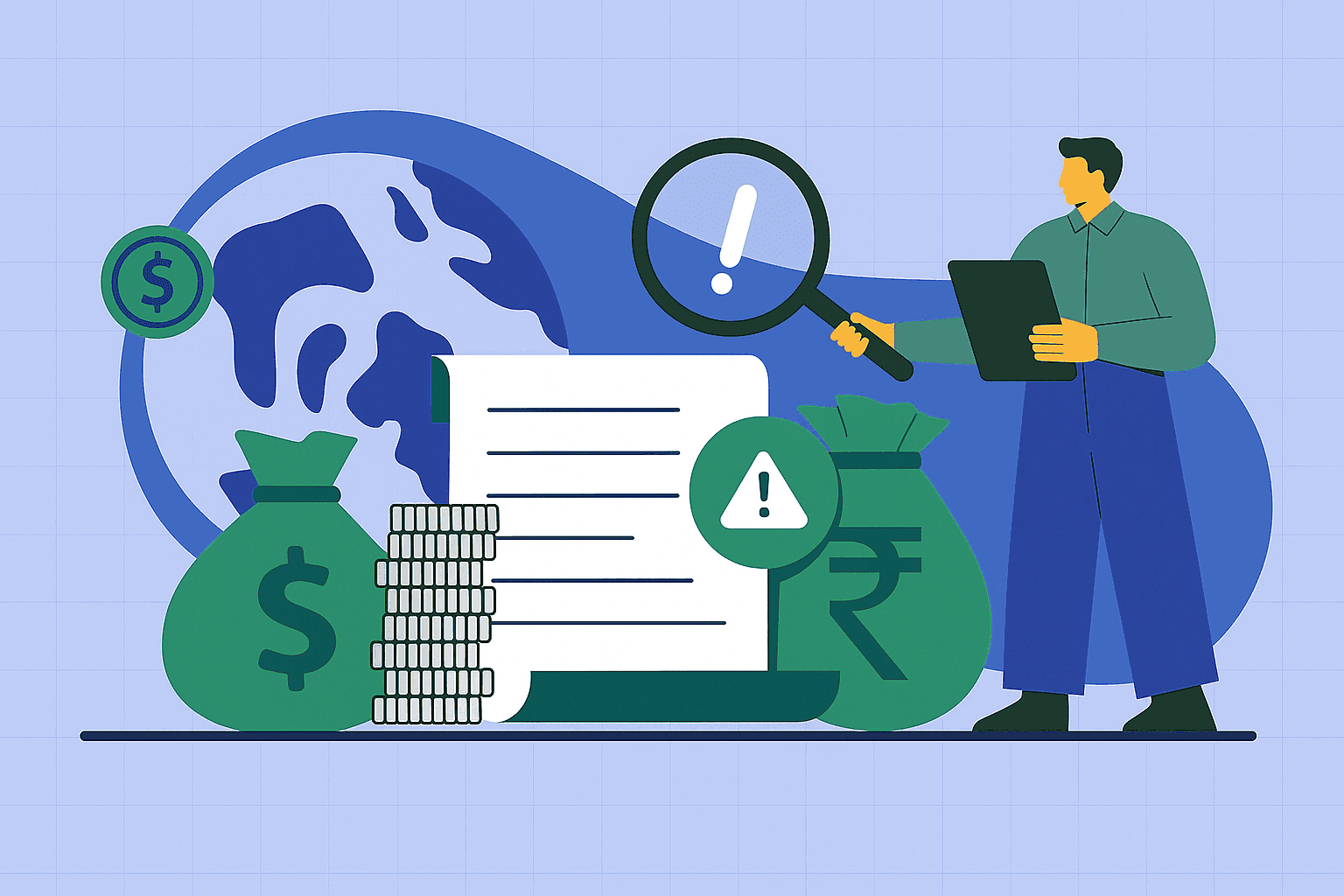
Inward Remittance in Suspense Account: Causes & Fixes

TL;DR - Summary
- What is an inward remittance in a suspense account? - An inward remittance in a suspense account is foreign money that has reached the bank in India but can't be credited to the beneficiary, because the bank can't match it to a verified account or purpose, so it holds the funds temporarily until the missing details are provided.
- Why does an inward remittance land in a suspense account? - An inward remittance lands in a suspense account because the bank can't match the incoming payment to a verified beneficiary account or a valid purpose.
- What are the common triggers for an inward remittance suspense hold? - The three most common triggers for an inward remittance suspense hold are a wrong or incomplete account number, a missing or incorrect FEMA purpose code, and a name mismatch between the payment instruction and the registered account holder.
- How do you get an inward remittance released from a suspense account? - To get an inward remittance released from a suspense account, you contact your bank's trade finance or forex desk, identify the held payment by its SWIFT reference (MT103), and submit your invoice and the correct FEMA purpose code so the bank can classify and credit the funds.
What Is an Inward Remittance in Suspense Account?
An inward remittance in a suspense account is a situation where foreign funds sent to an Indian recipient have arrived at the Authorised Dealer (AD) bank but can't be credited to the beneficiary's account. The bank can't match the payment to a verified account or purpose, so it parks the money temporarily in a suspense account until the missing details are provided.
Inward remittance is money received in India from abroad. For exporters, freelancers, and businesses, it's how a foreign client's payment arrives. It's governed by FEMA 1999 and routed through an RBI-authorised AD Category-I bank.
A suspense account is a temporary holding account in the general ledger. The bank uses it when a transaction can't be immediately classified or matched. It keeps the funds secure while the bank investigates and waits for the beneficiary to supply the missing information.
Here's how it plays out. A Bengaluru software consultant invoices a US client $3,000. The client's bank sends the wire but omits the FEMA purpose code. The funds arrive at the Indian AD bank, can't be matched to an export invoice, and sit in the suspense account until the consultant submits the purpose code and invoice.
Why Does an Inward Remittance Land in a Suspense Account?
An inward remittance lands in a suspense account because the AD bank cannot match the incoming payment to a verified beneficiary account or a valid purpose. The three most common triggers are a wrong or incomplete account number, a missing or incorrect FEMA purpose code, and a name mismatch between the payment instruction and the registered account holder.
When funds arrive via SWIFT (MT103), they pass through correspondent banks and land at the Indian AD bank via a Vostro relationship. At that point the bank must confirm the beneficiary account and purpose code before crediting. If either is missing or mismatched, the bank moves the payment to suspense.
- Missing purpose code: Every business inward remittance must carry a FETERS purpose code (for example, P0802 for software services). Without one, the bank has no basis to classify the receipt under FEMA, so it holds the funds in suspense until the beneficiary supplies the invoice and code.
- Account number or SWIFT BIC error: If the sender enters an incorrect account number or routes to the wrong SWIFT BIC, the bank can't identify the beneficiary. It parks the funds in suspense while it investigates.
- Name mismatch: If the account name in the payment instruction doesn't exactly match the name registered with the receiving bank, the bank treats it as an unidentified payment and routes it to suspense.
- KYC non-compliance: Payments routed via Rupee Drawing Arrangement (RDA) can only be credited to a fully KYC-verified account. If the account's KYC is incomplete, the credit is held.
| Trigger | What Went Wrong | Fix | Typical Resolution Time |
|---|---|---|---|
| Wrong/incomplete account number | Sender entered incorrect account or SWIFT BIC | Sender reissues with correct details; beneficiary submits bank confirmation | Varies by bank |
| Missing purpose code | No FEMA purpose code in payment instruction | Beneficiary submits invoice + purpose code to AD bank | Typically within a few working days of submission |
| Name mismatch | Account name in wire differs from registered name | Beneficiary submits KYC proof and account ownership documents | Varies by bank |
⚠️ WATCH OUT
If a payment sits unresolved in suspense beyond the bank's internal holding limit, the bank may return the funds to the sender. That restarts the entire international transfer fee cycle and can complicate FEMA compliance timelines for export realisation.

What Happens to Your Money While It Sits in Suspense?
While your inward remittance sits in suspense, the funds are physically held at the Indian AD bank. They have arrived in India but you can't access them, because the bank is waiting for you to supply the missing information before it can credit your account and convert the foreign currency to INR. If the hold isn't resolved within the bank's internal deadline, the funds can be returned to the sender.
An inward remittance follows this path:
- Your client's bank debits them and sends the funds through correspondent banks toward India, usually as a SWIFT MT103 payment.
- The funds reach the Indian AD bank via a Vostro or nostro relationship. The money is now in India but not yet in your account.
- The bank checks for a valid RBI purpose code and your invoice to classify the receipt. If either is missing, the money goes into the suspense account and the bank contacts you asking for the invoice and purpose code.
- Once you supply the missing details, the bank converts the foreign currency to INR at its rate and credits your account.
- The bank then issues the Foreign Inward Remittance Certificate (FIRC) or Foreign Inward Remittance Advice (FIRA), and for services exports the receipt is reported into EDPMS for reconciliation.
The friction point is step 3. Supplying the correct purpose code and invoice before or immediately after the payment lands is the single best way to prevent funds being held.
Getting a payment released is only half the job. Exporters also need to make sure the bank has matched the receipt to the right invoice and updated the relevant records. If that follow-up is missed, it can create unnecessary back-and-forth when the documents are needed for compliance.

How Do You Get an Inward Remittance Released from Suspense?
To get an inward remittance released from suspense, contact your AD bank's trade finance or forex desk, identify the held payment using the SWIFT reference (MT103), and submit the required documents. The primary ones are the invoice and the correct FEMA purpose code, so the bank can classify and credit the funds.
- Confirm the hold: Contact your AD bank's trade finance or forex operations desk, and skip the regular branch counter. Ask whether an inward remittance is sitting in suspense, and provide the expected amount, sender name, and approximate date.
- Obtain the SWIFT reference: Ask the bank for the MT103 SWIFT reference number for the held payment. This is your tracking identifier for all subsequent communication.
- Identify the trigger: Ask the bank exactly why the funds are held: missing purpose code, name mismatch, account error, or KYC issue. The fix depends on the trigger.
- Submit your invoice: Provide the export invoice that corresponds to the payment. The amount and currency on the invoice must match the inward remittance exactly.
- Confirm the purpose code: Submit the correct FEMA purpose code in writing (for example, P0802 for software services). If you're unsure of the code, check the RBI's FETERS purpose code list.
- Submit KYC or account ownership documents if required: If the hold was triggered by a name mismatch or KYC gap, provide your KYC documents and proof that the account belongs to you.
- Follow up in writing: Keep a written record (email) of everything you submit and the date. This protects you if the bank's internal deadline passes.
- Collect your FIRC/FIRA: Once the bank credits your account, immediately request the FIRC or its electronic equivalent (FIRA/eFIRA) for your CA and compliance records.
✅ PRO TIP
Get everything in writing. Submit your invoice and purpose code by email to the bank's trade desk, in addition to any phone call. This creates a timestamp record that matters if the bank's return deadline is approaching.
What Documents Do You Need to Submit to the Bank?
To get funds released from suspense, the core documents are the export invoice matching the payment amount and currency, the correct FEMA purpose code in writing, the recipient's account number, bank name/address and SWIFT code as registered, and a foreign exchange declaration form if the bank requires one based on the transaction amount and purpose code.
- Export invoice: It must match the payment amount and currency.
- FEMA purpose code: Submit the correct code in writing.
- Account details: The account number, bank name/address, and SWIFT code, as registered for the account that receives the foreign remittance.
- Foreign exchange declaration form: The bank may ask for it if required based on the transaction amount and purpose code.
If the hold was triggered by a name mismatch or KYC gap, you also provide your KYC documents and proof that the account belongs to you.
For services exporters, the invoice must be submitted to the bank so the receipt can be reconciled in EDPMS (the RBI's export monitoring system). The bank handles the EDPMS entry but requires the invoice and closure documents from you.
Once the funds are released, the bank issues a FIRC or its electronic version (FIRA/eFIRA). Your CA needs this document for GST zero-rating and income-tax records, and you must retain it.
Export proceeds must generally be realised within nine months of export. Confirm the current FEMA timeline with your bank, as regulations were updated in 2026. Retain the FIRC, invoices, and payment advices for at least five years for audit purposes.
✅ PRO TIP
Before your foreign client initiates the transfer, share your SWIFT BIC, your full account name exactly as registered with the bank, and the correct purpose code. A single mismatch on any of these is enough to trigger a suspense hold.
How Does Skydo Prevent Inward Remittance Suspense Holds?
Each of the three most common suspense triggers is a detail that's wrong or missing when the payment arrives: wrong account details, a missing purpose code, or a name mismatch. Skydo prevents inward remittance suspense holds by giving Indian exporters and freelancers dedicated virtual accounts in USD, EUR, GBP, SGD, AUD, and CAD. These come pre-loaded with complete, verified beneficiary details, so the bank receives a full, matched payment instruction the moment funds arrive.
- Triggers addressed upfront: The virtual account number is fixed and pre-verified, the account name matches exactly, and Skydo handles purpose code tagging so the payment is classified correctly on arrival.
- Quick setup: Setup takes 10–15 minutes, so you can have a virtual account ready before you send your next invoice to a foreign client. That eliminates the mismatch risk before the transfer is even initiated.
- Pricing: Pricing is transaction-based: $19 flat for payments under $2,000, $29 flat for $2,000–$10,000, and 0.3% for payments over $10,000. There are no monthly fees, and you pay only when you transact.
- Free FIRA: Every transaction comes with a free Foreign Inward Remittance Advice (FIRA) certificate automatically. You don't need to chase the bank for documentation, and your CA has everything needed for GST zero-rating and income-tax records.
- eBRC and EDPMS closure assistance: For eBRC, you link your DGFT account once, then bulk-upload shipping bills to auto-map IRMs and generate the eBRC in a click. Skydo also offers EDPMS closure assistance, so the compliance steps that follow a successful remittance are handled digitally instead of manually.
- Settlement and support: Settlement is within 1 working day. Support is India-based with multi-modal access (WhatsApp, call, text), so there's no global queue if you need to resolve an issue quickly.
Why is my inward remittance in a suspense account?
Your inward remittance is in a suspense account because the AD bank cannot match the incoming payment to your account or classify it. The most common reasons are a missing or wrong FEMA purpose code, an account number or SWIFT BIC error, or a name mismatch between the payment instruction and your registered account name. Contact your bank's trade finance or forex operations desk, provide the expected amount and sender name, and submit your invoice and correct purpose code to get the funds released.
How long can a bank hold foreign remittance in suspense?
Are funds in a remittance suspense account taxed?