Inward Remittance Shipping Bill Matching: Process & Compliance

TL;DR - Summary
- What is inward remittance shipping bill matching? - Inward remittance shipping bill matching is the process by which an Authorised Dealer (AD) bank formally links a foreign payment received in India to the specific shipping bill filed at customs for that export shipment.
- How does inward remittance shipping bill matching work step by step? - Inward remittance shipping bill matching has 5 steps: the shipping bill is filed at customs, the payment arrives in the NOSTRO/vostro account, the AD bank maps the remittance to the shipping bill number, the AD bank issues a Bank Realisation Certificate (BRC), and the BRC is uploaded to the DGFT portal as an eBRC.
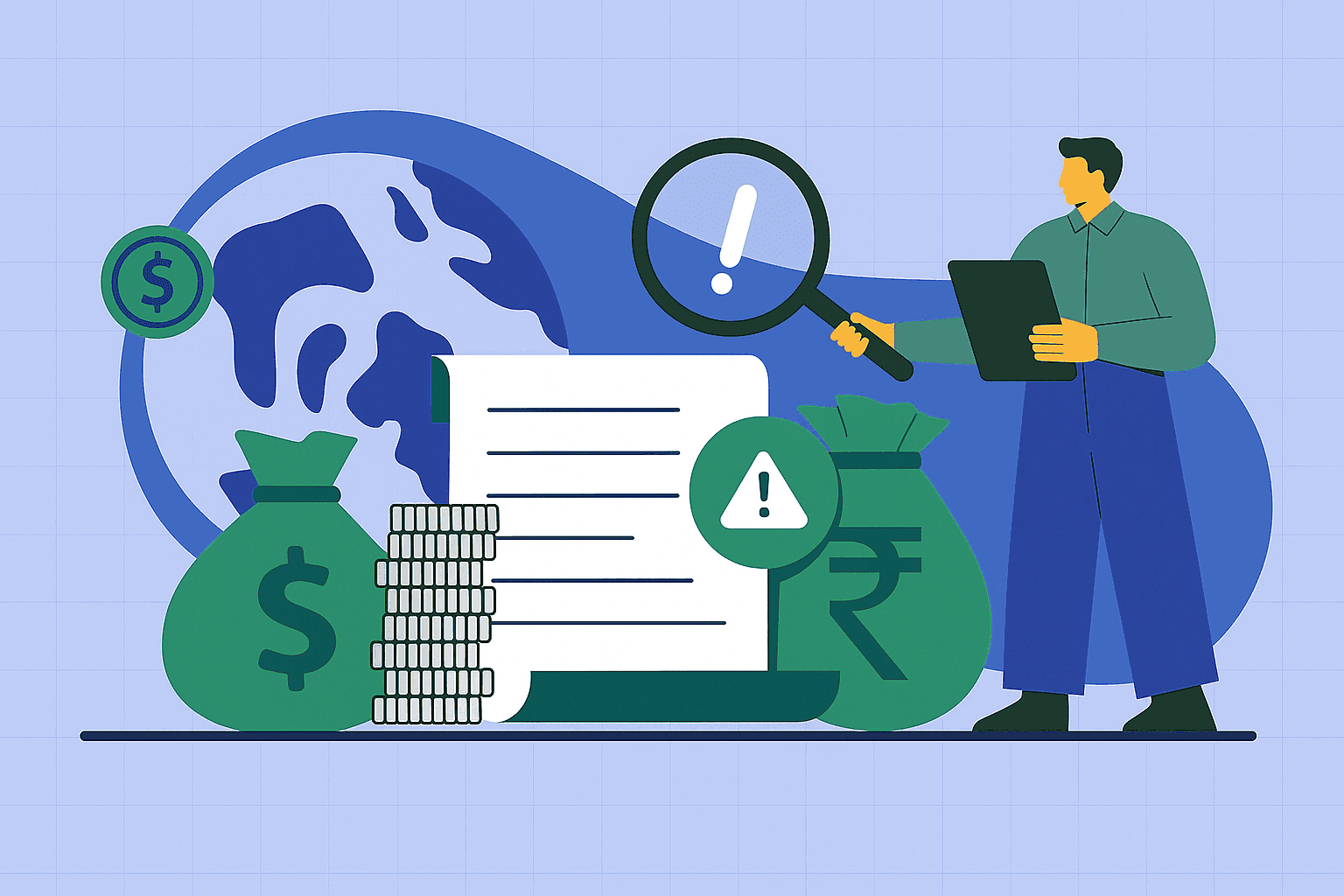
- What happens when the inward remittance and shipping bill amounts don't match? - When the inward remittance and shipping bill amounts don't match, you must inform your AD bank and provide supporting documentation, because the bank can't proceed with BRC issuance until the variance is explained and documented.
- What are RBI's timeline rules for realizing export proceeds against a shipping bill? - RBI mandates that export proceeds against every shipping bill be realized within 9 months from the date of shipment, and the window can be extended only in specific circumstances if an extension is applied for before the original deadline lapses.
What Is Inward Remittance Shipping Bill Matching?
Inward remittance shipping bill matching is the process by which an Authorised Dealer (AD) bank formally links a foreign payment received in India to the specific shipping bill filed at customs for that export shipment.
Indian goods exporters use it to prove that the payment for a particular export consignment has been received and accounted for under FEMA. Without this linkage, the export is not considered "realized" in regulatory terms.
Take a Mumbai garment exporter who ships goods worth $5,000 to a buyer in Germany and files Shipping Bill No. 1234567 at customs. When the $5,000 arrives in the exporter's NOSTRO/bank account, the AD bank maps that inward remittance to Shipping Bill No. 1234567. That act of mapping is the "matching."
Why Is Shipping Bill Matching Mandatory Under FEMA?
Under FEMA regulations, RBI mandates that export proceeds against every shipping bill be realized within 9 months from the date of shipment, and without the linkage between the inward remittance and the shipping bill, the export is not considered "realized" in regulatory terms.
Proceeds that aren't realized within the stipulated period trigger an overdue export reporting obligation, and the compliance guideline for inward remittance covers the wider rules.
In that case, the AD bank is required to report the outstanding shipping bill to RBI. That can lead to scrutiny and penalties under FEMA.

How Does the Shipping Bill Matching Process Work Step by Step?
Matching runs in 5 steps. You file the shipping bill at customs, the foreign buyer's payment lands in the AD bank's NOSTRO/vostro account, the AD bank maps the remittance to the shipping bill number, the AD bank issues a Bank Realisation Certificate (BRC), and the BRC is uploaded to the DGFT portal as an eBRC.
- Shipping bill filed at customs: You file the shipping bill at customs before or at the time of export. It carries a unique shipping bill number that becomes the anchor for all downstream compliance.
- Payment received in NOSTRO/vostro account: The foreign buyer's bank sends the payment via SWIFT. The funds land in the AD bank's NOSTRO/vostro account before being credited to your account.
- AD bank maps remittance to shipping bill number: The AD bank creates an Inward Remittance Message (IRM) and formally links it to the specific shipping bill number. This is the matching event.
- BRC issued: Once matching is confirmed, the AD bank issues a BRC as documentary proof that export proceeds against that shipping bill have been realized.
- eBRC uploaded to DGFT portal: The AD bank uploads the BRC electronically to the DGFT portal, generating an eBRC. You can then use it for claiming export incentives, closing EDPMS entries, and other regulatory purposes.
✅ PRO TIP
Always quote the shipping bill number in the payment instruction you send your foreign buyer. Most matching delays happen because the buyer's bank omits reference details in the SWIFT MT103 message.
What Happens When the Remittance and Shipping Bill Amounts Don't Match?
An inward remittance can differ from the shipping bill value for 3 reasons: the buyer deducts charges such as foreign bank fees or commissions, currency fluctuation causes a numerical difference when the payment arrives in a different currency from the invoice, or the buyer pays in instalments against a single shipping bill.
In all of these cases, you must proactively inform your AD bank and provide supporting documentation. The bank cannot proceed with BRC issuance until the variance is explained and documented.
- Buyer deductions: Obtain a deduction certificate or correspondence from the buyer explaining the shortfall. The AD bank uses it to close the IRM against the shipping bill even if the amounts differ by the deduction value.
- Currency mismatches: When a buyer pays in a different currency than the invoice (for example, invoice in USD and payment in EUR), the shipping bill value and remittance value won't match numerically. You must obtain a currency conversion certificate from your AD bank, or the BRC will remain stuck.
- Partial payments: Each instalment creates a separate IRM. The AD bank maps each IRM to the same shipping bill progressively until the full invoice value is realized. Tracking multiple IRMs against one shipping bill adds complexity that often surfaces only during CA audits.
⚠️ WATCH OUT
When a buyer pays in a different currency than the invoice, the AD bank needs a currency conversion certificate before it can match the remittance to the shipping bill. Without it, your BRC issuance stalls.
How Is Shipping Bill Matching Different for Goods vs Service Exporters?
Goods exporters match the inward remittance to a shipping bill, which is a customs document, and the process ends with a BRC that the AD bank issues and uploads as an eBRC to the DGFT portal. Service exporters (IT services, consulting, freelancers) have no physical shipment and therefore no shipping bill. Their compliance document is a FIRC (Foreign Inward Remittance Certificate) or FIRA (Foreign Inward Remittance Advice) issued by the bank for each payment received.
| Parameter | Goods Exports (Shipping Bill Matching) | Service Exports (FIRC/FIRA) |
|---|---|---|
| Document issued | Bank Realisation Certificate (BRC) / eBRC | FIRC / FIRA |
| Who issues it | AD Bank → uploaded to DGFT | AD Bank / Payment aggregator |
| Regulatory purpose | Prove export realization, claim incentives, close EDPMS | Proof of foreign earnings for GST, LUT, compliance |
| RBI purpose code | P0101 (export of goods) | P0103 (IT/software) or service-specific code |
| Customs document required | Yes, Shipping Bill | No |
The regulatory purpose differs too. For goods exporters, the BRC/eBRC proves export realization, supports claims for incentives, and closes EDPMS entries. For service exporters, the FIRC/FIRA is proof of export earnings and is used for GST refunds, LUT filing, and other compliance purposes.
RBI purpose codes also differ. Goods export remittances typically carry purpose code P0101 (export of goods). Service export remittances typically carry purpose code P0103 (software/IT services) or other relevant service codes, depending on the nature of the service.
What Are RBI's Timeline Rules for Realizing Export Proceeds Against a Shipping Bill?
RBI mandates that export proceeds against every shipping bill be realized within 9 months from the date of shipment. This is the standard realization period under FEMA regulations.
- Extensions: The 9-month window is extendable in specific circumstances (for example, project exports, certain commodity exports, or where RBI grants specific approval). You or your AD bank must apply for an extension before the original deadline lapses.
- Split remittances: When a buyer makes split (partial) remittances against a single shipping bill, the AD bank must track each instalment separately. The 9-month clock still runs from the date of shipment, and the date of the first instalment doesn't start it.
- Overdue proceeds: Failure to realize proceeds within the stipulated period triggers an overdue export reporting obligation. The AD bank is required to report the outstanding shipping bill to RBI, which can lead to scrutiny and penalties under FEMA.
- Audit gaps: Most exporters discover timeline compliance gaps only during CA audits, when overdue IRMs or unmatched shipping bills are flagged. Proactive tracking of each shipping bill's realization status against the 9-month deadline is the safest practice.
The realisation deadline runs from the shipment date, not the invoice date or the payment due date. If credit terms run close to that deadline, there's no room left for a late buyer, a SWIFT query or slow matching at the bank. Keeping a buffer of two to three months is what stops a shipping bill from going overdue.

How Does Skydo Simplify Inward Remittance Compliance for Service Exporters?
Goods exporters carry the burden of shipping bill matching, IRM tracking, and BRC follow-up. Service exporters face a parallel but simpler compliance path, yet they still lose time chasing banks for FIRC certificates and correct purpose codes.
Skydo takes that follow-up off your plate:
- FIRA for every transaction: Skydo automatically issues a FIRC (called a FIRA, Foreign Inward Remittance Advice) for every transaction received. You don't need to call your bank, visit a branch, or follow up with a relationship manager.
- Correct purpose codes: Skydo applies the correct RBI purpose code to every inward remittance at the point of receipt. That eliminates the risk of wrong purpose codes that require rectification later.
- Free virtual accounts: You get free virtual accounts in USD, EUR, GBP, SGD, AUD, and CAD, so you can receive payments in the currency your client prefers. There's no account opening fee, and setup takes 10–15 minutes.
- Pricing: Under $2,000 costs a $19 flat fee, $2,000–$10,000 costs a $29 flat fee, and over $10,000 costs 0.3%. There are no hidden percentage fees and no monthly charges, and you pay only when you transact.
- eBRC closure assistance: If you also deal with goods and need eBRC closure, link your DGFT account once, bulk upload shipping bills, auto-map IRMs, and generate the eBRC in a click.
- EDPMS closure assistance: Skydo also offers EDPMS closure assistance, completing the compliance loop if you manage both goods and services revenue.
- Settlement: Settlement is within 1 working day, so there are no unpredictable timelines of the kind that complicate 9-month realization tracking.
- Support: Support is India-based and multi-modal (WhatsApp, call, text), with no global support queues.
What is the statutory deadline to match shipping bills?
Export proceeds must be realized within 9 months from the date of shipment under FEMA. If that doesn't happen, the AD bank reports the overdue export to RBI. Extensions are available, but you must apply for them through the AD bank before the 9-month window closes, and they are not granted automatically.
Can one Inward Remittance Message (IRM) be matched to multiple shipping bills?
Who handles the e-BRC generation after matching?
The buyer paid me less due to foreign bank deductions. Can I still match?
What if the bank generated an IRM with the wrong purpose code?