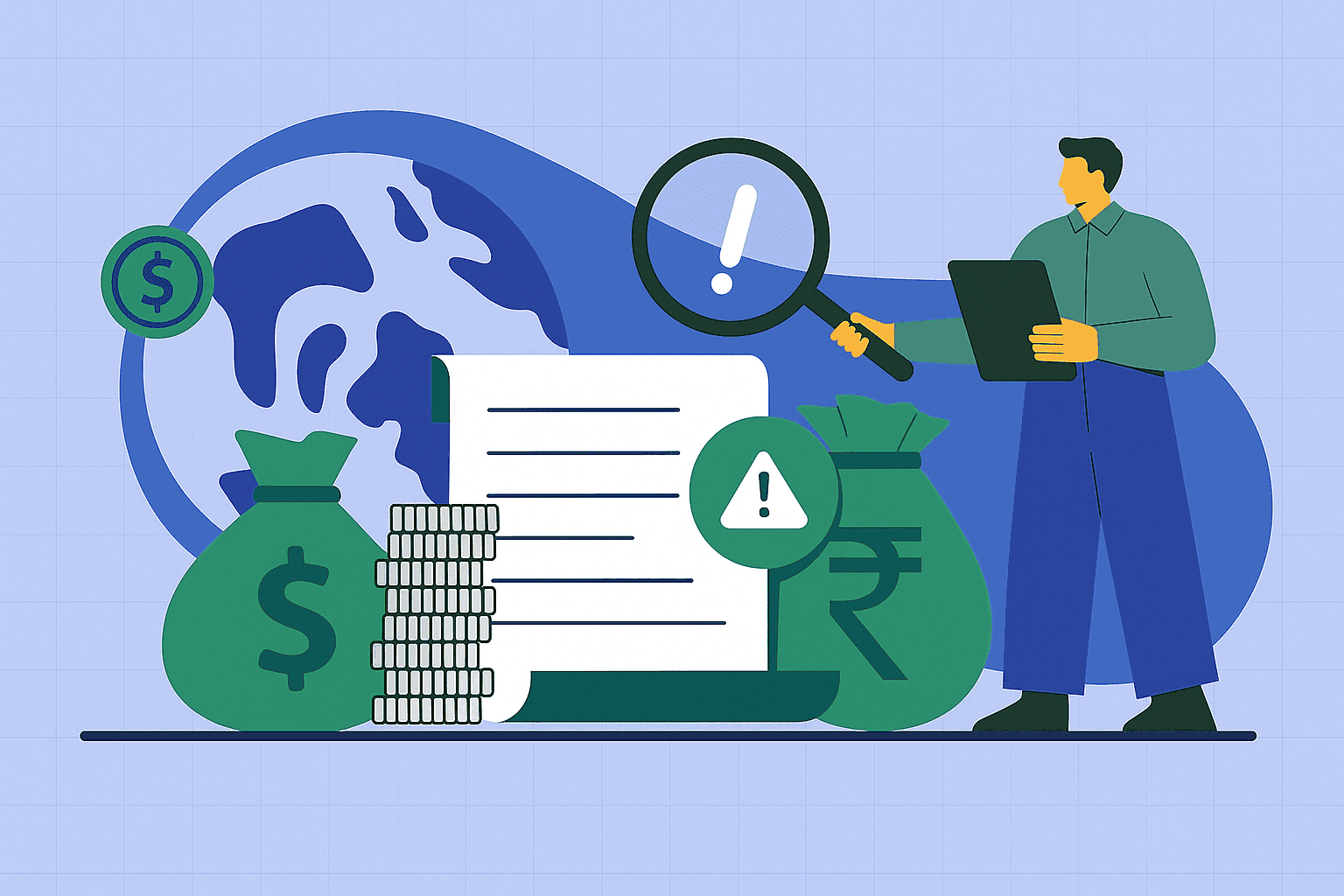
8 Questions to Ask Before Signing an Export Contract

TL;DR - Summary
- What is an export contract and why does it matter before you sign? - An export contract is a legally binding agreement between an Indian exporter and a foreign buyer that defines what will be delivered, when, at what price, and under what conditions, and it matters because it governs the entire transaction from shipment to payment.
- What are the 8 questions every Indian exporter must ask before signing an export contract? - Before signing an export contract, ask what you are delivering, when and how you will get paid, who pays bank and intermediary charges, which Incoterm applies, what happens if the buyer delays or doesn't pay, what happens if the order is cancelled or the contract is terminated, which law applies and how disputes will be resolved, and which tax, export-control or compliance requirements you need to meet.
- What red flags in an export contract signal payment or compliance risk? - Red flags in an export contract include vague payment terms such as "payment upon completion" with no date, unlimited liability, no late-payment interest clause, a buyer who can cancel without a fee, and payment from a third party, all of which expose you to payment loss, unlimited liability, or compliance risk.
- What compliance obligations does an export contract trigger under Indian law? - An export contract links to customs documentation, FEMA obligations, GST treatment, and export incentive claims, so what the contract says triggers each of them, and you also need to check whether your goods or services require a DGFT export license.
What Is an Export Contract and Why Does It Matter?
An export contract is a legally binding agreement between an Indian exporter and a foreign buyer that defines what will be delivered, when, at what price, and under what conditions. It is the document that governs the entire transaction from shipment to payment.
For Indian exporters, the contract is also the foundation for compliance. It links to customs documentation, FEMA obligations, GST treatment, and export incentive claims, and what the contract says triggers all of them.
Take a Pune-based software firm signing a $15,000 services contract with a UK client. If the contract does not specify the payment currency, timelines, and which bank account receives the funds, the exporter can face short payments, EDPMS mismatches, and delayed FIRC certificates.
Who Should Use This Export Contract Checklist?
This checklist is for Indian exporters who are about to sign a contract with a foreign buyer, whether they export physical goods such as textiles, pharma and engineering components or services such as IT, consulting and design.
Freelancers with foreign clients, Amazon sellers receiving international payments, and manufacturers entering their first overseas deal will all find every question relevant.
Service exporters and goods exporters face different risks in a contract. Incoterms apply only to goods, while scope-of-work and acceptance criteria matter more for services. The checklist flags which questions apply to whom.
SUGGESTED QUOTE — VERIFY & ATTRIBUTE BEFORE PUBLISHING
<I delivered a design project to a client abroad and the agreement said payment on completion, with no date and nothing about what counted as complete. The buyer kept asking for small revisions, and I had no clause to point to when I asked for my money.>
Who could say this: A freelancer in India who exports design services to overseas clients and has had a payment held up by an unclear agreement
1. What Exactly Am I Delivering?
Your export contract must state the product description, quantity, unit of measurement, and technical specifications precisely. Vague descriptions like "software services" or "textile goods" create acceptance disputes later.
- Goods exporters: Confirm that the HS code in the contract matches what will appear on the shipping bill and the commercial invoice. A mismatch between the contract description and your export documentation is a common reason RoDTEP claims and eBRC reconciliation stall.
- Service exporters: Define the exact deliverables, milestones, and what constitutes buyer acceptance. "Completion" means different things to different buyers, and without a written acceptance criterion, the buyer can withhold payment indefinitely.
- Consistency across documents: Check that the contract description matches what you will declare on your export invoice and the other export documents you eventually create. Customs authorities and banks verify this consistency.
2. When and How Will I Get Paid?
The payment terms in your export contract must name the payment method (advance payment, milestone-based payment, open account (payment after delivery), documentary collection, or Letter of Credit (LC)), the exact due date or triggering event, and the payment currency. They should also say whether partial payments are permitted and at what stages.
- Payment method: Each method carries a different risk profile. Advance payment protects the exporter most, open account exposes you to non-payment after goods have shipped, and an LC sits in the middle but only protects you if every document presented is perfectly compliant.
- Due date: State the exact due date or the triggering event, such as 30 days from the bill of lading date or 15 days from acceptance of deliverables. "Payment upon completion" with no date is a red flag.
- Currency: Name the currency explicitly: USD, EUR, GBP, or another agreed currency. Leaving it as "as mutually agreed" creates disputes at settlement time.
- Partial payments: Confirm whether they are permitted and, if so, at what stages. Partial payment schedules affect your EDPMS reporting obligations and eBRC closure timelines.
- FEMA timeline: Under FEMA, you must realize export proceeds within a stipulated period from the date of shipment. The payment due date in the contract must be consistent with this timeline to avoid a compliance breach.
Once your contract locks in payment currency and timelines, Skydo gives Indian exporters a free USD, EUR, GBP, SGD, AUD, or CAD virtual account so the payment lands exactly as negotiated, with no hidden bank charges cutting into the agreed amount. Flat fees start at $19 per transaction.
✅ PRO TIP
Always name a specific bank account for settlement in the contract rather than "as mutually agreed". This prevents disputes over conversion rates and processing delays.
3. Who Pays the Bank, Intermediary and Transfer Charges?
Your export contract must state which party pays the bank, intermediary and transfer charges. International wire transfers often pass through one or more intermediary (correspondent) banks, and each may deduct a fee before the money reaches you, so the amount credited can be lower than the amount the buyer sent. The cleanest position for an Indian exporter is a clause saying all bank charges outside India are borne by the buyer.
The contract should name one of three options:
- OUR: the sender pays all charges.
- BEN: the beneficiary (you, the exporter) pays all charges.
- SHA: the charges are shared. If the contract is silent, the default in most banking systems is SHA, meaning you absorb some costs.
If intermediary charges are deducted, the amount credited to your account is less than the invoice value. That short payment does not reconcile cleanly with your EDPMS records or eBRC, and it triggers follow-up compliance work.
Even a $20–$30 deduction by an intermediary bank, if it is not documented and agreed in the contract, can require a write-off approval or additional documentation to close your export transaction in EDPMS.
4. Which Incoterm Applies?
The Incoterm in your export contract (for example Ex Works (EXW), Free On Board (FOB), Cost, Insurance, Freight (CIF), or Delivered Duty Paid (DDP)) decides whether you or the buyer is responsible for freight costs, insurance, export customs clearance, and import customs clearance at the destination.
- EXW: the buyer handles everything from your premises. This is the minimum obligation for you and maximum responsibility for the buyer.
- FOB: you deliver the goods to the port and clear them for export. The buyer takes over once the goods are on board the vessel.
- CIF: you pay freight and insurance to the destination port.
- DDP: you bear all costs, including import duties at the destination. This is maximum obligation and cost exposure for you.
Getting the Incoterm wrong, or leaving it unspecified, can flip a profitable deal into a loss before the goods even ship. You end up absorbing freight, insurance, or duty costs that were never priced into the quote.
The Incoterm must also be consistent with the shipping bill and other export documents filed at customs. A mismatch between the contract Incoterm and the declared freight terms on the shipping bill creates documentation discrepancies.
If you export services, Incoterms do not apply. Skip this question and focus on delivery milestones and acceptance criteria instead.
✅ PRO TIP
If you are new to exporting, FOB is often the safest starting Incoterm. Your obligation ends at the port of origin and the buyer controls freight and insurance costs from there.
5. What Happens If the Buyer Delays or Doesn't Pay?
Your export contract should answer late or missing payment before it happens. It should define what counts as a payment default (typically, payment not received a set number of days after the due date), add a late-payment interest clause, let you suspend deliveries, and give you the right to terminate after a defined notice period.
- Default definition: Spell out what constitutes a default so there is no ambiguity about when your remedies are triggered.
- Late-payment interest: Interest at a specified rate per month on overdue amounts gives the buyer a financial reason not to delay and partially compensates you for the cost of waiting.
- Right to suspend: The contract should let you suspend further deliveries or halt ongoing work if a payment milestone is missed. Without this clause, you may be obligated to keep delivering against an already-defaulting buyer.
- Cancellation on default: After a defined notice period (for example, 14 or 30 days), you should be able to terminate the contract and pursue recovery of all amounts due, including costs already incurred.
- FEMA reporting: If export proceeds are not realized within the prescribed period, you must report this to your bank and seek an extension. The payment-default clause in the contract is your first line of evidence when you engage your bank on an overdue transaction.
6. What Happens If the Order Is Cancelled or the Contract Is Terminated?
Your export contract should say what happens on cancellation or termination: a cancellation fee, refund rules for any advance, payment for work already done, who bears the costs for goods already shipped, a written notice period, and a separate right to terminate for non-payment.
- Cancellation fee: Specify a fixed amount or a percentage of the contract value that the buyer pays if they cancel after a defined point, for example after production has begun or goods have been shipped.
- Refund of advances: If you have received an advance and the contract is cancelled, state under what conditions (if any) it must be refunded and within what timeframe.
- Work already completed: Confirm that you are entitled to payment for all completed work and costs incurred up to the date of cancellation, even if the full order is not fulfilled.
- Goods already shipped: If the cancellation notice arrives after shipment, the contract must address who bears return freight costs, insurance, and any import duties at the destination, and whether the buyer is still obligated to pay the invoice.
- Notice period: Require both parties to give written notice (for example, 30 days) before terminating, so the other party has time to cure the breach.
- Termination for non-payment: Make this a distinct clause from mutual termination. It should let you terminate immediately (or with a short cure window) if payment is not received, without being subject to the standard notice period.
7. Which Law Applies and How Will Disputes Be Resolved?
Your export contract should name the governing law, which is the country's law used to interpret and enforce the contract, and say whether disputes go to court or arbitration. It should also say how formal notices are served. If the contract is silent on the governing law, courts determine it, which is unpredictable and expensive.
- Governing law: Aim for Indian law wherever possible. If the buyer insists on their home country's law, take legal advice before agreeing, as enforcement of an Indian court judgment abroad can be difficult.
- Court or arbitration: Arbitration is generally faster, more private, and easier to enforce across borders under the New York Convention.
- Arbitration details: If you choose arbitration, the contract must name the arbitration seat (city and country), the arbitral institution or rules (for example, ICC, SIAC, or the Indian Arbitration and Conciliation Act), the number of arbitrators, and the language of proceedings.
- Neutral seat: If you deal with buyers in multiple countries, a neutral arbitration seat (for example, Singapore) is often more practical than insisting on India, as it gives both parties a neutral forum.
- Notice clause: Specify how formal notices, including dispute notices, must be served (email, courier, or registered post) and to which named address. A dispute notice sent to the wrong address or by the wrong method can invalidate the process.
8. Are There Any Tax, Export-Control or Compliance Requirements I Need to Meet?
Before you sign, check six things: whether your goods or services need a DGFT export license, whether the contract is consistent with Indian GST treatment of exports, whether your Importer Exporter Code (IEC) is valid and active, whether the buyer's country imposes withholding tax, whether the buyer and any intermediaries pass sanctions checks, and which customs or regulatory documents the buyer needs from you.
- Export license: Certain categories (dual-use items, chemicals, defense-related goods) are subject to export controls. Check whether you need an export license from DGFT, because these goods cannot be shipped without prior approval regardless of what the contract says.
- GST treatment: Goods exports are zero-rated, and service exports under LUT are also zero-rated. The contract value and payment terms must align with the GST documentation you will file.
- IEC: Your IEC must be valid and active before the contract is signed. It is a prerequisite for all export transactions and must appear on shipping bills and customs filings.
- Withholding tax: Some countries require the buyer to deduct a percentage of the invoice as withholding tax before remitting, which reduces what you actually receive. The contract should address who bears this cost and what tax certificates the buyer will provide.
- Sanctions and restricted-party checks: Confirm the buyer, their country, and any intermediary entities are not on RBI-sanctioned, US OFAC, EU, or UN sanctions lists. Exporting to a sanctioned entity or country creates serious legal exposure regardless of the contract terms.
- Customs and regulatory documents: If the buyer requires specific documentation from you (for example, a Certificate of Origin, phytosanitary certificates, or product-specific quality certificates), the contract should name each document and specify who is responsible for obtaining it and bearing its cost.
💡 QUICK INSIGHT
Certain export categories require a DGFT export license. Shipping without one can result in goods being seized at customs, the contract being voided, and penalties under the Foreign Trade (Development and Regulation) Act.
Export Contract Checklist Before You Sign
Before you sign, confirm that your export contract covers eight groups: delivery scope, payment terms, bank and transfer charges, Incoterms (goods only), default and cancellation, dispute resolution, compliance, and documentation.
Delivery Scope
- The product or service description matches your export documentation.
- Quantity and specifications are precise.
- Acceptance criteria are defined (services).
Payment Terms
- The payment method is named (advance, LC, open account, or milestone).
- The payment due date or trigger event is specified.
- The currency of payment is named.
- Partial payment terms are defined.
Bank and Transfer Charges
- Responsibility for intermediary bank charges is stated.
- The party bearing SWIFT/correspondent charges is named.
- A short-payment resolution process is included.
Incoterms (Goods Only)
- The Incoterm is named and defined.
- Freight, insurance, and customs responsibilities are clear.
- The point of risk transfer is specified.
Default and Cancellation
- A late-payment interest clause is present.
- A suspension-of-delivery right is included.
- The cancellation fee is defined.
- The notice period for termination is stated.
Dispute Resolution
- The governing law is named.
- The dispute resolution method (arbitration or court) is specified.
- The arbitration seat and rules are named (if arbitration).
- Notice requirements are stated.
Compliance
- The export license requirement has been checked.
- GST treatment is consistent.
- The buyer's withholding-tax obligation is addressed.
- The sanctions check is complete.
- Your IEC is valid.
Documentation
- All required export documents are listed.
- Responsibility for each document is assigned.
- The cost of obtaining certificates is allocated.
Red Flags to Watch for in an Export Contract
Red flags in an export contract are terms that expose you to payment loss, unlimited liability, or compliance risk, and the time to check for them is before you sign, before any dispute has started.
- Vague payment terms: Wording such as "payment upon completion" with no defined date or triggering event leaves the buyer free to delay indefinitely with no contractual consequence.
- Open-ended changes: If the buyer can change specifications, quantities, or scope without agreeing a revised price, you are exposed to cost overruns with no recovery mechanism.
- Unlimited liability: A contract with no liability cap means a single disputed shipment could expose you to claims far exceeding the contract value. Always negotiate a liability cap equal to the contract value.
- No late-payment interest clause: The buyer faces zero financial cost for delaying payment by weeks or months.
- Free cancellation: If the buyer can cancel without paying a cancellation fee, you absorb all production or preparation costs with no recovery.
- Uncapped bank charges: If all bank and transfer charges are automatically deducted from the payment amount with no cap, you get unpredictable short payments that are hard to reconcile in EDPMS.
- Impractical dispute forum: A foreign governing law combined with an expensive or impractical forum (for example, litigation in the buyer's home country) can make it economically unviable to pursue a claim even if you are in the right.
- No acceptance criteria: Without defined acceptance criteria for goods or services, the buyer can claim non-acceptance indefinitely and withhold payment without being in formal breach.
- Third-party or other-country payment: Payment from a third party or from a country that is not the buyer's home country can create FEMA compliance issues for you, even if the commercial intent is legitimate.
A lot of exporters assume a signed contract protects them automatically. It doesn't. If the terms are vague, or the contract doesn't spell out what happens when either side defaults, enforcing your rights gets hard. Before you sign, make sure it clearly covers payment terms, what each side has to deliver, and what happens if someone doesn't.

How Does Skydo Help Indian Exporters Get Paid on Their Export Contracts?
Once your export contract is signed with the currency, due dates and bank charges agreed, the next step is making sure the payment arrives in full and closes cleanly for compliance. Skydo is built for exactly that.
Your buyer pays into a local Skydo account in their own country, with accounts available in the US, UK, Canada, Australia and 10+ other countries. Because the buyer pays locally, the full invoice amount reaches you without intermediary bank deductions, so there are no short payments to reconcile in EDPMS. The money is converted at the live FX rate with zero margin, and you pay a flat fee of $19 for payments up to USD 2,000, $29 for USD 2,001 to 10,000, and 0.3% above USD 10,000.
Funds reach your Indian account in under 24 hours, and a GST-compliant FIRA is issued instantly for every payment, giving you proof of inward remittance for GST refunds, FEMA realisation and RBI reporting without chasing your bank.
Is LC required for export from India?
No, an LC is not legally required for export from India. Exporters can use advance payment, open account, documentary collection, or other agreed payment methods. An LC is a bank-backed instrument that guarantees payment, but only if every document presented to the buyer's bank is perfectly compliant, so a single discrepancy can delay or block payment even under a valid LC.
What are the steps of the export process in India?
What happens if the buyer delays payment under an export contract?
How long does an Indian exporter have to realise export proceeds under FEMA?
Can an export contract be in Indian rupees instead of foreign currency?
What documents must be mentioned in an export contract?
Can payment come from a third party instead of the buyer in an export contract?
What is the difference between a proforma invoice and an export contract?
Do service exporters need a different type of export contract than goods exporters?