Switch from Bank to Payment Platform for Exports

TL;DR - Summary
- Why are Indian exporters switching from bank to payment platform for exports? - Indian exporters are switching from bank to payment platform for exports because online payment platforms offer faster, more cost-transparent alternatives to traditional bank SWIFT transfers.
- What does your bank actually cost you per export invoice? - On a $5,000 export invoice routed through a bank at a 2–5% all-in cost, you lose $100–$250 per transaction, while the same invoice costs $29 flat on Skydo.
- How do bank SWIFT and payment platforms compare for exports? - Bank SWIFT typically takes 3–5 business days and costs up to 2–5%, while PA-CB licensed payment platforms can achieve T+1 settlement and Skydo charges a flat $19 for invoices under $2,000.
- How do you switch from bank to payment platform for exports without closing your bank account? - Switching from your bank to a payment platform for exports takes five steps, starting with gathering KYC documents and choosing a PA-CB licensed platform, and you do not have to close your bank account.
Why Are Exporters Switching from Banks to Payment Platforms?
Indian exporters are switching because online payment platforms have changed how they receive cross-border payments, offering faster, more cost-transparent alternatives to traditional bank SWIFT transfers. The core draw across all platforms is convenience, speed, and cost compared to the traditional bank route.
- Transparent pricing: Clear fee structures help exporters understand transaction costs, forex markups, and the final amount they will receive.
- Faster payment processing: Digital payment infrastructure and local collection methods can reduce the delays associated with traditional SWIFT transfers.
- Dedicated customer support: Access to support teams can help resolve delayed payments, failed transfers, and reconciliation issues without repeated follow-ups across bank departments.
- Simplified documentation: Some platforms assist with inward-remittance certificates and export documentation, reducing the administrative effort involved in managing international receipts.
- Multi-currency collection: Businesses can collect payments in supported foreign currencies through virtual accounts and local payment rails, making it easier for overseas clients to pay.
- Better payment visibility: Online dashboards and transaction tracking help exporters monitor incoming payments, identify delays, and reconcile receipts against invoices.
- Dedicated customer support: Choose a platform that offers responsive support for delayed payments, failed transfers, and compliance queries. Access to a team familiar with export payments can help resolve issues faster and reduce repeated follow-ups with banks or intermediaries.
✅ PRO TIP
Compare the all-in cost (fee plus FX markup) across platforms before picking one. The headline fee is rarely the full picture.
Bank SWIFT vs Payment Platform: How Do They Compare?
A bank SWIFT transfer costs up to 2–5% (markup plus SWIFT charges) and typically takes 3–5 business days to settle, while a PA-CB licensed payment platform can achieve T+1 settlement. Skydo charges a flat $19 for invoices under $2,000 and a flat $29 for $2,000–$10,000, then 0.3% above $10,000. Skydo also issues a free Foreign Inward Remittance Advice (FIRA) certificate automatically on every transaction.
- FIRC and FIRA process: Banks require manual follow-up, relationship manager (RM) calls, and SWIFT copy chasing. Skydo issues the FIRA certificate automatically, and it's free.
- RBI compliance: Banks handle FEMA reporting through your Authorized Dealer (AD) bank. PA-CB licensed platforms must hold RBI authorization under the 2024 PA-CB framework.
- RM dependency: The bank route requires contact with your RM for tracking and documentation. Payment platforms are fully digital with real-time tracking.
| Parameter | Bank SWIFT | Payment Platform (e.g., Skydo) |
|---|---|---|
| Fee on $5,000 invoice | 2–5% = $100–$250 | $29 flat |
| Settlement time | 3–5 business days | Within 1 working day |
| FIRA/FIRC | Manual request, delayed | Auto-issued, free |
| Compliance | AD bank handles FEMA | PA-CB licensed, auto-compliance |
| Payment tracking | No real-time visibility | End-to-end digital tracking |
| Monthly fees | Often yes (account charges) | None. You pay only when you transact. |
The numbers in the table already make the case. Skydo setup takes 10–15 minutes. Your first virtual account, in USD, EUR, or GBP, is free to open, and there's no monthly fee until you transact. Get started with Skydo.

What Does Your Bank Actually Cost You on Every Export Invoice?
International bank transfer fees on a $5,000 export invoice come to $100–$250 when your bank charges a 2–5% all-in cost. Banks also apply a hidden FX markup on top of their declared fee, typically 1.5% to 3% above the mid-market rate on currency conversion and separate from the wire transfer charge. The same $5,000 invoice costs $29 flat on Skydo, a saving of $71 to $221 on that single payment.
- $10,000 invoice: A 2% bank markup equals $200 lost. Skydo's flat fee for the same invoice is $29.
- Time cost: Beyond the fee, exporters routinely spend hours calling their RM, chasing SWIFT copies, and manually reconciling FIRC certificates. None of that is reflected in the percentage fee.
- The mid-market gap: The best platforms disclose the mid-market rate alongside the conversion rate applied. The gap between those two numbers is the real cost of using your bank.
The real cost of a payment comes down to the exchange rate you get, any intermediary fees deducted along the way, and the final amount credited to your account. Looking at these together helps you understand how much you're actually spending on every transaction.

What Should You Look for in an Export Payment Platform?
Look for five things in an export payment platform: transparent FX rates, settlement speed, automated compliance, real-time payment tracking, and multi-currency support.
- Transparent FX: The platform should show the mid-market rate alongside the conversion rate applied to your transaction. The best platforms offer rates within 0.5% to 1% of mid-market, significantly better than the 1.5% to 3% typical of traditional bank conversions.
- Settlement speed: T+1 or T+2 is now achievable through PA-CB licensed platforms. If you are still waiting 5 to 7 business days after your client pays, there is a faster option available.
- Automated compliance: The platform should handle purpose code classification, EDPMS reporting, and FIRA/FIRC generation automatically. Manual compliance is where most exporters lose time and where errors happen most frequently.
- Real-time payment tracking: End-to-end visibility of where your money is at any point is a prerequisite for reliable cash flow management. Most traditional bank SWIFT transfers lack it.
- Multi-currency support: The platform should support the currencies your clients pay in, such as USD, EUR, GBP, and others, without forcing conversion at unfavorable rates.
💡 QUICK INSIGHT
RBI's PA-CB framework (2024) requires all cross-border payment aggregators to be licensed (circular DPSS.CO.OD No.S33/02.14.003/2023-24). Checking whether a platform holds this authorization is the single most important compliance step before switching.
Does Switching Mean You Have to Close Your Bank Account?
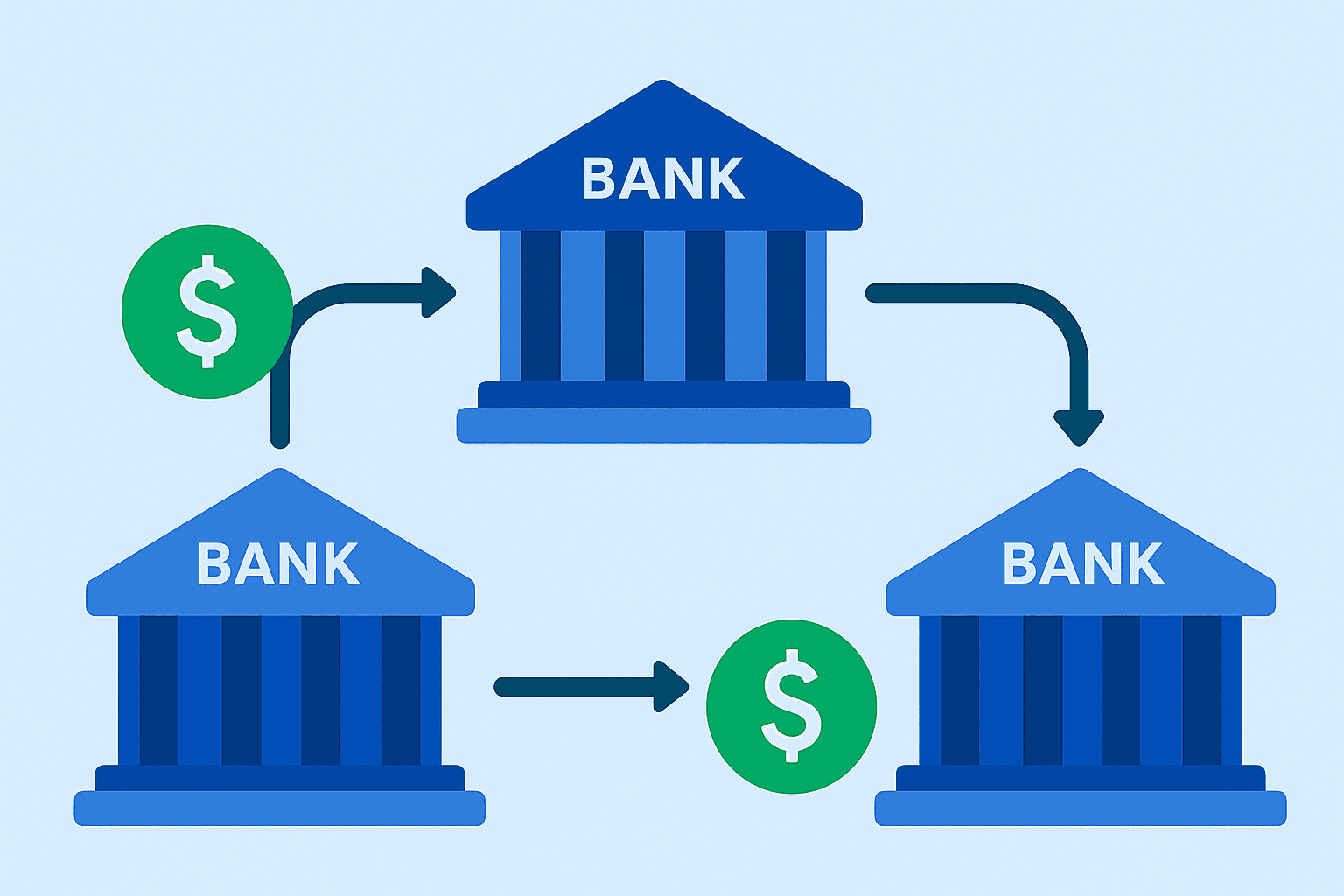
No, switching to a payment platform does not mean closing your bank account or ending your relationship with your AD bank. Your AD bank still handles FEMA reporting and EDPMS filing, and a payment platform sits on top of that infrastructure as an additional receiving layer.
Your AD (Authorized Dealer) bank continues to play a mandatory role. FEMA reporting and EDPMS filing are functions it handles, and they cannot be bypassed regardless of which payment platform you use.
In practice, your foreign client pays into your virtual account on the platform. The platform converts the payment and settles the INR equivalent into your existing Indian bank account, so your bank relationship stays intact throughout.
You can also run both in parallel. Use the platform for new clients or currencies where the cost and speed advantage is clear, and keep your bank for existing relationships where SWIFT is already established. There is no rule requiring exclusivity.
How Do You Actually Switch from Your Bank to a Payment Platform for Exports?
Switching from your bank to a payment platform for exports involves five steps: gather KYC documents, choose a PA-CB licensed platform, set up your virtual account, send a test invoice, and confirm FIRA receipt.
- Gather your KYC documents: Estimated time: 30 minutes. Collect your business PAN, GST certificate, Importer Exporter Code (IEC), bank account details, and proof of business address. These are standard requirements across all PA-CB licensed platforms.
- Choose a PA-CB licensed platform: Estimated time: 1–2 hours for research. Verify the platform holds RBI's PA-CB authorization before signing up. This protects your export proceeds and ensures FEMA compliance.
- Set up your virtual account: Estimated time: 10–15 minutes on Skydo. Complete the onboarding form digitally. Skydo setup takes 10–15 minutes and gives you free virtual accounts in USD, EUR, GBP, SGD, AUD, and CAD.
- Send your first test invoice: Estimated time: same day. Share your new virtual account details with a client on a small invoice, ideally $500–$1,000, before migrating your largest clients. This lets you verify settlement speed and FIRA delivery without financial risk.
- Confirm FIRA receipt: Estimated time: within 1 working day of settlement. After the payment settles, confirm that your FIRA certificate has been issued. On Skydo, FIRA certificates are issued automatically and free of charge for every transaction.
Why Exporters Use Skydo for International Payments
Once your first payments start arriving, the question is what the platform does for you each time. For Indian exporters on bank SWIFT, the pain points are markups of 2–5% per transaction and manual work: RM calls, chasing SWIFT copies, and manual FIRC reconciliation. Skydo is built to remove both.
Skydo is a cross-border payment platform built specifically for Indian exporters (goods and services), freelancers with proper documentation, and Amazon sellers, which makes onboarding and compliance alignment straightforward for these categories.
- Flat fees: Skydo charges $19 for invoices under $2,000, $29 for $2,000–$10,000, and 0.3% above $10,000. There is no percentage markup on the exchange rate.
- Digital tracking: Skydo is fully digital with automatic payment tracking, so you know exactly where your money is without calling anyone.
- Free FIRA certificate: Skydo issues it automatically for every transaction, removing the manual follow-up that delays compliance at most banks.
- Closure assistance: If you manage EDPMS and eBRC obligations, link your DGFT account once, bulk upload shipping bills, and auto-map IRMs to generate eBRC in a single click.
- Predictable settlement: Skydo guarantees settlement within 1 working day, compared to the 3–5 day bank SWIFT window.
- Free virtual accounts: Virtual accounts in USD, EUR, GBP, SGD, AUD, and CAD are free to open. There are no monthly fees, and you pay only when you transact.
- India-based support: Support is multi-modal (WhatsApp, call, text) with no global queue, unlike the generic helpdesks attached to international platforms.
You can open your Skydo account and set up a free virtual account today.
Which platform is best for receiving export payments from India?
The best platform is one that holds RBI's PA-CB authorization, charges transparent fees without hidden FX markups, settles within T+1, and auto-generates FIRA certificates. Skydo meets all four criteria, with a flat fee starting at $19.
How do I receive payment for exports as an Indian business?
What are RBI's rules for receiving export payments?
What is the safest method of payment for exports?
Do I need to close my bank account to use a payment platform for exports?
What is a FIRA certificate and why does it matter for exporters?
How long does it take to set up a virtual account for export payments?
Can I use a payment platform for large export invoices, or only small ones?