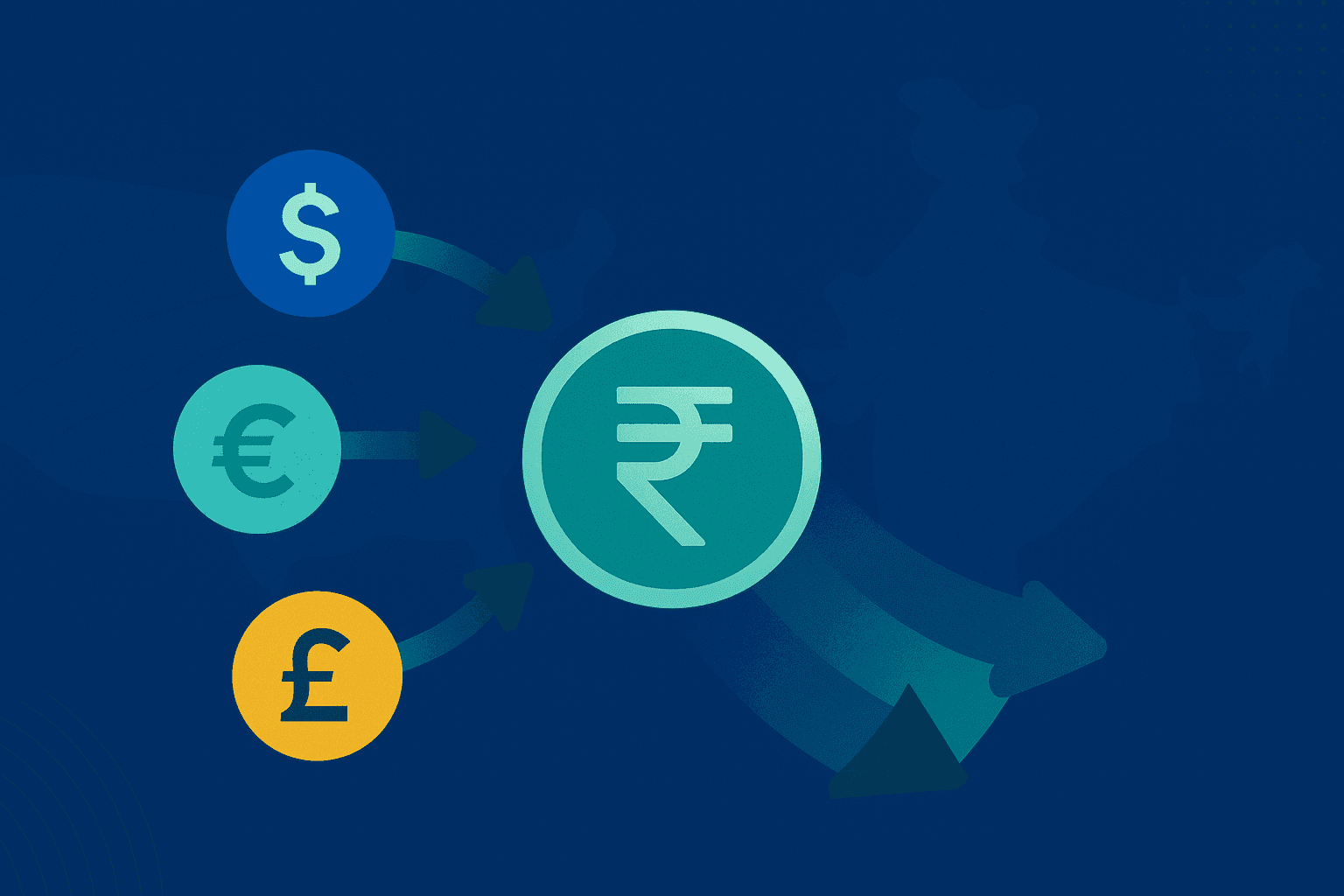
How to Benchmark Your FX Rate Against the Interbank Rate

TL;DR - Summary
- What is the interbank exchange rate? Banks trade currencies at wholesale buying and selling rates. The mid-market rate is the midpoint between those prices and is a useful benchmark, not a guaranteed customer rate. -
- What is an FX rate markup compared with the interbank rate? For a foreign-currency receipt converted into INR, the markup is the percentage shortfall of the applied rate against a matched mid-market benchmark. Transfer fees and taxes are separate costs. -
- How much does the FX rate vs interbank rate markup cost per invoice in INR? At an illustrative ₹84.00 per USD, a 3% rate reduction on $3,000 converted costs ₹7,560 before separate fees or taxes. -
- How do you benchmark your FX rate against the interbank rate? Compare the applied rate with a mid-market quote from the time the currency was converted. Multiply the rate difference by the foreign-currency amount actually converted. A daily reference rate gives an estimate, not an exact markup. -
What Is the Interbank Exchange Rate?
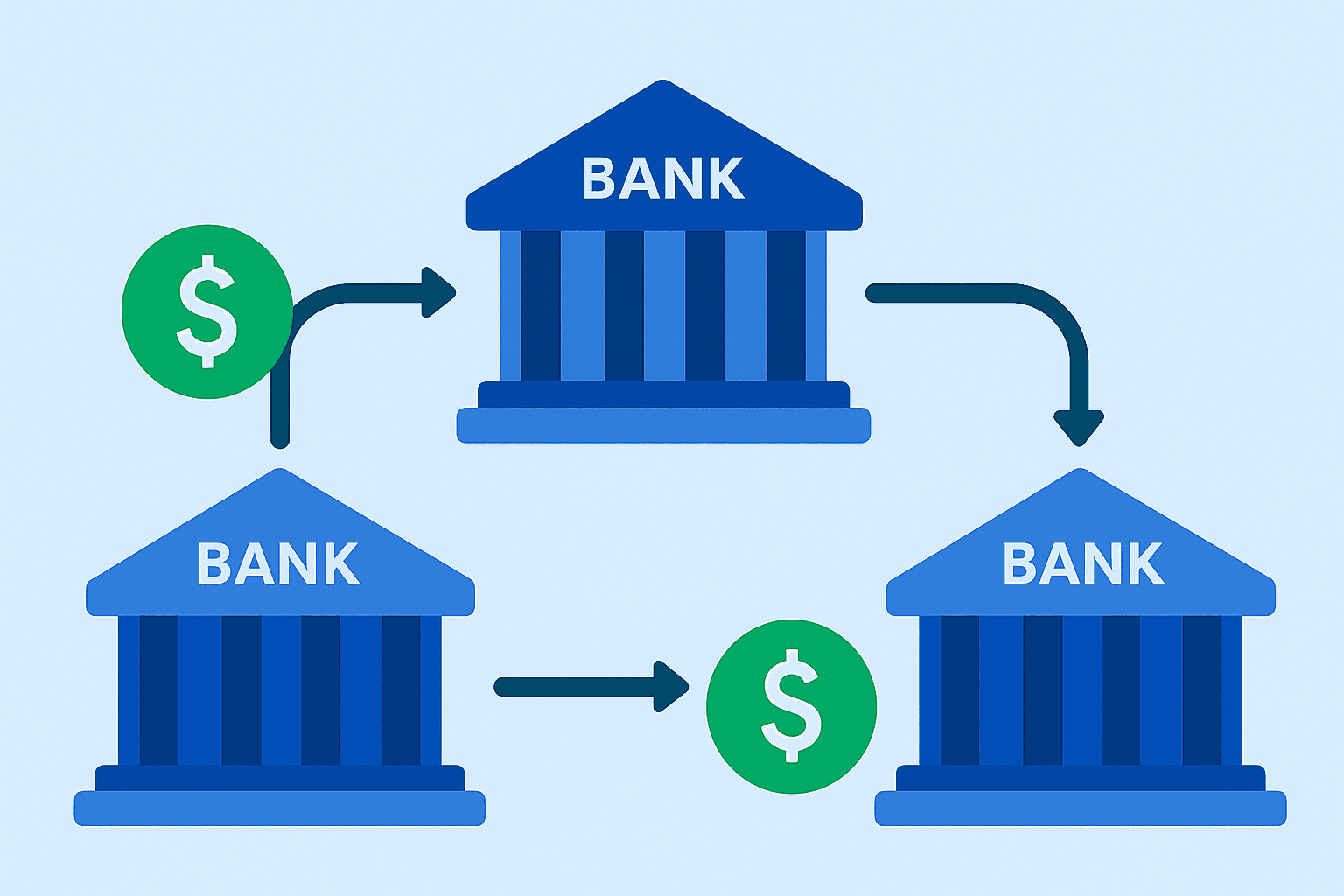
The interbank market is where banks trade currencies with each other at wholesale buying and selling rates. The mid-market rate sits halfway between those prices. It is a useful reference for comparing exchange rates, but it is not a single rate every bank trades at or every customer can receive.
If you're an Indian freelancer or exporter receiving foreign currency payments, compare your Indian rupee (INR) conversion rate with that benchmark. A lower applied rate means fewer rupees for the same foreign-currency amount. Use quotes from the same time so market moves do not look like markup. That timing helps explain why banks differ from live FX rates in currency exchange.
Here's an illustrative example. A Bengaluru-based user experience (UX) designer receives $3,000 for conversion. At that time, the US dollar (USD)/INR mid-market benchmark is ₹84.00 and the bank applies ₹81.50. The rate difference costs ₹7,500, before any separate charges. That cost may be built into the rate rather than shown as a fee.
✅ PRO TIP
Record a timestamped mid-market quote fromXE when your currency is converted, then compare it with your bank's applied rate. The conversion time may differ from the time the INR reaches your account.
What Is an FX Rate Markup?
A foreign exchange (FX) rate markup is the gap between a market benchmark and the exchange rate a provider applies. For a foreign-currency receipt converted into Indian rupees (INR), calculate it as (Benchmark rate − Applied rate) ÷ Benchmark rate × 100. Use rates quoted in INR per unit of the foreign currency, from the same time.
- How it works: The markup moves the exchange rate in the provider's favor. In this article's examples, a 3% markup means a 3% reduction from the ₹84.00-per-USD benchmark: ₹84.00 × 0.97 = ₹81.48. You receive ₹2.52 less per dollar, before separate fees.
- Not a fee line item: A rate markup is different from a transfer fee or a bank deduction. It may not appear as a separate fee, but you can check it by comparing the disclosed conversion rate with a matched benchmark. Review both the rate and the charges.
- Percentage or fixed spread: A provider may describe its rate margin as a percentage or as a fixed amount, such as ₹2 per dollar. A flat transaction fee does not automatically mean zero FX markup. Check both parts of the quote.
- PayPal and other payment platforms: Separate payment-processing fees from currency-conversion charges. For Indian merchant accounts, PayPal lists 4.4% plus a fixed fee for receiving international payments and a separate 3% charge above its base exchange rate for converting balances and payments received. These are not an 8% FX markup.

How Much Does the FX Rate vs Interbank Rate Markup Actually Cost You Per Invoice?
The INR cost depends on the foreign-currency amount actually converted, the matched benchmark rate and the applied rate. At an illustrative ₹84.00 benchmark and a 3% rate reduction, converting $3,000 costs ₹7,560 in rate difference alone. This is a hypothetical comparison, not a claim that every bank charges 3%.
The table applies a 3% rate reduction to three invoice sizes at an illustrative ₹84.00 per USD. It assumes the full invoice reaches conversion. Skydo's Global Bank Account fees are $19 up to $2,000, $29 from $2,001 to $10,000, and 0.3% above $10,000, plus 18% Goods and Services Tax (GST) on the fee. Skydo receipts below include that tax. The bank column excludes other fees and taxes, so this compares the stated costs, not every provider's all-in quote.
| Invoice Amount (USD) | Interbank Rate (₹/USD) | Settlement Rate at 3% Markup (₹/USD) | INR at Interbank Rate | INR at Bank Rate (3% markup) | INR with Skydo Fee + GST | Amount Lost to Markup |
|---|---|---|---|---|---|---|
| $500 | ₹84.00 | ₹81.48 | ₹42,000 | ₹40,740 | ₹42,000 − $19 fee (₹1,596) − ₹287.28 GST = ₹40,116.72 | ₹1,260 |
| $3,000 | ₹84.00 | ₹81.48 | ₹2,52,000 | ₹2,44,440 | ₹2,52,000 − $29 fee (₹2,436) − ₹438.48 GST = ₹2,49,125.52 | ₹7,560 |
| $12,000 | ₹84.00 | ₹81.48 | ₹10,08,000 | ₹9,77,760 | ₹10,08,000 − 0.3% fee (₹3,024) − ₹544.32 GST = ₹10,04,431.68 | ₹30,240 |
On a $3,000 conversion, the illustrative 3% markup costs ₹7,560 before other charges. On the $500 example, however, Skydo’s fee plus GST exceeds the bank’s assumed markup cost. Compare the final INR receipt for your own payment size.
Across 10 identical $3,000 conversions at the same illustrative rate and markup, the rate difference totals ₹75,600. Actual yearly costs change with payment sizes, exchange rates and provider pricing.
⚠️ COMMON MISCONCEPTION
Your bank must credit the rate shown on Google or XE. These are reference quotes, not guaranteed transaction rates. Your provider may apply a margin, a separate fee, or both. Check the actual quote rather than assuming every bank always adds a markup.
How Do Banks and Payment Platforms Apply This Markup?
Banks and payment platforms can include a margin in the exchange rate, vary their pricing by transfer size, or charge no separate transfer fee while earning from the conversion. A zero transfer fee does not tell you the total cost.
- Percentage spread: The provider quotes a rate below a matched mid-market benchmark when converting your foreign-currency receipt into INR. Your credit advice may show only the applied rate, so keep an independent benchmark for comparison.
- Tiered rate: The rate you get depends on transfer size.
- The "zero fee" tactic: A provider may advertise no transfer fee while including a margin in its conversion rate. Compare that rate with a matched benchmark and check the final INR amount. Read more about hidden fees in bank rates.
Transfers through the Society for Worldwide Interbank Financial Telecommunication (SWIFT) network can involve correspondent-bank charges. Depending on the route and charge arrangement, these may reduce the amount that reaches conversion or be paid separately. There is no universal charge per intermediary.
For a freelancer, the costs can stack up: bank deductions may reduce the foreign-currency amount, a rate margin may reduce the INR conversion value, and service fees and applicable GST can reduce the final credit further. Keep each cost separate when comparing providers.
⚠️ WATCH OUT
"Zero transfer fee" does not necessarily mean zero cost. Check for a rate margin, other deductions and taxes before comparing the final INR receipt.
How Can You Identify the FX Markup in Your Own Transactions?
To identify the FX markup, compare the applied conversion rate with a mid-market quote from the same time. Multiply the difference by the foreign-currency amount actually converted. If you only have a daily reference rate, treat the result as an estimate because the market may have moved.
- Note when the currency was converted, not just when the INR credit arrived. Ask your provider if the conversion time is missing.
- Find a timestamped USD/INR mid-market quote from XE. If that is unavailable, use the Financial Benchmarks India Pvt. Ltd. (FBIL) daily reference rate as an approximate comparison, not a live quote.
- Find the applied exchange rate and the foreign-currency amount converted on your bank’s credit advice or transaction statement. A Foreign Inward Remittance Advice (FIRA) or Foreign Inward Remittance Certificate (FIRC) may also contain useful details, but their fields can differ.
How to calculate your FX markup
1 Rate cost
2 Markup percentage
Keep fees and taxes separate.
For an illustrative $3,000 conversion, a matched benchmark of ₹84.00 and an applied rate of ₹81.50 give a rate cost of (₹84.00 − ₹81.50) × 3,000 = ₹7,500. The markup is about 2.98%. If $3,000 was invoiced but less reached conversion, use the amount converted and track the earlier deductions separately.
FIRA and FIRC are different documents, not interchangeable names. Keep the remittance evidence your bank or provider supplies. For export-of-services GST refunds, the rules ask for relevant Bank Realisation Certificates (BRCs) or FIRCs. Confirm which bank-issued evidence supports your claim rather than assuming any FIRA is enough.
To compare your last invoice, check Skydo's Global Bank Account pricing and calculate your expected INR after the fee and GST. For future invoices, also consider how to choose the right currency exchange rate for invoicing.
✅ PRO TIP
Ask for the conversion quote and all charges before you transfer. For foreign currency converted into INR, the relevant bank quote is generally the buying or telegraphic transfer (TT) buying rate. TheTT selling rate applies in the opposite direction. Check the applied rate again on your credit advice.
How Does Skydo Eliminates All Exchange Markups?
Skydo converts Global Bank Account payments at live FX rates with zero FX margin. We charge a separate transaction fee instead of adding a conversion markup. That fee is flat in the lower payment bands and percentage-based above $10,000, so zero markup does not mean zero total cost.
- Transparent pricing: Global Bank Account payments up to $2,000 cost $19; payments from $2,001 to $10,000 cost $29; payments above $10,000 cost 0.3%. GST of 18% applies to the fee. Account creation and maintenance are free. Other products, including Amazon Global Selling, have separate pricing.
- Free FIRA on every transaction: We automatically provide a free FIRA for each payment. Keep it with your invoice and payment records. For GST refunds, confirm the required bank evidence rather than treating every FIRA as a substitute for a FIRC.
- Quick setup and free virtual accounts: We provide local receiving accounts in currencies including USD, EUR, GBP, SGD, AUD and CAD, subject to onboarding and verification. Local collection lets clients pay through domestic rails and avoids SWIFT collection fees on that leg. Sender-bank fees or deductions on a SWIFT route can still apply.
- Settlement in 24 hours: We aim to settle payments in 24 hours after funds reach our receiving account. Transfer methods, weekends, holidays and sender-bank delays can affect when funds arrive, so check the timeline for your payment route.
- India-based support: Contact our team if you need help checking a conversion rate, understanding a deduction or tracing a delayed payment. Keep the invoice, payment reference and credit advice ready.
Returning to the $3,000 example, a 3% rate reduction costs ₹7,560. Skydo’s $29 fee is ₹2,436 at ₹84 per USD; adding ₹438.48 GST gives a total cost of ₹2,874.48. You retain ₹4,685.52 more than in the markup-only bank example. This assumes the same conversion benchmark and no other deductions.
What is the difference between the interbank rate and the rate my bank gives me?
Banks trade currencies at wholesale buying and selling rates. The midpoint between those prices is a useful benchmark. Your bank’s customer rate may include a margin, but there is no universal markup percentage. Compare rates from the same time and check separate fees.
How do I find the interbank rate for USD/INR on a specific date?
Is the exchange rate shown on Google the same as the interbank rate?
How much does a typical bank FX markup cost an Indian freelancer per year?
Does PayPal also apply an FX markup?
What is the quickest way to calculate the FX markup on a payment I already received?
Does the exchange rate on my FIRC or FIRA reflect the interbank rate?
How does Skydo's flat-fee model compare to a bank's percentage markup on a $3,000 invoice?