
Non-STPI Registration: Step-by-Step Process and Benefits

Once Non-STPI registration is done, you'll need clean export receipts. Skydo issues FIRA on every payment.
Exporting software or IT services from India requires following legal rules and meeting foreign exchange and export documentation requirements. Non-STPI registration enables startups, freelancers, and IT firms outside Software Technology Parks of India (STPI) to legally export software, file SOFTEX forms with the RBI, and receive international payments under FEMA.
Unlike STPI registration, it does not give any tax or duty benefits, but it makes compliance easier to handle. This guide explains who can apply, how to apply, the fees, how long it is valid, what you must do after registration, and easy tips to handle payments well.
TL;DR
- Non-STPI Registration: A certification for software exporters outside STP parks to file SOFTEX forms.
- Who Needs It: Any software or IT/ITES exporter not in an STP zone.
- Key Benefit: Gives legal certification of exports for RBI compliance, essential for receiving international payments.
- Timeline: Registration usually completes within 10 working days after submission of the complete application form, supporting documents, and processing fee.
What is Non-STPI Registration
Non-STPI registration allows software exporters outside Software Technology Parks of India (STPIs) to comply with RBI regulations under the Foreign Exchange Management Act (FEMA) for software export reporting and foreign exchange realization. It ensures SOFTEX filing and aligns with inward remittance compliance, including documentation and authorised dealer bank verification.
While STPI units enjoy tax benefits, duty-free imports, and other incentives, Non-STPI units do not receive these perks. However, they can still legally export software by filing SOFTEX forms, which serve as a declaration to the RBI. This ensures foreign payments are handled smoothly and earnings are returned as required, helping businesses avoid delays and follow compliance rules.
Key points:
- Non-STPI registration: Certification for software exporters outside STP zones.
- SOFTEX: Export declaration form filed through STPI to report software exports.
- Purpose: Enables legal certification of software/IT service exports and compliance with FEMA regulations.

Revenue Leak Calculator
- ✓ Fees quietly eating margin?
- ✓ Current provider vs Skydo
- ✓ Reclaim what's yours
What are the Benefits of Non-STPI Registration
Non-STPI registration may seem formal, but it supports businesses in meeting rules, handling payments smoothly, and accessing select government schemes. Here are the key non-STPI registration benefits for smooth software exports and payments:
Software Export Certification
Registered Non-STPI units can certify software exports with STPI. Incoming global payments may be delayed or may require additional documentation until export compliance is completed.
For example, when a software firm in Jaipur completes work for a European client, it can use Non-STPI registration to file SOFTEX. This enables the bank to release the payment without raising any FEMA-related concerns.
Legal Compliance under RBI and DGFT
Non-STPI registration helps meet the rules set under FEMA and DGFT (Directorate General of Foreign Trade). SOFTEX filing is generally required for software exports under RBI guidelines, with STPI acting as the designated authority for certification. Without this registration, businesses may face penalties, payment delays, or compliance checks, and repatriating export earnings becomes problematic.
Access to Export Promotion Incentives
Non-STPI units cannot receive tax benefits, but registration allows them to participate in government export promotion schemes. Recognition certificates and software export marketing may boost market credibility.
Simplified SOFTEX Filing Process
Non-STPI registration streamlines SOFTEX filing. Exporters with active registration may submit SOFTEX forms via the STPI online system or the approved process, based on the STPI center.
Who is Eligible for Non-STPI Registration in India
Any business involved in software exports, whether small or large, can choose Non-STPI registration to ensure proper compliance.
Entity Type Requirements
Eligible entities include:
- Private Limited Companies
- Limited Liability Partnerships (LLPs)
- Partnerships
- Proprietorships offering software or IT services
Minimum Turnover and Net Worth Criteria
STPI offices have different requirements, but candidates must show steady finances and operational efficiency. Ask your local STPI facility for details.
Software Export Activity Proof
The applicant must prove that it exports or plans to export software or IT services. Acceptable proof may include:
- Client contracts
- Purchase orders
- Invoices or Letters of Intent (LOIs)
Companies of all sizes can register non-STPI. With sufficient documents, freelancers and small IT service businesses can apply.
What Documents are Required for Non-STPI Registration
To register as a Non-STPI exporter, you must provide documents that confirm your business is legally established, financially capable, and actively involved in software exports. The checklist below makes this process easy to follow:
Company Incorporation Documents
Following documents establish the legal existence of your entity:
- Certificate of Incorporation
- Memorandum of Association (MOA) / Articles of Association (AOA)
- PAN Card
- GST Registration
Financial Statements and Bank Details
Verify the company’s financial stability and banking information through these documents:
- Audited financial statements (last 1–2 years)
- Bank account details
- Cancelled cheque or bank certificate
Export Contracts or Purchase Orders
These show the current or planned software export activities:
- Client contracts with foreign entities
- Export invoices
- Letters of Intent (LOIs) from overseas clients
For an easy application, keep these documents handy:
How to Apply for Non-STPI Registration
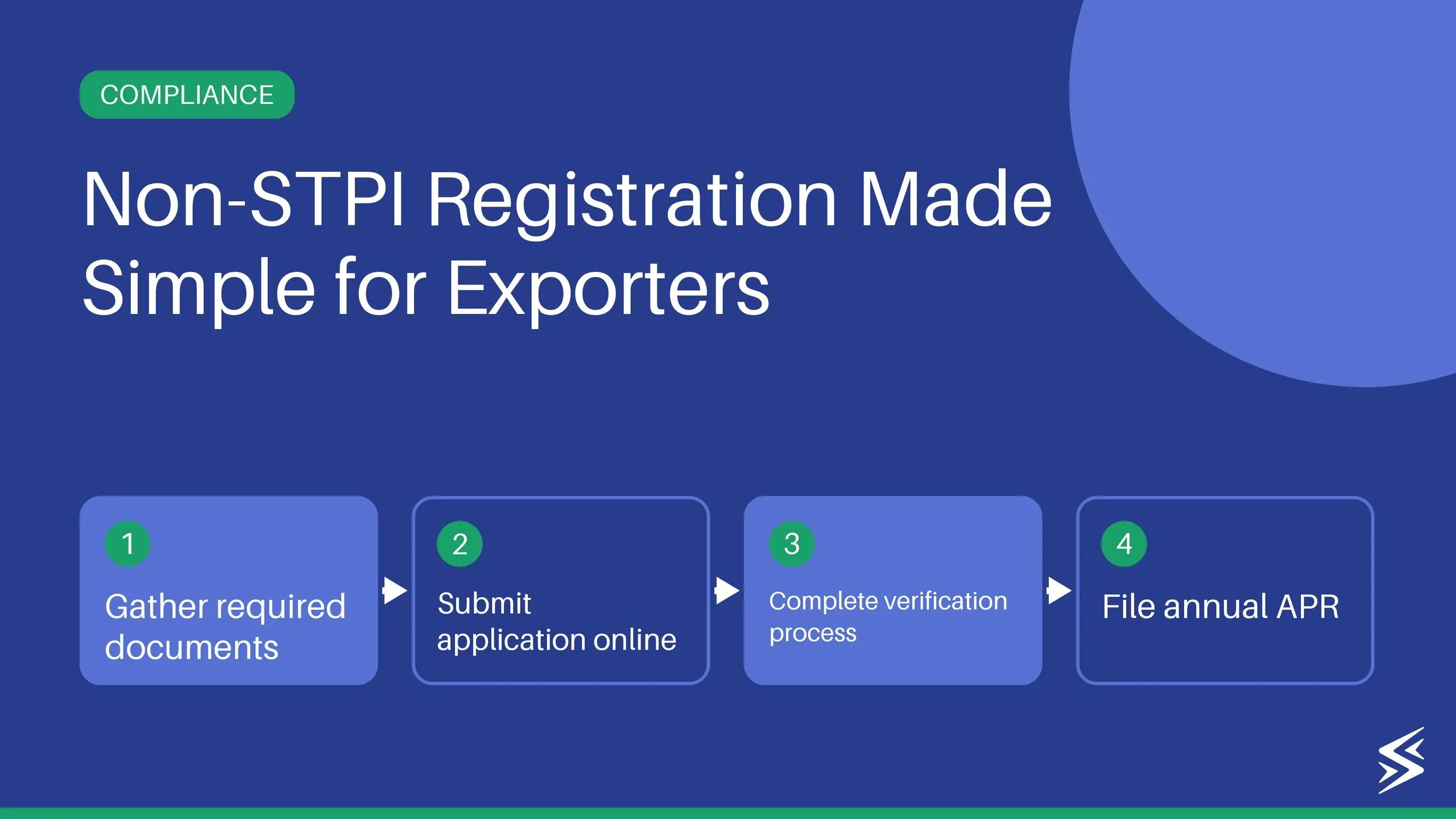
Gather required documents
IEC, certificate of incorporation, export contracts, audited financials, and bank details
Submit to regional STPI office
Fill Form-A online or in person via stpi.in — locate the office in your business jurisdiction
Pay registration fee
₹1,000 + GST via demand draft or NEFT in favour of the Director, STPI
Verification & site inspection
STPI reviews documents and may conduct a physical site visit
~ 10 working daysReceive registration certificate
Use this certificate to file SOFTEX forms for every software export transaction
Valid 3 yearsRenewal must be applied for 3 months before expiry
No charges on renewal
The application process is simple, but it requires careful attention to each step outlined below:
Step 1: Gather Required Documents
Ensure all business, financial, and export documents as stated above are complete and ready.
Step 2: Submit Application to Regional STPI Office
Locate the STPI office in your business jurisdiction through the official website (https://www.stpi.in/). Fill out the Non-STPI application (Form-A) online or in person.
Step 3: Pay Applicable Registration Fees
Pay the required fees during the application process.
Step 4: Await Verification and Site Inspection
STPI may conduct document verification and, in some cases, physical site inspections. Verification usually takes 10 working days from the date of submission of the complete application.
Step 5: Receive Non-STPI Registration Certificate
After your details are verified and approved, STPI issues the Non-STPI registration certificate. You need this certificate to file SOFTEX forms for each software export transaction.
Once the Non-STPI registration is done, managing international payments efficiently becomes crucial. Platforms like Skydo offer virtual accounts in multiple currencies with clear fees and full compliance support. This makes it easier to receive export earnings smoothly.
Maintain digital records of every document you submit. They will be needed for yearly compliance, SOFTEX reporting, and audit purposes.
What Are the Fees for Non-STPI Registration
Businesses applying for Non-STPI registration need to budget for certain required fees during the process.
- One-Time Registration Fee: ₹1,000 + GST, paid at the time of submitting the application via demand draft or NEFT in favour of the Director, STPI.
- Annual Service Charges: Recurring fees for maintaining Non-STPI compliance and eligibility for SOFTEX certification.
- SOFTEX Filing Charges: Slab-based annual fees paid to STPI, determined by the total value of export contracts registered during the financial year. These are not per-transaction fees.
STPI fees change from time to time, so check with your local STPI office before submitting your application.
What is the Validity Period of Non-STPI Registration
Non-STPI registration is valid for 3 years from the date of issue, uniform across all STPI centres, and is renewable based on compliance. Renewal carries no charges. To keep exporting software and filing SOFTEX forms without interruption, enterprises should plan ahead and understand how to renew Non-STPI registration online before the current registration expires.
Exporters must keep up with all compliance requirements during this time by:
- Filing SOFTEX forms on time for each export transaction
- Submitting required quarterly and annual reports to STPI
- Maintaining proper documentation for all export contracts
Timely renewal and regular compliance help businesses avoid disruptions in certification and ensure smooth receipt of foreign earnings.
What are the Post-Registration Compliance Requirements
For Non-STPI exporters, meeting compliance requirements is very important. Missing any obligation may lead to fines or slow down the process of getting paid.
SOFTEX Form Filing
SOFTEX forms are required for software exports and are filed based on invoicing cycles as per RBI and STPI guidelines.
Quarterly and Annual Returns
Non-STPI units must regularly submit performance reports to STPI, including the Quarterly Performance Report (QPR) and annual performance report (APR), to keep track of their export activities.
Payment Realization Reporting
Businesses must report any foreign exchange they receive within the required timelines set by the RBI. This helps ensure proper compliance and smooth tracking of export payments.
To prevent any delays or problems, make sure to meet all reporting and filing deadlines. The table below shows a typical schedule for compliance filings.
What is the Difference Between STPI and Non-STPI Registration
This comparison explains the main differences between STPI registration and Non-STPI registration.
Simplify Your Software Export Payments with Skydo
With Non-STPI registration in hand, exporters need a reliable way to receive money from international clients. Skydo provides a hassle-free way to collect payments, with all charges shown upfront. Setting up an account is fast, letting you receive funds right away.
- Virtual accounts in multiple currencies (USD, EUR, GBP, SGD)
- Transparent, flat-fee pricing
- Free FIRC/BIRCs for compliance documentation
- Quick onboarding for registered software exporters

Get international bank accounts in 5 mins

Save as much as ₹10 lakh annually with Zero FX Margin

Real time payment tracking and instant FIRA
Get international bank accounts in 5 mins
Save as much as ₹10 lakh annually with Zero FX Margin
Real time payment tracking and instant FIRA
Frequently asked questions
Freelancers and small IT service companies can get Non-STPI registration by providing evidence of software exports, such as contracts, invoices, or purchase orders.
About the author

Solution & banking
With a decade of experience at Citi Bank, Prashanth leads payments partnerships and solutions at Skydo.

Verified by
CA Akshay KumarLatest blog posts
View all posts
TCS on Foreign Remittance: Rates, Limits & Refund (2026)

TCS on Inward Remittance: What Actually Applies in 2026
GST Bill Format: Excel, Word, PDF & Export Rules
Related blog posts
View all posts
Liberalised Remittance Scheme: Meaning, Limits, TCS & Rules
IEC Verification Online: Meaning, Statuses, & Ways to Check