SEIS Scheme: Full Form, Benefits & What Replaced It

TL;DR - Summary
- What was the SEIS scheme? - The Service Exports from India Scheme (SEIS) was a government incentive that rewarded eligible service exporters with transferable Duty Credit Scrips worth 3% to 7% of net foreign exchange earnings.
- Is the SEIS scheme still active? - The SEIS scheme is no longer active. The scheme ended after FY 2019-20, and no SEIS benefits have applied since 1 April 2020. The final claim deadline has also passed.
- What replaced the SEIS scheme for service exporters? - No direct one-to-one replacement for the SEIS scheme exists for service exporters. RoDTEP applies to eligible goods exports, while service exporters can use other applicable export support measures.
- Why was the SEIS scheme discontinued? - The SEIS scheme was not continued under the newer foreign trade policy framework, which shifted towards other forms of export support and simpler compliance.
What Was the SEIS Scheme?
SEIS, or the Service Exports from India Scheme, was a government incentive rewarding eligible Indian service exporters. It offered transferable Duty Credit Scrips based on their foreign exchange earnings.
The scheme was launched on 1 April 2015 under the Foreign Trade Policy 2015-2020, replacing an older, narrower programme called the SFSI (Served from India Scheme). SFIS had covered a smaller set of exporters with less flexible terms, and SEIS was designed to widen that coverage considerably across the services sector as a whole.
At its core, the scheme worked on a simple mechanism. Eligible service exporters received Duty Credit Scrips calculated as a percentage, between 3% and 7%, of their net foreign exchange earnings from notified services. The underlying purpose was to reduce the infrastructural inefficiencies and higher operating costs Indian service providers often faced, making their offerings more competitive against international rivals on price.
These scrips carried real and practical value beyond a simple paper credit. They were freely transferable, and an exporter could use them to pay certain central duties and taxes directly, including basic customs duty and additional customs duty on domestic procurement. An exporter with no immediate use for them could sell them in the open market for cash instead. The entire process (from application to scrip issuance), ran electronically through the DGFT online system.
The scheme formally ended after FY 2019-20. DGFT issued a notice on 20 February 2023 confirming that no SEIS benefits had applied to any export activity from 1 April 2020 onward. Exporters with pending claims for services rendered up to FY 2019-20 were still permitted to apply, but that window has since closed as well.
Who Was Eligible for the SEIS Scheme?
Eligible
- Net forex USD 15K (companies) / USD 10K (individuals)
- Active 10-digit IEC and valid RCMC
- Services listed under Appendix 3D
- Delivered via Mode I or Mode II
Not Eligible
- Services outside Appendix 3D
- Mode III or Mode IV delivery
- No active IEC in service period
- Equity, debt, donations, or inter-company transfers
Service exporters had to satisfy several DGFT-prescribed conditions at once to qualify for SEIS benefits, covering earnings thresholds, registration status, and the specific nature of the services rendered.
Who Was Eligible
- A minimum net foreign exchange threshold applied depending on business structure. USD 15,000 annually for companies, LLPs, and partnership firms, and USD 10,000 annually for individual and sole proprietors. This distinction made the scheme accessible even to smaller, independent exporters.
- Net foreign exchange itself followed a specific formula. Gross foreign exchange earnings minus foreign exchange expenses. Only confirmed foreign currency receipts generally counted toward this figure, though certain sectors had additional deemed foreign exchange provisions built in.
- An active, 10-digit Import Export Code was mandatory throughout the entire period the service was rendered, and also at the time of application itself. Without a valid IEC covering that full period, an exporter had no eligibility whatsoever, regardless of how much foreign exchange was actually earned.
- Only services notified under Appendix 3D of the Foreign Trade Policy qualified. These fell into defined categories, i.e., professional services such as legal, accounting, architectural, and engineering work, along with research and development, business services, and communication and audio-visual services. Construction, education, environmental services, and tourism and travel completed the list.
- How the service was actually delivered mattered as much as what the service was. Only Mode I, cross-border supply from India to an overseas client, and Mode II, consumption abroad by a foreign client visiting India, qualified for SEIS. Mode III, delivery through a commercial presence overseas, and Mode IV, an Indian professional physically relocating abroad to deliver the service, did not qualify under either category.
- Exporters also needed a Registration cum Membership Certificate from the relevant Export Promotion Council before a claim could be processed.
Who Was Not Eligible
- Certain foreign exchange inflows never counted toward the net foreign exchange calculation at all, regardless of amount. This included equity or debt participation receipts, donations and grants received from abroad, and loan repayments or inter-company transfers between related entities.
- Services that were not explicitly listed under the notified appendices were excluded entirely. This applied regardless of how much genuine foreign exchange they generated or how similar they seemed to a listed category.
- As noted above, Mode III and Mode IV supply generally did not qualify for a reward under the scheme. This covers delivery through overseas commercial presence or an Indian professional working physically abroad.
- Exporters without an active IEC covering the complete service period were ineligible outright. This applied even where every other condition, including the net foreign exchange threshold, had clearly been met.
How Did the SEIS Scheme Work?
The SEIS Process, End to End
Hover any step for details
Register on DGFT
Active IEC, digital profile, and DSC or Aadhaar e-Sign for authentication.
Calculate Net Forex
Gross forex minus outflows. Must clear USD 15K or USD 10K threshold.
Compile Documents
Invoices, FIRCs, CA-certified statement linking them, and RCMC copy.
Submit ANF-3B
File the form on DGFT portal, pay fees, receive a tracking number.
Scrip Issued
Digital Duty Credit Scrip issued at 3% to 7% of net earnings.
File within 12 months of the financial year end
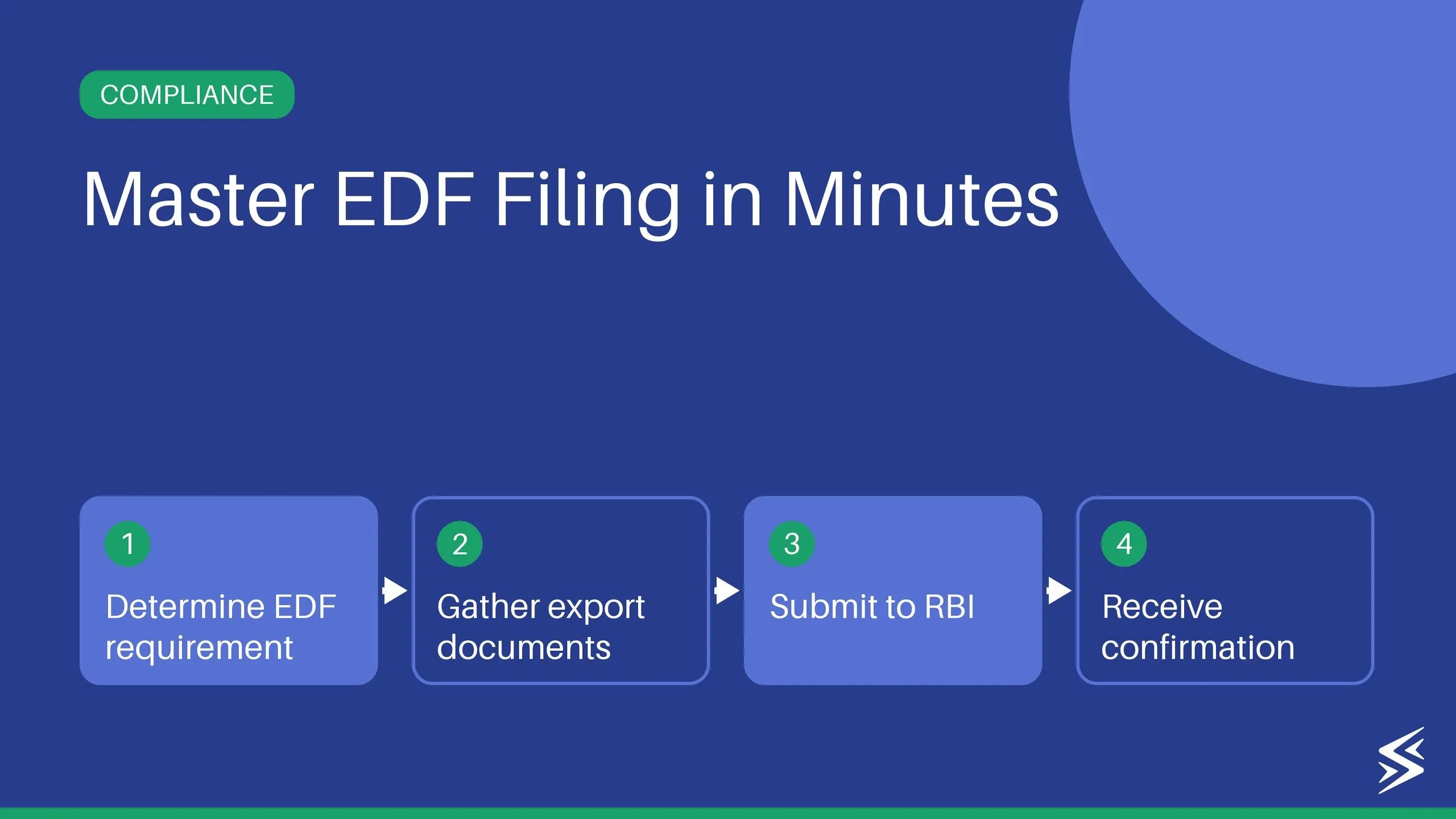
The SEIS process ran end-to-end through the DGFT online portal, moving an eligible exporter from initial registration through to a usable Duty Credit Scrip in five distinct steps.
- Prerequisites and registration: Exporters needed an active 10-digit IEC and a registered digital profile on the DGFT system, along with a Digital Signature Certificate or Aadhaar-based e-Sign for authentication purposes.
- Calculating net foreign exchange earnings: Service providers computed net foreign exchange as gross foreign exchange earnings minus explicit foreign exchange outflows tied directly to the service. The result was checked against the applicable USD 15,000 or USD 10,000 minimum threshold.
- Compiling documentation: Required documents included invoice copies, corresponding FIRCs, and a Chartered Accountant or Company Secretary certified statement showing the link between invoices and FIRCs. A written description of services rendered, self-certified invoice copies, the DGFT digital signature, and an RCMC copy completed the set.
- Submitting the form: Applicants completed ANF-3B, the Aayat Niryat Form, on the DGFT portal, uploaded invoice-wise foreign exchange earnings data, and attached supporting documents. Fees were paid online, and the application was submitted to the jurisdictional Regional Authority, which then generated a tracking number.
- Scrip issuance: Once the DGFT authority processed and verified the application, a digital Duty Credit Scrip was issued at the applicable rate. This ranged between 3% and 7% of net earnings depending on the notified service category. Applications generally had to be filed within 12 months of the relevant financial year ending.
Once issued, a scrip could be used to reduce several specific duties like basic customs duty, additional customs duty, safeguard duty, transitional specific safeguard duty, and anti-dumping duty. It could not, however, be used to set off GST, compensation cess, or education cess. This limited its usefulness for exporters whose import costs were dominated by GST rather than customs duties.
Scrips carried a validity of 24 months from the date of issue. An unused scrip could be transferred to another party if it was approaching expiry. Revalidation through a special DGFT request was possible under exigent circumstances, though this was not guaranteed. Because scrips were freely transferable, an exporter with no import activity of their own could simply sell the scrip in the open market. This converted the benefit directly into cash rather than letting it go unused.
💡 QUICK INSIGHT
Duty Credit Scrips could be sold on the open market rather than only used against an exporter's own duties. This made SEIS a direct cash benefit, not merely a tax offset tool for importers.
What Were the Major Services and Their Rate Benefits Under SEIS?
The Services Exports from India Scheme (SEIS) was introduced under the Foreign Trade Policy 2015-20 to encourage exports of specified services from India. Eligible service providers received Duty Credit Scrips based on their net foreign exchange earnings, with the applicable rate depending on the service category.
For services provided during FY 2019-20, the government notified the eligible categories and rates separately through Appendix 3X. The rates for that year were generally 3% or 5%, rather than the 3% to 7% range seen in some earlier SEIS rate schedules.
| Service category | Examples of eligible services | FY 2019-20 reward rate |
|---|---|---|
| Professional services | Legal, accounting, taxation, architecture, engineering and certain medical services | 5% |
| Research and development | R&D in natural sciences, social sciences and humanities | 5% |
| Other business services | Advertising, market research, personnel placement, scientific and technical consulting, photography, publishing and similar services | 3% |
| Audiovisual services | Film and video production, radio and television services, sound recording | 5% |
| Construction and related engineering | Building construction, civil engineering, installation and finishing work | 5% |
| Educational services | Primary, secondary, higher and adult education, subject to scheme conditions | 5% |
| Environmental services | Sewage, refuse disposal and sanitation services | 5% |
| Tourism and travel-related services | Hotels and restaurants | 3% |
| Tourism and travel-related services | Travel agencies, tour operators and tourist guides | 5% |
The exact eligibility depended on the CPC classification and other SEIS conditions, so a freelancer could not claim a particular rate simply by describing their work as an IT, consulting or professional service. The service had to fall within a notified category.
How Did the SEIS Benefit Work?
The benefit was provided through Duty Credit Scrips, rather than as a direct cash payment. These scrips could be transferred and used for eligible customs duties and other permitted central levies under the rules applicable to the scheme.
For FY 2019-20, the total SEIS entitlement was also capped at ₹5 crore per IEC. The scheme's eligibility requirements included minimum net free foreign exchange earnings, with a lower threshold applicable to individual service providers and sole proprietorships.
Consider an eligible service provider whose notified service attracted a 5% SEIS rate and who earned USD 50,000 in net foreign exchange during FY 2019-20. A 5% rate would produce a Duty Credit Scrip entitlement equivalent to USD 2,500, subject to the scheme's rules and the applicable INR limits.
Note: This example shows how the reward was calculated. It should not be assumed that every freelancer or IT consultant automatically qualified for the 5% rate, since eligibility depended on the specific service classification and other SEIS conditions.
Why Was The SEIS Scheme Discontinued?
The Services Exports from India Scheme (SEIS) was not continued for services from FY 2020-21, although the government subsequently processed benefits for eligible exports made during FY 2019-20. The decision reflected a broader shift away from traditional export subsidies and concerns about how effectively SEIS was supporting India's service exports.
- Limited impact on export growth: In February 2020, then Commerce Minister Piyush Goyal said that SEIS had not contributed positively to increasing service exports. The government was therefore reconsidering whether continuing the incentive was delivering enough value relative to its cost.
- Benefits were concentrated among a relatively small group: Goyal also said that only around 2,200 companies were claiming the SEIS benefit, with many being large and profitable businesses. This raised questions about whether the subsidy was reaching a sufficiently broad base of service exporters.
- A broader move away from export subsidies: The government increasingly favoured measures aimed at improving the underlying competitiveness of Indian businesses rather than relying on recurring incentive schemes. This formed part of the wider reform of India's export-promotion framework.
- WTO-related policy pressure: India's export incentive regime was also under scrutiny at the World Trade Organization (WTO). However, the WTO dispute should be viewed as part of the broader policy backdrop rather than described as the direct reason SEIS was discontinued. The WTO's dispute concerning India's export subsidies specifically covered schemes including MEIS, not SEIS itself.
What Happened to MEIS and SEIS?
The Merchandise Exports from India Scheme (MEIS) for goods was discontinued and replaced by RoDTEP (Remission of Duties and Taxes on Exported Products), which addresses certain embedded duties and taxes on exported goods. SEIS, however, did not receive a directly equivalent replacement scheme for service exporters.
💡 QUICK INSIGHT
MEIS had a successor in RoDTEP for goods exporters. SEIS did not receive an equivalent replacement for service exporters, thereby making the transition different for businesses exporting services.
What Replaced SEIS Scheme for Indian Service Exporters?
There is no direct one-to-one replacement for SEIS for Indian service exporters. SEIS provided Duty Credit Scrips linked to net foreign exchange earnings, but no equivalent percentage-based reward scheme was introduced for services after FY 2019-20.
| Scheme | Who It's For | What It Offers | Replaces SEIS? |
|---|---|---|---|
| RoDTEP | Eligible goods exporters | Remission of specified embedded duties, taxes and levies on eligible exports | No, goods-focused |
| Market Access Initiative (MAI) | Eligible exporters, including service exporters | Support for market research, trade fairs, overseas promotion and branding | No, promotional support only |
| Interest Equalisation Scheme (IES) | Eligible exporters and specified categories | Interest support on eligible pre- and post-shipment export credit | No, financing support only |
| Startup India and sector-specific initiatives | Eligible startups and businesses | Funding, regulatory support, market access and capability-building, depending on the scheme | No, broader business support |
The MAI can support activities such as international trade fairs, market research and overseas promotion, while the Interest Equalisation Scheme helps eligible exporters reduce the cost of export credit. Broader programmes such as Startup India and sector-specific initiatives may also provide business or market support, but none offer the export-linked Duty Credit Scrip that SEIS provided.
For service exporters, the key gap is therefore the absence of a direct reward calculated as a percentage of net foreign exchange earnings. Exporters must instead rely on the schemes for which they independently qualify and manage the costs of international business, including payment and compliance expenses.
How Does Skydo Help Service Exporters Receive International Payments?
With SEIS no longer available for current service exports, exporters cannot rely on a percentage-based duty credit to offset their costs. Managing the cost and administration of international payments therefore becomes even more important.
Skydo helps service exporters receive overseas payments with transparent fees, faster settlement and automated remittance documentation. Skydo offers:
- Transparent payment costs: Skydo uses a flat-fee structure with zero FX margin. Payments up to USD 2,000 cost $19 + GST, payments from USD 2,001 to USD 10,000 cost $29 + GST, and payments above USD 10,000 cost 0.3% + GST.
- Automated FIRA: Skydo automatically generates a free instant FIRA (Foreign Inward Remittance Advice) for international payments, which can be downloaded from the dashboard. This removes the need to follow up separately with a bank for each document.
- Faster settlement: Payments are settled into the Indian bank account in less than 24 hours, while allowing users to track payment status through the platform.
- Local virtual accounts: Skydo currently offers virtual accounts across the US, UK, Canada, Australia and other countries, with setup taking around 5 minutes.
For service exporters receiving international payments, this can reduce the administrative work involved in collecting overseas invoices, tracking settlements and maintaining remittance records.
Who was eligible for the SEIS scheme?
Service exporters located in India with an active IEC were eligible, subject to the scheme's conditions. The minimum net foreign exchange earnings requirement was USD 15,000 for service providers and USD 10,000 for individuals and sole proprietorships. The services also had to fall within the categories notified under Appendix 3D and be supplied through eligible modes, including Mode I and Mode II.
Is the SEIS scheme still active or has it been discontinued?
What is the full form of SEIS?
What scheme replaced SEIS for service exporters in India?
What were SEIS duty credit scrips and how could they be used?
What is the difference between SEIS and MEIS?
What documents were needed to apply for SEIS?
Why is FIRA still important for service exporters even after SEIS ended?