Best Bank for Exporters in India: Key Factors & Options

TL;DR - Summary
- What makes a bank good for export business in India? - A good bank for export business in India supports the operational and compliance needs of cross-border trade, with competitive forex handling, trade finance products, documentation support, and digital access.
- What should exporters compare across banks in India? - Exporters should compare five things across banks: the forex margin, whether the Foreign Inward Remittance Certificate (FIRC) is issued automatically or manually, digital onboarding and turnaround time, access to trade finance products, and minimum balance requirements on export current accounts.
- Which banks are best for exporters in India? - The best banks for exporters in India include HDFC Bank, ICICI Bank, State Bank of India (SBI), Axis Bank, and EXIM Bank, and each suits a different exporter profile.
- Where does a payment aggregator like Skydo fit in when choosing a bank for exporters in India? - Skydo is an RBI-authorized payment aggregator that works alongside your existing bank account, so you can receive international payments in free virtual accounts, settle the converted amount into your Indian bank account, and get an automatic FIRC for every transaction.
What Makes a Bank Good for Export Business in India?
A good bank for export business in India is one that supports the specific operational and compliance needs of cross-border trade. That means competitive forex handling, trade finance products, documentation support, and digital access.
Banks in India fall into three broad categories for exporters:
- Public sector banks: lower fees, slower service
- Private banks: higher fees, better service and digital access
- International banks: most expensive, best global reach
The right choice depends on the nature of your export business. A Bengaluru-based IT services firm invoicing a US client for $5,000/month has very different needs from a Mumbai textile exporter managing letters of credit and physical shipments.
What Should Exporters Actually Compare Across Banks?
Exporters should compare five things across banks: the forex margin charged on conversion, whether the Foreign Inward Remittance Certificate (FIRC) is issued automatically or manually, digital onboarding and turnaround time, access to trade finance products (pre-shipment and post-shipment credit, letters of credit), and the minimum balance required on export current accounts.
- Forex margin: This is the most financially significant factor and the least transparently disclosed. Banks quote an exchange rate but rarely reveal the spread built into it. On a $5,000 payment, a 2% hidden forex margin costs approximately ₹8,300 that never appears as a line item on the invoice or the bank statement.
- FIRC issuance: Speed matters for compliance. If a bank issues FIRC manually and takes 3–5 days per transaction, exporters with high transaction volumes build up a documentation backlog.
- Digital setup time: This affects how quickly you can start receiving payments. Some banks require branch visits, physical documents, and relationship manager (RM) coordination, while others offer fully digital onboarding.
- Trade finance access: This is relevant primarily for goods exporters who need pre-shipment credit or post-shipment working capital. Service exporters and freelancers typically do not need it.
- Minimum balance requirements: These vary by bank on export current accounts and can lock up working capital, which is relevant for small and mid-size exporters.

Which Banks Are Best for Exporters in India?
The best banks for exporters in India include HDFC Bank, ICICI Bank, State Bank of India (SBI), Axis Bank, EXIM Bank, and Yes Bank, and each suits a different exporter profile.
- HDFC Bank: Competitive forex rates and straightforward Exchange Earners' Foreign Currency (EEFC) account setup make it a strong choice for mid-to-large export businesses managing regular foreign currency receipts.
- ICICI Bank: It has a broad suite of trade services, including letters of credit and custom forex solutions, plus a dedicated relationship manager. It suits exporters who need personalized support and a strong international banking network.
- State Bank of India (SBI): India's largest public sector bank has an extensive branch network and lower fees. It provides specialized forex services and is accessible even in non-metro locations, which makes it a cost-effective option for exporters who prioritize reach over digital convenience.
- Axis Bank: It positions itself on modern, tech-forward banking, with financing options for import-export and user-friendly online banking. It suits exporters who prefer managing transactions digitally.
- EXIM Bank: A dedicated trade finance institution focused on businesses engaged in international trade, with lower forex margins that are particularly beneficial for large-value transactions. It is not a retail bank and is not used for day-to-day banking. Exporters use it for trade finance.
- Yes Bank: It is tailored for SMEs, with competitive charges and customized trade solutions. It fits smaller export businesses that want flexibility without the overhead of large private banks.
The table compares HDFC, ICICI, SBI, Axis, and IndusInd on the five criteria that matter to exporters, with Skydo as a complementary layer.
| Bank | Forex Margin | FIRC Issuance | Digital Setup | Trade Finance | Min Balance |
|---|---|---|---|---|---|
| HDFC | Competitive forex rates | Not specified | Not specified | Pre- and post-shipment credit | Not specified |
| ICICI | Not specified | Not specified | Not specified | Letters of credit; pre- and post-shipment credit | Not specified |
| SBI | Not specified | Not specified | Not specified | Pre- and post-shipment credit | Not specified |
| Axis | Not specified | Not specified | Not specified | Financing options for import-export | Not specified |
| IndusInd | Not specified | Not specified | Not specified | Not specified | Not specified |
| Skydo (complementary layer) | $19 under $2,000; $29 for $2,000–$10,000; 0.3% above $10,000 | Automatic for every transaction | 10–15 minutes, fully digital | Not specified | Not specified |
✅ PRO TIP
You don't have to switch banks. Use Skydo to receive and convert international payments at a flat fee, and keep your existing current account for local operations.
What Is an EEFC Account and Do Exporters Need One?
An EEFC account is a special non-interest-bearing current account, held in foreign currency with an Authorised Dealer (AD Category-I) bank in India. It lets resident foreign exchange earners keep up to 100% of their overseas earnings in the original foreign currency without immediate conversion to Indian Rupees (INR). Exporters don't need one, because the Reserve Bank of India (RBI) does not legally require them to open or maintain an EEFC account.
Do Exporters Need One?
- Not mandatory: The RBI does not legally require exporters to open or maintain an EEFC account.
- Optional and situational: You benefit from an EEFC account only if you regularly incur business expenses, pay overseas vendors, or service trade-related loans in foreign currencies.
How Do FIRC and eBRC Work, and Why Do They Matter for Indian Exporters?
FIRC is a document issued by a bank or authorized payment aggregator that confirms a foreign payment has been received in India, and it serves as proof of export proceeds. The Electronic Bank Realisation Certificate (eBRC) is a DGFT-mandated document that confirms export proceeds have been realized. FIRC is required for GST refund claims and general compliance, and eBRC is required for claiming export incentives and closing shipping bills.
Both documents are generated per transaction. They become a compliance burden when issued manually, especially if you have multiple monthly receipts.
If a bank takes 3–5 days to issue FIRC and you have 10+ transactions per month, that creates a running backlog of unresolved compliance documents.
The practical workflow for eBRC has three steps:
- You link your DGFT account.
- You upload your shipping bills.
- The system maps incoming remittances (IRMs) to the correct shipments.
Skydo automates this as a one-time setup followed by bulk upload.
How Does Skydo Fill the Gaps Banks Leave for Exporters in India?
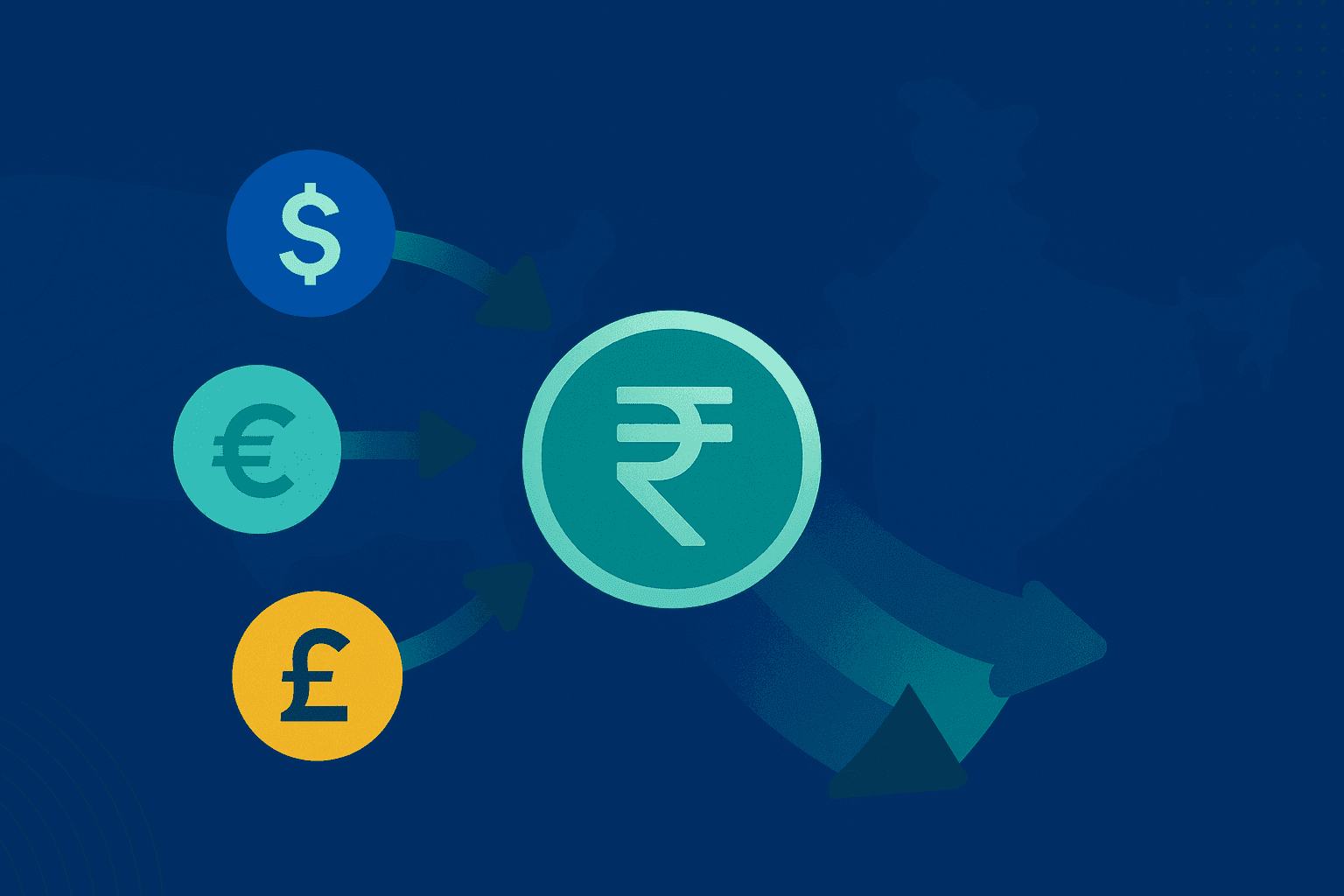
Banks charge forex margins that can reach up to 8% on international receipts, including hidden spread and transaction fees. Some banks also issue FIRC only on request, which leaves exporters with a compliance backlog. Skydo fills those gaps with flat-fee forex receipt, automatic FIRC for every transaction, and fully digital onboarding, without requiring you to replace your existing bank account.
Skydo's fee is $19 for payments under $2,000, $29 for payments of $2,000–$10,000, and 0.3% for payments above $10,000. There is no percentage-based forex markup.
- Digital setup: Setup takes 10–15 minutes and is fully digital. There are no RM calls, no branch visits, and no SWIFT copy chasing.
- Automatic FIRC: FIRC is issued automatically for every transaction, with no manual request needed. This directly addresses the compliance backlog exporters face with banks that issue FIRC on request.
- eBRC in one click: DGFT account linking is a one-time activity. After that, you can bulk-upload shipping bills, and IRMs are auto-mapped to generate eBRC in one click.
Which bank in India is best for a small or mid-size service exporter?
For small to mid-size service exporters, private banks like HDFC or ICICI offer digital convenience and trade services, while SBI is a lower-cost option with wider reach. The right fit depends on whether you prioritize digital access or branch proximity. If your payment receipt needs are straightforward, you can also layer a payment aggregator like Skydo on top of any bank account to handle forex receipt and FIRC without switching banks.
Do freelancers exporting services need a current account or will a savings account work?
Are RBI-authorized payment aggregators a safe alternative to receiving payments through a bank?
What Export Finance Options Do Banks Offer?