Cross Border Ecommerce: How Indian Sellers Get Paid

TL;DR - Summary
- What is cross-border ecommerce? - It means selling goods or services online to buyers in another country. A store or company abroad is not always needed, but local registration and tax rules can still apply.
- How big is the cross-border ecommerce opportunity? - CBIC reported ₹3,510 crore in ecommerce exports through India’s courier channel in FY2022–23. This is a courier-only figure, not a total for all Indian cross-border ecommerce exports.
- How do Indian sellers get paid in cross-border ecommerce? - Buyers pay through banks, payment providers or marketplaces. Funds reach the seller through a permitted channel, with bank or provider records to document the export receipt.
- What are the key challenges of cross-border ecommerce? - Regulations, shipping, currency conversion and payment collection. Compare the full cost, settlement terms and remittance documents before choosing a provider such as Skydo.
What Is Cross-Border Ecommerce?
Cross-border ecommerce means selling goods or services online to buyers in another country. You may not need a physical store or company abroad, but your product, fulfilment model and destination can create local registration or tax duties.
For Indian sellers, including exporters, freelancers and agencies, it can mean reaching foreign customers without setting up a company abroad. The payment currency and conversion route depend on the platform and provider.
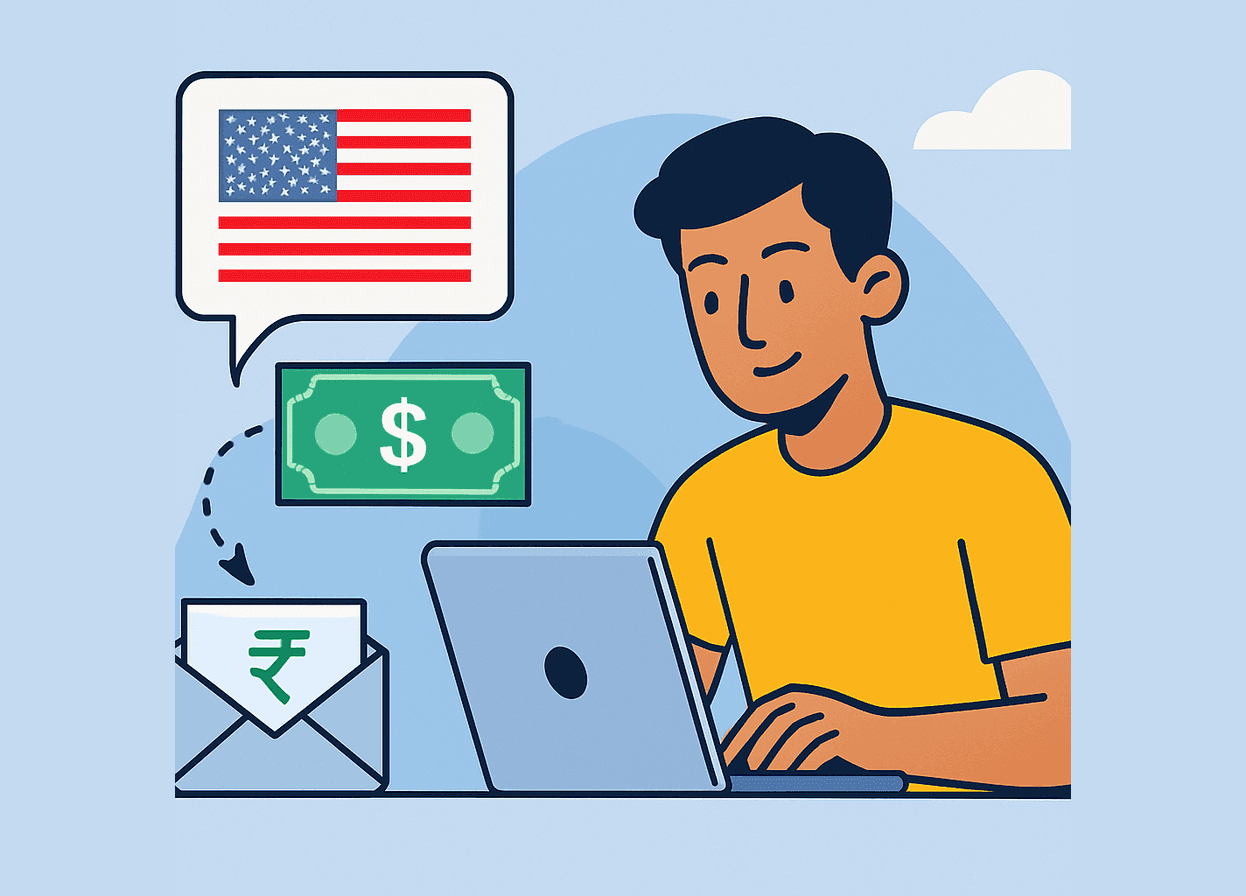
Say a Bengaluru handicrafts seller lists products on an international marketplace. A buyer in Germany places an order and pays in EUR. The seller ships from India and receives payment in their Indian bank account.
How Big Is the Cross-Border Ecommerce Market in India?
CBIC reported ₹3,510 crore in ecommerce exports through India’s courier channel in FY2022–23. This measures only the courier channel, not all cross-border ecommerce exports. Check demand and landed costs for your own product and destination.
Tracking India's export growth figures from DGFT and RBI annual reports gives you a benchmark for which product categories are growing fastest internationally.
What Are the Types of Cross-Border Ecommerce?
Cross-border ecommerce operates across three models: B2B, where a business sells to a foreign business, B2C, where a business sells directly to a foreign consumer, and C2C, where an individual sells to an individual, often via marketplace platforms.
B2C includes selling on Amazon.com, Etsy or a Shopify store to foreign consumers. B2B includes online sales of goods or services to foreign companies. These models do not always require a local store, but destination-country rules still apply.
The table below compares B2B and B2C cross-border payments by buyer, payment method, documents and settlement timing. Actual requirements depend on what you sell and the channel you use.
| Dimension | B2B | B2C |
|---|---|---|
| Who is the buyer? | Foreign business/company | Individual foreign consumer |
| Typical payment method | Wire transfer / invoice-based | Card, PayPal, marketplace payout |
| Key documents needed | Invoice; shipping bill or applicable declaration for goods; receipt evidence as required | Invoice; shipping bill or applicable declaration for goods; receipt evidence as required |
| Average settlement time | Depends on bank, checks, currency and route | Depends on payout schedule, reserves and bank processing |
There's no single fee percentage that applies to every seller. The actual cost depends on the platform, payment method, currency conversion and applicable taxes. Sellers should compare the final INR amount they receive after all fees and deductions, rather than looking at one charge in isolation.

How Does Cross-Border Ecommerce Work for Indian Sellers?
For an Indian seller, the process starts with an online order or service agreement. The buyer pays through the chosen bank, payment provider or marketplace. The funds are processed and, where needed, converted to INR before credit to the seller’s Indian bank account. Keep the invoice and receipt records.
Costs and delays can arise at each step: marketplace payout schedules, transfer charges, exchange-rate margins and document checks. Match the payment records to your invoices and export declarations.
- You list your product or service on a platform: Amazon, Shopify or a direct invoice.
- The foreign customer pays in USD, EUR or GBP.
- The payment reaches your bank, payment provider or marketplace balance. A virtual account is one possible route, not a required step.
- Where conversion is needed, the bank or processor converts the funds at its quoted rate. Compare this rate and any separate fees before accepting it.
- Funds reach your Indian bank account after the provider’s payout process, bank checks and any required conversion. Timing varies by route.
- Download the bank or provider’s remittance advice or certificate, and match it to the invoice. The document name and issue process vary.
Receive export payments through permitted banking or payment channels and meet FEMA reporting requirements. Check that your provider is authorized for the service and transaction type you need.
Your payment channel supplies remittance records. For GST refunds on exported services, retain the relevant BRC or FIRC, as applicable. Ordinary goods-export refunds use invoices and shipping-bill details; you must still track realisation of the proceeds.
Skydo helps you receive cross-border payments with published standard fees of $19 up to $2,000, $29 from $2,001 to $10,000, and 0.3% above $10,000, plus 18% GST on the fee. Amazon pricing differs. Skydo provides free automatic FIRA; its terms target T+1 to T+3 business days after its screening and compliance checks, subject to the route and other institutions’ processing.
✅ PRO TIP
Before choosing a payment channel, check which remittance document it provides, when it becomes available and whether it meets your bank and refund requirements.
What Are the Benefits of Cross-Border Ecommerce?
Cross-border ecommerce can widen your customer base, open markets with stronger demand, diversify seasonal sales and build international visibility. Foreign-currency revenue may increase INR receipts when the rupee weakens, but exchange rates, fees and overseas costs can also reduce margins.
- Untapped demand: Reaching an international market lets you sell where domestic demand may be low or seasonal. For example, a seller with strong domestic competition can find untapped demand abroad.
- Brand visibility: A global presence increases brand visibility and can position you as an industry leader, which in turn attracts more customers and business partners.
- Operational efficiency: Exposure to international competition can push sellers to become more operationally efficient, which benefits the business overall.
- Foreign-currency revenue: A weaker rupee can increase the INR value of USD, EUR or GBP receipts. A stronger rupee can reduce it. Foreign-currency earnings are not a guaranteed margin boost or a complete hedge.
Which Platforms and Channels Support Cross-Border Ecommerce?
The main platforms and channels for cross-border ecommerce are global marketplaces (Amazon Global Selling, Etsy, eBay), self-hosted storefronts (Shopify with international shipping enabled), and direct B2B channels (invoicing foreign clients via email with a payment link or bank transfer instruction).
- Amazon Global Selling: This is Amazon's dedicated program that lets Indian sellers list products on Amazon's international marketplaces (US, UK, UAE, etc.) and reach foreign consumers without building their own storefront.
- Shopify: Indian sellers can build an international storefront and connect payment gateways. Foreign-currency display does not guarantee checkout in that currency. Shopify Payments is not currently available in India; check your provider’s checkout currencies.
- Direct invoicing: For services exporters and freelancers, the platform is often a simple invoice sent to a foreign client. In this case, the payment channel (how the money moves) is the more critical decision.
Each platform has its own payout cycle and currency conversion method. These directly affect how much you net after fees and forex conversion.
Amazon requires an accepted bank account or a provider in its Payment Service Provider Program. For Indian Etsy sellers, Etsy Payments requires a linked Payoneer account. A generic USD virtual account is not a substitute for platform eligibility.
💡 QUICK INSIGHT
Your selling platform and payment channel affect different costs. Check which payout providers the platform accepts before comparing fees and exchange rates.
How to Set Up Your Ecommerce Business for International Sales
To set up your ecommerce business for international sales, start with market research, expand into one foreign market at a time, research the target market's trade and consumer protection laws, and then build your operations: a selling platform, international shipping or digital delivery, and an RBI-authorized payment channel to receive foreign currency.
- Market research: Check demand, competitors, pricing and local expectations. Country Commercial Guides from the International Trade Administration can help you understand market conditions.
- One market at a time: Expand into one foreign market at a time instead of trying to go global immediately. This allows for accurate market understanding and improves the chance of success.
- Local laws: Research international trade and consumer protection laws for the target market, as non-compliance can result in significant revenue losses through penalties.
- Operational setup: Set up the infrastructure in sequence: choose a selling platform (marketplace or own storefront), configure international shipping or digital delivery, and set up an RBI-authorized payment channel to receive foreign currency.
How to Price Products for International Customers
To price products for international customers, research competitors, check which display and checkout currencies your platform supports, and calculate landed cost. Include platform charges, delivery, returns, duties, taxes and currency conversion.
- Competitor pricing: Local competitors and their pricing are part of your market research before you enter.
- Landed cost: Check duties and taxes for each product and destination, along with delivery and return costs. Low-value exemptions differ by country, product and date; a low-priced order is not automatically duty-free.
- Forex spread: Compare the quoted conversion rate with a same-time market benchmark. Include any separate conversion or payment fee when calculating what you will receive.
How to Manage Currency Conversion and Exchange Rates in Cross-Border Ecommerce
Currency conversion may happen when a buyer pays, when a marketplace pays out or when your provider settles the funds. The exchange rate and any conversion fee determine the INR received.
Some providers publish conversion charges; others include a margin in the exchange rate. Compare the full quote rather than assuming a standard 3–8% spread.
A marketplace may convert the payout currency before sending funds. Check whether your receiving provider will convert again, and compare the total cost.
⚠️ COMMON MISCONCEPTION
PayPal cannot provide remittance evidence. In fact, it offers free weekly digital FIRA reports. Its published standard international commercial receipt fee is 4.40% plus a fixed fee; received-balance conversion adds 3% above its base rate. Check the full quote and document requirements.
What Are the Customs Duties and Taxes on Cross-Border Ecommerce?
Customs duties and taxes on cross-border ecommerce vary by destination country and product type. The importing country applies its own import duty rates, and these can significantly affect the landed cost for the foreign buyer or erode your margin if you absorb them.
- GST on exports: Qualifying exports are zero-rated for GST. Registered exporters can use an LUT or bond without paying IGST and claim eligible input-tax-credit refunds. The paid-IGST refund route is subject to notified conditions. Services refunds require the relevant BRC or FIRC; goods use different documentation.
- De minimis thresholds: Do not assume low-value orders are duty-free. The US has suspended the $800 commercial de minimis exemption. In the EU, a temporary €3 duty per tariff category in a low-value parcel applies from 1 July 2026, plus a separate €2 handling fee per item from 1 November 2026. VAT is separate.
- Local regulations: Intellectual property laws, consumer protection laws and product-specific regulations differ by country. Certain products are prohibited or subject to special requirements in specific markets, and failing to comply can result in fines and penalties.
- Landed cost: Extra levies or customs duties not anticipated at the time of pricing can turn a profitable transaction into a loss. Build a landed-cost calculation before entering a new market.
How to Manage International Shipping and Fulfilment
To manage international shipping and fulfilment, configure international shipping or digital delivery for your platform, then balance delivery speed against cost, since customers expect fast delivery.
- Carrier rates: High-volume sellers can negotiate rates with carriers.
- Packaging: Efficient packaging reduces per-unit cost.
- Unforeseen costs: Foreign countries have different import, export and taxation laws that can add unforeseen costs.
What Are the Key Challenges of Cross-Border Ecommerce?
The key challenges are meeting destination-market rules, managing shipping and returns, controlling currency conversion costs, and keeping payment and export records complete.
- International regulations: Intellectual property laws, tax regulations and consumer protection laws differ by market. Products that are allowed in India may be prohibited or restricted in the destination country. Non-compliance leads to fines, penalties and revenue loss.
- Shipping: Foreign countries have different import, export and taxation laws that can add unforeseen costs. Customers expect fast delivery, so balancing speed against cost is a persistent operational challenge.
- Payment collection: Use a permitted channel and check its documents, payout conditions and reconciliation tools. The cost of payment collection versus logistics depends on your business.
- Hidden forex fees: An exchange-rate margin can reduce the amount received even when the advertised transfer fee is low. Compare the final INR quote and all separate charges.
⚠️ WATCH OUT
Check that a payment provider is authorized for your transaction type. Using a non-compliant route can create FEMA and documentation problems; authorization alone does not replace your export and tax obligations.
How Do Indian Cross-Border Ecommerce Sellers Get Paid Internationally?
Indian sellers receive export payments through banks, marketplace payouts and RBI-authorized payment aggregators. A virtual account can provide local receiving details for a supported currency; it is not necessarily a bank account owned by the seller or a balance the seller may hold indefinitely.
- Direct bank wire: The buyer instructs a bank transfer to your Indian bank. Charges, intermediary deductions, receipt documents and processing time depend on the banks and route.
- Virtual account: A provider supplies receiving details for supported payments, then processes the funds for settlement. Check its fees, remittance document and settlement terms.
- FIRC: A Foreign Inward Remittance Certificate records an inward payment. For GST refunds on exported services, keep the relevant BRC or FIRC, as applicable, matched to invoices. A FIRC is not a universal condition for zero-rating or ordinary goods-export refunds.
- FEMA: Use a permitted payment channel and meet export reporting rules. Normally, realise and repatriate proceeds within nine months of goods shipment or the service invoice date. INR-invoiced or INR-settled exports have 12 months; permitted extensions and special cases apply.
- Valid export remittance: A foreign payment alone does not establish that a sale qualifies as an export for tax purposes. Keep the invoice, relevant export declaration and receipt evidence, and meet the conditions that apply to goods or services.
- Settlement timelines: Bank transfers and provider payouts depend on the route, cut-offs, holidays and compliance checks. Marketplace payout schedules and reserves can add time before the payment is sent to your bank or provider.
- Currency conversion: Check when conversion takes place, the rate applied and all separate charges. Compare the final INR amount for the same payment amount and conversion time.
💡 QUICK INSIGHT
A SWIFT payment may attract correspondent-bank charges. Ask who bears the sending, receiving and intermediary fees before agreeing the invoice amount.
How Does Skydo Help With Cross-Border Ecommerce Payments?
Once the product, platform, logistics and pricing are ready, choose how you will collect payment. Skydo is one option for supported export receipts; compare its terms with the alternatives for your transaction size and route.
Skydo supports eligible export receipts, including Amazon Global Selling payouts, through local receiving details in USD, EUR, GBP, AED, SGD, AUD and CAD. Its payment service is not a traditional foreign bank account. Check marketplace and currency eligibility before sharing the details.
- How you get paid: An eligible buyer or marketplace pays into your Skydo receiving details. Skydo processes the payment and settles it to your Indian bank account. Its terms target T+1 to T+3 business days after screening and compliance clearance, depending on currency, route and other institutions’ checks and processing.
- Free FIRA: Skydo provides a free automatic Foreign Inward Remittance Advice for each payment. It helps match payments to invoices; confirm which bank certificate your refund or compliance process requires. It does not guarantee that every GST refund document is complete.
- Transparent pricing: Standard published fees are $19 up to $2,000, $29 from $2,001 to $10,000, and 0.3% above $10,000, plus 18% GST on the fee. Amazon Global Selling has separate pricing. There are no monthly fees; check your transaction quote and any route-specific charges.
- Setup and support: Onboarding is digital, with account use subject to verification. Skydo offers India-based support via WhatsApp, phone and email. A quick application does not guarantee approval or payment settlement within a fixed time.
- Export compliance help: Skydo offers eBRC generation assistance, including DGFT linking, bulk shipping-bill upload and IRM matching. It also supports EDPMS closure work with remittance records and reconciliation assistance. Your authorized dealer bank remains responsible for updating or closing EDPMS entries.
Is cross-border ecommerce legal for individual freelancers and small sellers in India?
Yes, individuals and small businesses can sell permitted goods or services internationally. Use a permitted payment channel and meet the registration, tax, customs and FEMA requirements that apply to your activity.
What documents does an Indian seller need for cross-border ecommerce?
What is a FIRC and why do Indian exporters need it?
Can Indian sellers receive payment in USD without converting immediately?
What is the difference between FIRC and eBRC?
Which selling platforms are best for Indian sellers going cross-border?
How long does it take for an Indian seller to receive international payment?
What hidden costs should Indian cross-border sellers watch out for?