B2B Embedded Payments: How They Work & What to Know

TL;DR - Summary
- What are B2B embedded payments? - B2B embedded payments are payment processing capabilities built directly into a business platform, such as a procurement tool, ERP, or SaaS product, so one business can pay another without leaving that platform.
- How do B2B embedded payments actually work? - APIs connect payment initiation and status data to business software. Banks or providers move the funds; approval and reconciliation can share the workflow.
- What changes with B2B embedded payments compared to traditional B2B payment flows? - Fewer manual handoffs between software and payment systems. Fees and speed still depend on the provider and route.
- What do Indian exporters need to know about receiving B2B embedded payments? - Confirm a supported export-receipt route, provide purpose-code information and keep remittance evidence. An embedded interface does not replace Indian compliance requirements.
What Are B2B Embedded Payments?
B2B embedded payments are payment capabilities built into procurement tools, ERPs or SaaS products. One business can initiate payment to another within its usual workflow, though authentication may still involve an external bank or provider.
For Indian exporters, this can happen when a foreign client initiates a cross-border payment inside procurement or accounts payable software. A bank or payment provider handles the transfer.
For example, a US SaaS company could approve a Bengaluru agency’s invoice in its procurement platform. If configured, approval may trigger payment. It does not mean the agency has received the funds.
💡 QUICK INSIGHT
If your client initiates payment within an ERP or procurement tool, it may be using an embedded payment feature. The underlying provider and financial institutions still handle the transfer.
How Do B2B Embedded Payments Actually Work?
B2B embedded payments connect payment APIs to business software. Approval, initiation, status updates and reconciliation can share one workflow, while banks or providers handle the transfer.
A typical digital B2B payment flow has six steps:
- A business places an order or approves a deliverable.
- The supplier issues an invoice with the agreed payment terms.
- The buyer authorises payment within the platform, using a supported method such as bank transfer or corporate card.
- The provider performs the checks needed for the chosen method, including authorisation, risk checks and funds or credit checks where relevant.
- The underlying payment system transfers funds to the supplier or its payment account.
- Payment data is matched to the invoice automatically or reviewed by the supplier’s finance team.
Embedded systems can automate parts of steps 3–6, reducing data entry and matching errors. B2B workflows may involve credit terms and approval chains. Neither consumer nor business payments are always immediate.
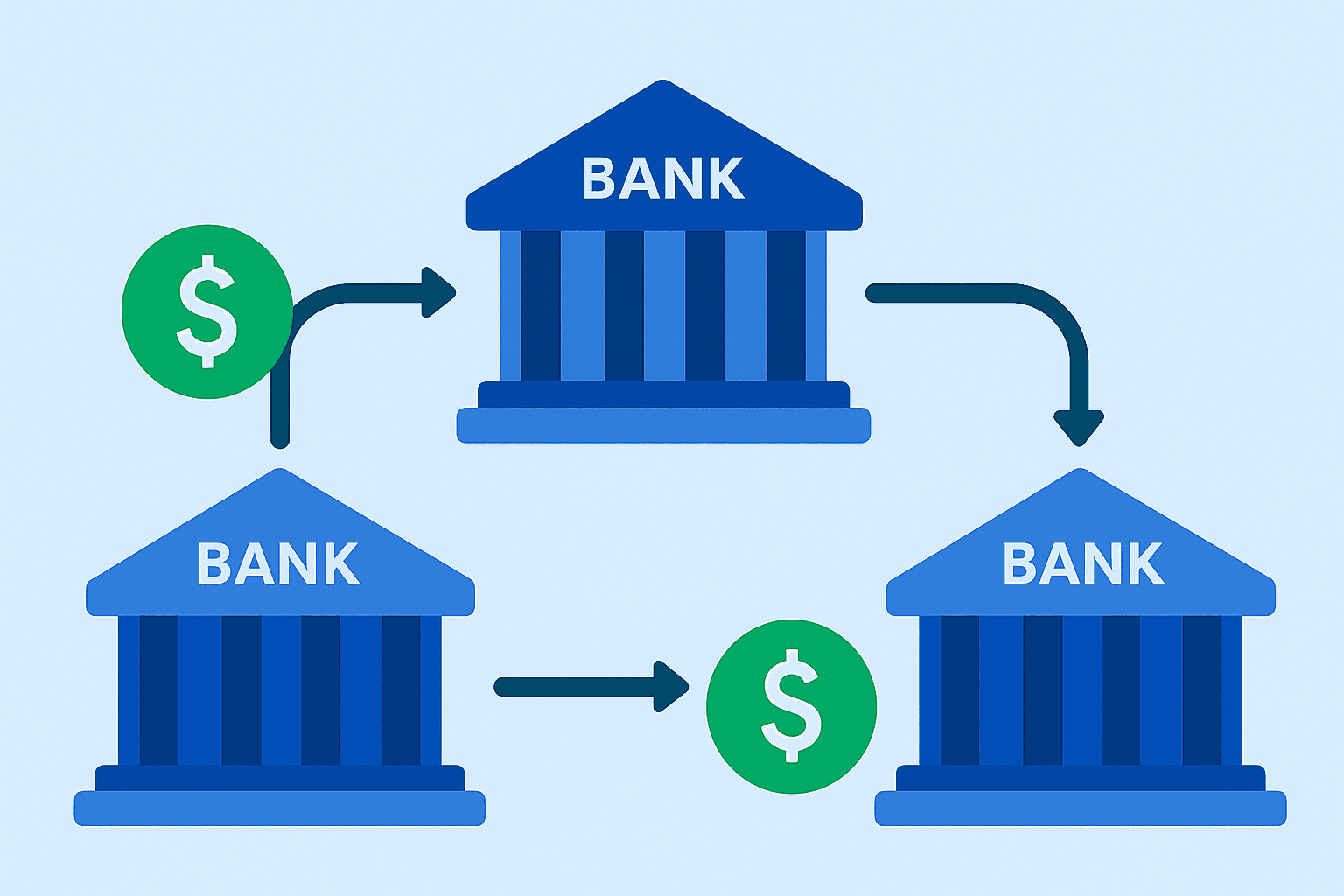
For cross-border B2B payments, providers may use correspondent banking, local collection networks or other permitted arrangements. SWIFT carries messages, not money. Intermediary banks, currency conversion and timing depend on the route.
Consider an illustrative $5,000 invoice from a Bengaluru UX agency to a US SaaS client. If the client's procurement platform is configured for automatic payment after approval, it may instruct the buyer's bank or provider to send the funds.
On a SWIFT-based route, banks exchange instructions and settle through their accounts, sometimes using correspondent banks. Fees and arrival time depend on the route, cut-offs and checks. A platform status of paid is not proof of credit to your account.
Businesses should understand that a payment marked as initiated or completed on a platform does not necessarily mean the funds have reached the supplier. The underlying banking route, intermediary processing and compliance checks determine when the money is actually credited. Finance teams should always reconcile platform updates with their bank statements.


Traditional vs. Embedded B2B Payment Flow: What Changes?
Embedded payments connect initiation and status data with approval and reconciliation. This reduces manual handoffs, but does not guarantee lower fees or faster settlement.
| Dimension | Traditional B2B Payment Flow | Embedded B2B Payment Flow |
|---|---|---|
| Steps involved | Buyer approves invoice → opens banking portal → initiates transfer → shares payment reference | Invoice approval can trigger payment initiation, depending on configuration |
| Fee visibility | Sender, intermediary, receiving-bank and FX charges depend on the route | Provider may quote platform fees upfront; external and FX charges can still apply |
| Settlement time | Varies by bank, corridor, cut-offs and checks | May reduce initiation delays; settlement depends on the underlying rails |
| Documentation burden | Payment references and remittance evidence may need separate retrieval | Payment data may flow automatically; export documentation still needs checking |
| Reconciliation effort | Manual matching unless bank feeds or accounting integrations are enabled | Can automate invoice matching when the required reference data is available |
Traditional workflows may involve paper checks, ACH, and manual bank transfers, with payment records entered separately into accounting software. Embedded workflows can reduce that work. Faster cash collection is not the same as earlier revenue recognition, which follows the applicable accounting rules.
For Indian exporters, a platform may pass payment references automatically. You still need remittance evidence and must supply the purpose-code and export information your receiving provider requires.
✅ PRO TIP
When a client pays via an embedded platform, ask for the unique transaction reference. This can make reconciliation on your end easier.
What Are the Benefits of B2B Embedded Payments?
B2B embedded payments can reduce manual work, improve cash-flow visibility and connect payment controls to business software. Results depend on the integration and route.
- Faster payments and better cash flow: Automated instructions can reduce administrative delays. Actual receipt time still depends on the payment route.
- Reduced reconciliation effort: References and invoice data can enable automatic matching. Partial payments, deductions and missing references may need review.
- Improved compliance and security: Approval rules, access controls and records support checks. They do not remove fraud risk or replace each business’s obligations.
- Integration with existing systems: Payment APIs can connect with ERP, accounting and other business software, depending on the platform and available integrations.
- Cash flow for Indian service exporters: If an invoice is paid and settled sooner, working capital becomes available earlier. Embedding payments alone does not guarantee a particular number of days saved.
- Sectors with complex invoicing: Logistics, manufacturing and professional services businesses can use integrated payment data to reduce manual follow-up and improve visibility into collections.
Skydo offers local collection details in seven currencies, published fees and free automated FIRA. Confirm the payer, platform, currency and route are supported before sharing account details.
⚠️ COMMON MISCONCEPTION
An instant payment instruction does not mean instant receipt in India. The underlying route, bank processing and compliance checks still determine when funds become available.
What Do Indian Exporters Need to Know About B2B Embedded Payments?
Check the receiving route, remittance evidence and purpose-code information. A foreign platform may use an India-side partner, but its interface alone does not prove your export-reporting requirements are met.
- Remittance evidence: Keep your invoice, settlement record and available advice or certificate. FIRA (Foreign Inward Remittance Advice) differs from a bank-issued FIRC. Ask which records your transaction requires; a separate FIRC is not mandatory for every receipt.
- Purpose codes: These classify inward remittances, such as software or consulting receipts. Provide accurate invoice and purpose information to your receiving provider. Ask whether the buyer must include the code in its instructions.
- Non-SWIFT routes: Payments can be valid through permitted banking or authorised payment-aggregator arrangements. Check the provider’s authorisation, receiving route and export-reporting support. PA-CB transactions have a ₹25 lakh per-transaction limit; an embedded software interface alone is not a PA-CB.
- EDPMS reporting: Give your authorised dealer bank the records needed to match receipts to shipping bills or service-export records and update applicable EDPMS entries. PA-CBs must supply supporting information for closure where applicable.
✅ PRO TIP
Share the exact receiving details and supported payment method with your client. Give your receiving provider the invoice and correct purpose code, and check any required buyer instructions before payment.
Which B2B Embedded Payment Platforms Are Commonly Used?
Several providers offer embedded payment infrastructure for marketplaces, SaaS businesses and other B2B platforms. Their capabilities vary depending on the business model and markets served.
- Stripe Connect: Supports payment acceptance, seller onboarding, split payments and payouts for marketplaces and SaaS platforms.
- Adyen for Platforms: Offers payment processing, user onboarding, fund allocation, payouts and reporting through a single integration.
- Worldpay for Platforms: Provides embedded payment processing, merchant management and payment solutions for software businesses.
- Finix: Offers payment processing, merchant onboarding, payout management, risk controls and reporting for platforms that want to manage their payment infrastructure.
- Mangopay: Provides marketplace payment infrastructure, including digital wallets and multi-party fund flows for businesses managing payments between buyers and sellers.
These platforms primarily support businesses embedding payment functionality into their own products. Availability, onboarding requirements and payout capabilities vary by provider and market.
For Indian businesses, using an embedded payment platform does not necessarily mean it supports cross-border supplier payments to India. Confirm the supported payment route, receiving method and documentation requirements before choosing a provider.
For more on receiving international payments in India, see India-specific payment infrastructure and options.
How Does Skydo Help You Receive B2B Embedded Payments From Abroad?
Skydo helps eligible businesses and freelancers receive international B2B payments. A client may use its embedded platform if it supports Skydo’s collection details. Confirm the payer, currency and route before sending.
- Local collection details in seven currencies: Skydo lists USD, EUR, GBP, SGD, AUD, CAD and AED. Eligible local payments avoid SWIFT. Follow the exact account and payment instructions for your route.
- Published transaction fees: Skydo lists $19 up to $2,000, $29 for $2,001–$10,000, and 0.3% above $10,000, plus 18% GST on the fee. Amazon Global Selling pricing differs. Sender or intermediary charges may apply on SWIFT routes; confirm the full quote before payment.
- Free automated FIRA: Skydo provides a downloadable Foreign Inward Remittance Advice for each receipt at no extra charge. It is not the same document as a bank-issued FIRC. Keep it with your invoice and settlement record.
- eBRC and EDPMS: These are separate processes. Banks transmit inward-remittance messages to DGFT; exporters use those records and shipping-bill or invoice details to self-certify electronic Bank Realisation Certificates. The authorised dealer bank handles EDPMS closure or updates. Ask Skydo what assistance is available for your export type.
- Conditional settlement: Skydo’s terms provide for commercially reasonable efforts to credit funds within T+1 to T+3 business days after successful screening. Currency, corridor and payment-chain checks affect timing; one-day receipt is not guaranteed.
Apply online at skydo.com. Activation depends on eligibility, KYC and documents, not a guaranteed 10–15 minutes. Skydo advertises no monthly fee; transaction charges apply.
What is the difference between embedded payments and traditional bank transfers in B2B transactions?
A separate bank-transfer workflow usually requires switching from invoice software to banking tools. Embedded payments let the buyer initiate payment within business software and can link status and invoice data automatically. Both approaches can use the same underlying bank-transfer rails.
Do embedded B2B payment platforms generate FIRC certificates for Indian exporters?
Are payments received through non-SWIFT embedded payment rails valid under FEMA?
How long does it take to receive a B2B embedded payment from a foreign client in India?
What purpose code should I provide when my foreign client pays through an embedded procurement platform?
Can Indian freelancers and agencies use the same embedded B2B payment infrastructure as large exporters?
What fees are typically deducted when an embedded B2B payment crosses international borders?
How do I reconcile a B2B payment that was initiated through my client's ERP or procurement software?
What should I do if my foreign client's embedded payment platform routes money through an intermediary wallet?