
RBI Purpose Codes for International Payments
What is an RBI Purpose Code?
An RBI purpose code is a short alphanumeric label that tells your bank and the RBI why money is moving into or out of India. Each code is a single letter followed by four digits. The letter shows the payment's direction, and the digits pin down its exact purpose. Here's how one breaks down:P
Direction
(P = money into India, S = money out)
0802
Purpose
(What the payment is for, e.g. software services)
Types of Purpose Codes
RBI purpose codes are split by the direction of the payment. Every code falls into one of two groups, depending on whether money is entering or leaving India.01P-codes (inward)
These apply to money coming into India. Any foreign payment you receive uses a P-code, whether it's an export payment from an overseas client, a software services invoice, consultancy fees, or a small-value freelance receipt. For most Indian exporters and freelancers, P-codes are the ones that matter day to day, since they cover the money landing in your account.02S-codes (outward)
These apply to money leaving India. You'll come across an S-code when you pay an overseas supplier, settle a foreign software subscription, send money for imports, or remit funds abroad for services. They classify the reason your business is sending money out of the country.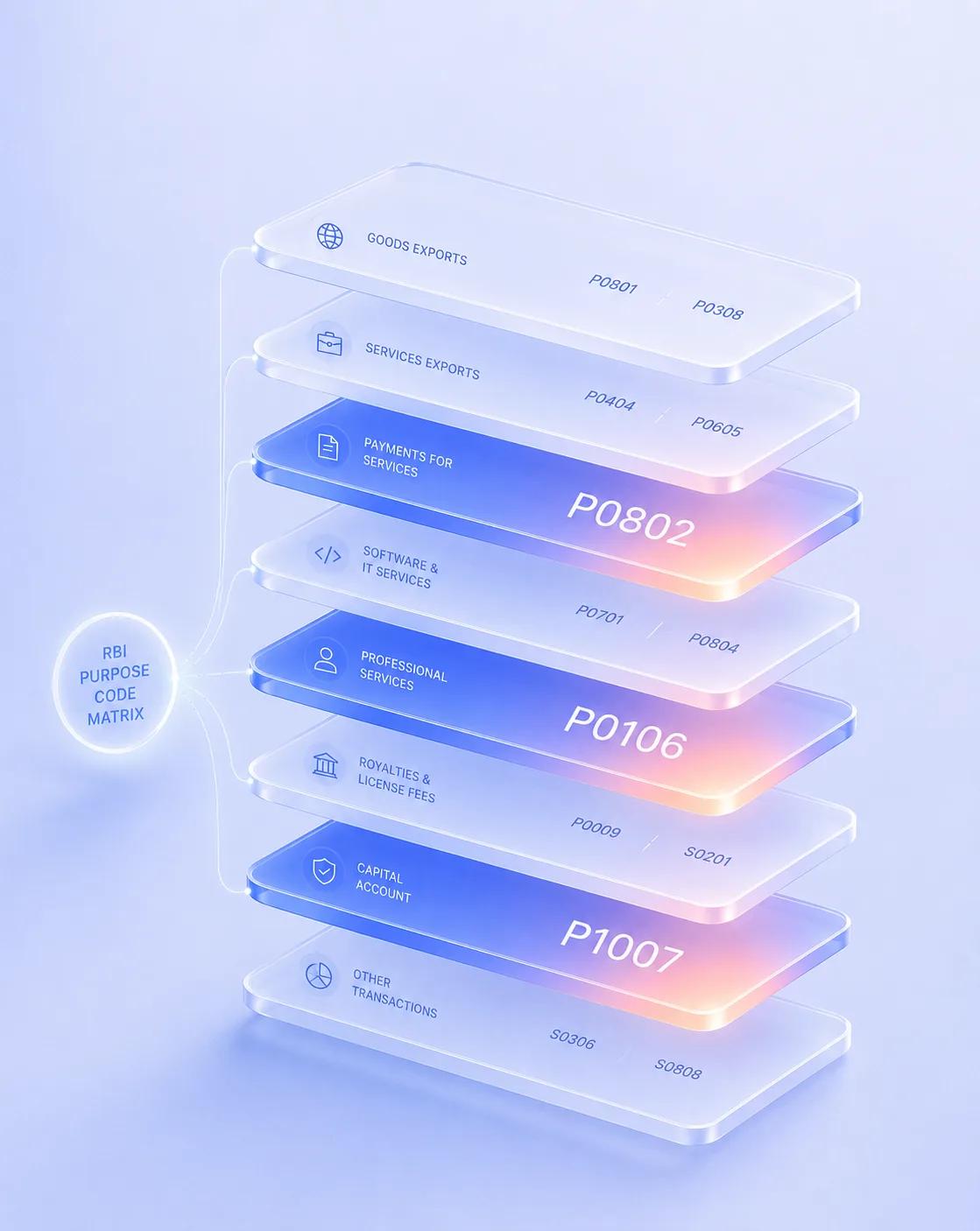
The Complete RBI Purpose Code List
We've compiled every RBI purpose code, each with its exact usage, category, and examples. Sort by direction and type using the filters on the right, or use the search at the top to jump straight to your code.IT, Software & Telecom Services
 P0801P0802P0803P0804P0805P0806P0807P0808P0809
Why are Purpose Codes required?
Purpose codes exist so every cross-border payment can be tracked, reported, and regulated correctly. They serve a few key functions.01Regulatory complianceThe RBI needs to know the reason behind every rupee entering or leaving India. The purpose code is how it monitors that money moves legally under FEMA, the Foreign Exchange Management Act.
02Balance of payments trackingThe RBI adds up these codes to see how much money flows in versus out of the country. That total, called the balance of payments, shows how healthy India's economy and forex reserves are.
03Correct documentationEach code maps to the paperwork that payment needs, like your FIRA and invoice. Declaring the right one keeps your GST filing, refunds, and export records clean and audit-ready.
04Smooth processingBefore releasing your money, banks check that the code matches your documents. A correct code clears quickly, while a wrong one risks holds, queries, or a returned payment.
Getting the code right keeps your payment compliant, properly documented, and quick to settle.
What happens if you use the wrong Purpose Code?
A wrong purpose code changes how your payment is reported and processed. That single mismatch can trigger any of the problems below.Payment delaysThe bank stops to verify a code that doesn't match your invoice, so your credit gets held up.
Compliance issuesYour payment is filed to the RBI under the wrong category, misstating your forex records under FEMA.
Documentation mismatchesThe code stops matching your FIRA and invoice, so your GST and export proofs no longer agree.
Rejected paymentsAn invalid or mismatched code can make the bank return the payment, costing you time and repeat fees.
Manual reworkFixing a wrong code means raising a request and going back and forth with your bank for days.
Picking the correct code upfront saves you the delays, the paperwork, and the compliance risk.
How to select the correct Purpose Code?
Picking the right code comes down to three checks. Work through them in order and you'll land on yours.Step 1
Identify the directionStart with which way the money moves. Payments coming into India use a P-code, while payments leaving India use an S-code.
Step 2
Match the nature of the transactionPin down what the payment is actually for, like software, consultancy, or advertising, and find the broad category that fits it.
Step 3
Confirm the exact codeSearch the directory within that category and pick the specific code, like P0802 for software consultancy, that matches your invoice.
How and Where to Declare the RBI Purpose Code?
The purpose code is declared at the point your foreign payment is processed. In practice, it shows up in a few places.Where it's declared
01On the inward remittance formWhen a payment lands, your bank asks you to declare the purpose, and the code is recorded against the transaction.
02With supporting documentsYour invoice and FIRA must carry the same details the code maps to, so your paperwork stays consistent and clean.
03In your bank or platform dashboardOn a payment platform, the code is captured within the payment flow itself, so there's no separate form to chase.
Who handles it
BankYou declare it
With a traditional bank you usually declare the code yourself on each remittance, often by responding to the bank's request before funds are released.PlatformsCaptured in-flow
With a platform built for cross-border payments, the code is captured inside the payment flow, so you're not chasing a separate form each time.With Skydo, the right purpose code is applied to every payment automatically.
Best practices for using RBI Purpose Codes
A few simple habits keep your payments clean, compliant, and quick to settle.Know your go-to codeMost businesses use the same one or two codes. Confirm yours once and reuse it.
Match code to invoiceMake sure the code reflects what your invoice describes, so documentation lines up.
Keep your FIRA on fileStore the FIRA for every payment — it ties back to the code during audits and GST.
Recheck when work changesWhenever you land on a new type of project, confirm whether it needs a different code before invoicing.
Use a platform that captures itA cross-border platform records the right code automatically, removing guesswork.
Handle the code correctly and it stops being something you chase.
Simplify Cross-Border Payments for Indian Businesses with Skydo
Getting paid from abroad means dealing with purpose codes, FIRA, and FEMA reporting. Skydo takes care of all of it, so you don't have to.The right code, captured for youSkydo records the correct purpose code as part of your payment, so there's no form to fill or bank to chase.
Instant, free FIRA on every paymentYour remittance proof is generated and stored automatically on each payment, ready whenever you need it.
Zero FX markup, flat feesYou get paid at the live mid-market rate with a flat fee, so you keep more of every invoice instead of losing it to markup.
Settled in 24 hoursYour foreign payment reaches your Indian bank within a day, fully reported and compliant, with nothing left for you to file.
200K+Payments processed annually
50K+Businesses trust Skydo
4.8+Average rating
Licensed by RBI under the PA-CB framework
Frequently Asked Questions
What is an RBI purpose code?
An RBI purpose code is a 5-character alphanumeric code that classifies the reason behind a payment moving into or out of India. Set by the Reserve Bank of India under FEMA, it tells your bank and the RBI what a foreign transaction is for, so it's reported correctly. Inward payments use a P-code, outward payments use an S-code.What is the purpose code for freelancers receiving small payments?
Freelancers use the code that matches the nature of their work, most often a software or consultancy code like P0802 for service exports. The size of the payment doesn't change it, what matters is what the work actually was. Search the directory above to find the code that fits your service.Who decides the purpose code, me or my bank?
The code reflects the true nature of your transaction, so declaring it correctly is your responsibility. With a traditional bank you usually confirm it on each remittance before funds are released. With a cross-border platform like Skydo, the correct code is captured in the payment flow, so it's handled for you.Is a purpose code the same as a FIRA?
No. A purpose code classifies why a payment was made, while a FIRA (Foreign Inward Remittance Advice) is the document proving the payment was received. They work together, the code is recorded against the transaction, and the FIRA carries the details that back it up for audits and GST.Do I need a purpose code for every international payment?
Yes. Every payment moving into or out of India must carry a purpose code for FEMA reporting, whatever the amount. The code makes sure the transaction is classified, documented, and cleared correctly. A payment platform records it automatically, so you don't have to declare it manually each time.Receive your next payment, fully compliant.
5-minute demo. Same-day setup. No contract.All RBI Purpose Codes A-Z
Every purpose code with a detailed guide, grouped by category. Browse the full list or use the filters above to narrow it down.Capital & Investment Flows
- P0001 Return of Indian portfolio investment abroad in equity
- P0002 Return of Indian portfolio investment abroad in debt
- P0003 Return of Indian direct investment abroad in equity
- P0004 Return of Indian direct investment abroad in debt
- P0005 Return of Indian investment abroad in real estate
- P0006 Foreign direct investment in India in equity
- P0007 Foreign direct investment in India in debt
- P0008 Foreign direct investment in India in real estate
- P0009 Foreign portfolio investment in India in equity
- P0010 Foreign portfolio investment in India in debt
- P0011 Repayment of loans extended to non-residents
- P0012 Long and medium term loans from non-residents (ECB)
- P0013 Short term loans from non-residents
- P0014 Non-resident deposit receipts (FCNR(B)/NRE)
- P0015 Bank loans and overdrafts taken by ADs
- P0016 Purchase of foreign currency
- P0017 Sale of intangible assets - Government
- P0018 Other capital receipts
- P0019 Sale of intangible assets - Non-Government
- P0020 Financial derivative receipts
- P0021 Sale of shares under employee stock option
- P0022 Other investment in ADRs and GDRs
- P0024 External assistance received by India
- P0025 Repayment of external assistance extended by India
- P0028 Capital transfer receipts - Government
- P0029 Capital transfer receipts - Non-Government
- P0099 Other capital receipts not included elsewhere
- S0001 Indian portfolio investment abroad in equity
- S0002 Indian portfolio investment abroad in debt
- S0003 Indian direct investment abroad in equity
- S0004 Indian direct investment abroad in debt
- S0005 Indian investment abroad in real estate
- S0006 Repatriation of FDI in India in equity
- S0007 Repatriation of FDI in India in debt
- S0008 Repatriation of FDI in India in real estate
- S0009 Repatriation of foreign portfolio investment in equity
- S0010 Repatriation of foreign portfolio investment in debt
- S0011 Loans extended to non-residents
- S0012 Repayment of long and medium term loans from non-residents
- S0013 Repayment of short term loans from non-residents
- S0014 Repatriation of non-resident deposits (FCNR(B)/NRE)
- S0015 Repayment of loans and overdrafts taken by ADs
- S0016 Sale of foreign currency against another currency
- S0017 Purchase of intangible assets - Government
- S0019 Purchase of intangible assets - Non-Government
- S0020 Financial derivative payments
- S0021 Sale of shares under employee stock option
- S0022 Investment in Indian Depository Receipts
- S0023 Opening of foreign currency account abroad
- S0024 External assistance extended by India
- S0025 Repayment of external assistance received by India
- S0026 Capital transfers - Government
- S0027 Capital transfers - Non-Government
- S0099 Other capital payments not included elsewhere
Goods Trade
- P0101 Export bills negotiated, purchased or discounted
- P0102 Realisation of export bills (goods)
- P0103 Advance receipts against exports (goods)
- P0104 Receipts for exports not covered by shipping bill
- P0105 Export bills (goods) sent on collection
- P0106 Conversion of overdue export bills
- P0107 Realisation of overdue export bills
- P0108 Receipts against merchanting trade exports
- P0109 Export realisation from Nepal and Bhutan
- S0101 Advance payment against imports
- S0102 Payment towards imports - invoice settlement
- S0103 Imports by diplomatic missions
- S0104 Intermediary and transit trade payments
- S0108 Payment against merchanting trade imports
- S0109 Payments for imports from Nepal and Bhutan
Transport & Logistics
- P0201 Surplus freight or passenger fare - Indian shipping companies
- P0202 Operating expenses of foreign shipping companies in India
- P0205 Operational leasing with crew - shipping companies
- P0207 Surplus freight or passenger fare - Indian airlines
- P0208 Operating expenses of foreign airlines in India
- P0211 Operational leasing with crew - airlines companies
- P0213 Other transportation services
- P0214 Stevedoring, demurrage and port handling - shipping
- P0215 Stevedoring, demurrage and port handling - airlines
- P0216 Freight fare receipts - shipping companies
- P0217 Passenger fare receipts - shipping companies
- P0218 Other receipts by shipping companies
- P0219 Freight fare receipts - airlines companies
- P0220 Passenger fare receipts - airlines companies
- P0221 Other receipts by airlines companies
- P0222 Freight receipts under other modes of transport
- P0223 Passenger fare under other modes of transport
- P0224 Postal and courier services by air
- P0225 Postal and courier services by sea
- P0226 Postal and courier services by other modes
- S0201 Surplus freight or passenger fare - foreign shipping companies
- S0202 Operating expenses of Indian shipping companies abroad
- S0203 Freight on imports - shipping companies
- S0204 Freight on exports - shipping companies
- S0205 Operational leasing of vessels with crew - shipping
- S0206 Booking of passages abroad - shipping companies
- S0207 Surplus freight or passenger fare - foreign airlines
- S0208 Operating expenses of Indian airlines abroad
- S0209 Freight on imports - airlines companies
- S0210 Freight on exports - airlines companies
- S0211 Operational leasing of vessels with crew - airlines
- S0212 Booking of passages abroad - airlines companies
- S0214 Stevedoring, demurrage and port handling - shipping
- S0215 Stevedoring, demurrage and port handling - airlines
- S0216 Passenger payments - shipping companies
- S0217 Other payments by shipping companies
- S0218 Passenger payments - airlines companies
- S0219 Other payments by airlines companies
- S0220 Freight under other modes of transport
- S0221 Passenger fare under other modes of transport
- S0222 Postal and courier services by air
- S0223 Postal and courier services by sea
- S0224 Postal and courier services by other modes
Travel
- P0301 Purchases towards travel
- P0302 Business travel receipts
- P0304 Travel for medical treatment
- P0305 Travel for education
- P0306 Other travel receipts
- P0308 Foreign currency surrendered by returning Indian tourists
- S0301 Business travel
- S0303 Travel for pilgrimage
- S0304 Travel for medical treatment
- S0305 Travel for education
- S0306 Other travel including holiday trips
Communication Services
Construction & Project Services
Insurance & Pension
- P0601 Life insurance premium receipts
- P0602 Freight insurance receipts
- P0603 General insurance and reinsurance premium receipts
- P0604 Reinsurance premium receipts
- P0605 Insurance auxiliary services and commission
- P0606 Settlement of insurance claims
- P0607 Non-life and term life insurance claim settlements
- P0608 Life insurance claim settlements
- P0609 Standardised guarantee services
- P0610 Premium for pension funds
- P0611 Periodic pension entitlements
- P0612 Invoking of standardised guarantees
- S0601 Life insurance premium
- S0602 Freight insurance premium
- S0603 General insurance and reinsurance premium
- S0605 Insurance auxiliary services and commission
- S0607 Non-life and term life insurance claim settlements
- S0608 Life insurance claim settlements
- S0609 Standardised guarantee services
- S0610 Premium for pension funds
- S0611 Periodic pension entitlements
- S0612 Invoking of standardised guarantees
Financial Services
IT, Software & Telecom Services
- P0801 Hardware consultancy
- P0802 Software consultancy and implementation
- P0803 Database and data processing charges
- P0804 Repair and maintenance of computer and software
- P0805 News agency services
- P0806 Other information services and subscriptions
- P0807 Off-site software exports
- P0808 Telecommunication services including email and voice mail
- P0809 Satellite services including space shuttle and rockets
- S0801 Hardware consultancy and implementation
- S0803 Database and data processing charges
- S0804 Repair and maintenance of computer and software
- S0805 News agency services
- S0806 Other information services and subscriptions
- S0807 Off-site software imports
- S0808 Telecommunication services including email and voice mail
- S0809 Satellite services including space shuttle and rockets
Intellectual Property & Royalties
Professional & Business Services
- P1002 Trade related services - commission on exports and imports
- P1003 Operational leasing without crew - airlines
- P1004 Legal services
- P1005 Accounting, auditing and bookkeeping services
- P1006 Business and management consultancy services
- P1007 Advertising, trade fair and market research services
- P1008 Research and development services
- P1009 Architectural services
- P1010 Agricultural and forestry services
- P1011 Inward remittance for maintenance of offices in India
- P1012 Distribution services
- P1013 Environmental services
- P1014 Engineering services
- P1015 Tax consulting services
- P1016 Market research and public opinion polling services
- P1017 Publishing and printing services
- P1018 Mining and on-site processing services
- P1019 Commission agent services
- P1020 Wholesale and retailing trade services
- P1021 Operational leasing without crew - shipping
- P1022 Other technical, scientific and space services
- P1099 Other services not included elsewhere
- S1002 Trade related services - commission on exports and imports
- S1003 Operational leasing without crew - airlines
- S1004 Legal services
- S1005 Accounting, auditing and bookkeeping services
- S1006 Business and management consultancy services
- S1007 Advertising and trade fair services
- S1008 Research and development services
- S1009 Architectural services
- S1010 Agricultural and forestry services
- S1011 Payments for maintenance of offices abroad
- S1013 Environmental services
- S1014 Engineering services
- S1015 Tax consulting services
- S1016 Market research and public opinion polling services
- S1017 Publishing and printing services
- S1018 Mining and on-site processing services
- S1020 Commission agent services
- S1021 Wholesale and retailing trade services
- S1022 Operational leasing without crew - shipping
- S1023 Other technical, scientific and space services
- S1099 Other services not included elsewhere
Personal, Cultural & Recreational Services
- P1101 Audio-visual and related services
- P1102 Personal and cultural services
- P1103 Radio and television production and transmission
- P1104 Entertainment services
- P1105 Museums, library and archival services
- P1106 Recreation and sporting activity services
- P1107 Educational services
- P1108 Health services
- P1109 Other personal, cultural and recreational services
- S1101 Audio-visual and related services
- S1103 Radio and television production and transmission
- S1104 Entertainment services
- S1105 Museums, library and archival services
- S1106 Recreation and sporting activities services
- S1107 Education including correspondence courses abroad
- S1108 Health services
- S1109 Other personal, cultural and recreational services
Government & Diplomatic
Transfers, Gifts & Donations
- P1301 Family maintenance and savings
- P1302 Personal gifts and donations
- P1303 Donations to religious and charitable institutions in India
- P1304 Grants and donations to governments and institutions
- P1306 Receipts and refund of taxes
- P1307 Migrant transfers including personal effects
- S1301 Family maintenance and savings
- S1302 Personal gifts and donations
- S1303 Donations to religious and charitable institutions abroad
- S1304 Grants and donations to governments and institutions
- S1305 Government contributions to international institutions
- S1306 Payment and refund of taxes
- S1307 Migrant transfers including personal effects
Income (Salary, Interest, Dividends, Profits)
- P1401 Compensation of employees
- P1403 Interest on loans extended to non-residents
- P1404 Interest on debt securities
- P1405 Interest receipts of ADs on own investments
- P1406 Repatriation of profits to India
- P1407 Receipt of dividends by Indians
- P1408 Profit remittance by branches of Indian FDI enterprises abroad
- P1409 Dividend remittance by Indian FDI enterprises abroad
- P1410 Interest from Indian FDI enterprises abroad to parent in India
- P1411 Interest income on portfolio investment made abroad
- P1412 Dividends on portfolio investment made abroad
- P1499 Other income receipts
- S1401 Compensation of employees
- S1402 Interest on non-resident deposits (FCNR(B)/NRE)
- S1403 Interest on loans from non-residents
- S1405 Interest payment by ADs on own account
- S1408 Profit remittance by FDI enterprises in India
- S1409 Dividend remittance by FDI enterprises in India
- S1410 Interest payment by FDI enterprises to parent abroad
- S1411 Interest on portfolio investment in India
- S1412 Dividends on portfolio investment in India
Refunds, Reversals & Other
- P1501 Refunds and rebates on account of imports
- P1502 Reversal of wrong entries and non-import refunds
- P1503 Receipts by residents under international bidding
- P1505 Deemed exports between SEZ, EPZ and DTA
- S1501 Refunds and rebates on account of exports
- S1502 Reversal of wrong entries and non-export refunds
- S1503 Payments by residents for international bidding
- S1504 Notional sales on dishonoured export bills
- S1505 Deemed imports between SEZ, EPZ and DTA
Maintenance & Repair Services
Manufacturing / Processing Services
AD Bank Cover-Page Reporting
Bengaluru, Karnataka
Second Floor, Indiqube Serenity, Phase 2, 31, Hosur Rd,near Vishal Megamart, Muneswara Nagar, Sector 6, HSR Layout,Bengaluru, Karnataka, 560068
Compare
Company
Compare
Copyright © 2026 Skydo Technologies Private Limited